

Primary sources and work by professional historians, scholars and writers which change how we view the history of our country, our world and ourselves.
Joined January 2020
- Tweets3K
- Following80
- Followers15K
- Likes375




Pinned Tweet
We are thrilled to share with you the newly launched Nehru Archives– one of the most ambitious archiving projects in the world.
Over a year and a half ago, the Jawaharlal Nehru Memorial Fund commissioned our mothership, Oijo to create this behemoth. It was an unprecedented challenge but the excitement of going into uncharted territory took over. Our founders brought together over 80 PhD and postgraduate scholars, researchers and history students and worked closely with historians to create, curate and digitize the core content. Then the amazing folks at Miranj and Nowform joined the Oijo team, to create a state of the art design, structure and functionality for the website. After what seemed like an endless roller coaster ride we finally have the nehruarchive.in — India’s first comprehensive, easily searchable, digitally native archive of Jawaharlal Nehru’s letters, writings, speeches and more, built with deeply interconnected, metadata-driven architecture.
Currently in its first phase, this ongoing digital library project aims to compile text, photographs, audio and video by and related to India’s first Prime Minister, Jawaharlal Nehru, in one place, making them freely and effortlessly available for researchers, students, journalists and anyone interested in the history and making of modern India. To the best of our knowledge, an open and fully accessible archive of this scale and depth is unprecedented — not just in India, but globally.
Since its launch, traffic on the archive has been immense, it has been actively cited in media as well as social media and we have been inundated with requests and feedback at contact@nehruarchive.in
We hope you continue to use the archive in this way. Every time you do, its search algorithm improves and it becomes easier for someone else, somewhere else, to find modern Indian history in the digital ether. Also, do continue writing to us. We are processing your feedback as quickly as we can to build on this very solid foundation.


"Raja Ramchandraji ki Jai!" and "Nara-e-Haideri!" echoing on the exact same battlefield set the stage for what followed.
The history of the 1940s in South Asia is often overshadowed by the tragedy of partition and sectarian violence, but the battlefields of Manipur tell a remarkably different story. When the Japanese 15th Army invaded northeast India in 1944, they were met by determined Indian soldiers, divided by faiths but united in purpose.
By the time the Second World War reached the borders of India, the British Indian Army had swelled from 200,000 to nearly 2.5 million men. Recruits were drawn from distant Nepal to the remotest corners of the Madras province. The crisis became a crucible of modern Indian unity, with men from diverse backgrounds fighting united on their own soil for the first time in centuries.
In the monsoon-drenched hills of the Ukhrul-Palel ridge, faith became the ultimate armor for these soldiers. On July 23, 1944, two platoons of the 6th Rajputana Rifles began a treacherous ascent toward Lone Tree Hill. Subedar Sardar Khan, leading the left flank, closed the 30-yard gap to the enemy line. As he led his men through pouring rain, he shouted the traditional Rajput battle cry, Raja Ramchandraji ki Jai, or Glory to Lord Rama. Those were his final words before a grenade struck him down, but his men pushed forward and carried the crest.
A few miles away near Chepu, the 12th Frontier Force Regiment faced a similarly desperate situation. After their commanding officers were killed, Subedar Kagir Khan took charge at dawn. He led his company up a sparsely covered hill in a brutal 20-minute bayonet charge. There were no formal orders shouted, only clipped curses and ancient Shiite rallying calls to Imam Ali, including Nara-e-Haideri and Nara-e-Takbeer. The Japanese forces melted away, and the crest was secured by dusk.
As the war correspondent PRS Mani noted in his original dispatches, and as Dr. Inderjeet Mani highlights in the compiled and recently published book Captain Mani’s War, this military crisis forged a composite brotherhood in the trenches. Their work offers a vital historical record of a united India where Hindu, Muslim, Sikh, and Christian soldiers faced the same mortar fire together.


Born nameless on a Mumbai pavement, taken in by mill workers, never seen the inside of a classroom, and yet Narayan Gangaram Surve became one of the most powerful voices in twentieth-century Marathi literature.
He called his seminal collection Maaze Vidyapeeth, My University. The university was the factory floor, the basti, the chawl, the protest march, and the trade union meetings. In 145 poems written across decades, he gave language to the working class: their hunger, their daily endurance, their refusal to be made invisible.
When he compared the moon to a piece of bhakri, he wasn’t being folksy. He was insisting that poetry answer to the reality of hunger before it answers to beauty.
Surve did not argue for the inclusion of the working class in existing literary culture. He built a different literary culture from the ground up. “I do not have a caste, I do not have a religion, I do not espouse a gotra; my only identity is that I am a human being.” Over eight decades later, that remains a radical position.
To mark his centenary, we are publishing a special note on our website, written by playwright and cultural commentator @BoodhuRamu on Surve’s preface to Sanad, his 1982 poetry collection, edited by celebrated Marathi poet, Kusumagraj. The title is pointed: sanad means a credential, a certification. For a poet who had none of the usual qualifications, the word carried an edge.
The preface is part autobiography, part poetics, and part manifesto, describing his formation in the mills, his debt to Annabhau Sathe, and a philosophy arrived at after a lifetime of struggle.
As Surve himself said: “A poem is not just writing on a page; it is a truth that can introduce a new thought, alter a life forever, and open your eyes to a reality you never knew existed.”
Read Ramu Ramanathan’s note on Surve’s preface to Sanad here:
indianhistorycollective.com/…

Three stories. Two wars. One poet.
In January 1917, while fighting on the Somme, the English poet Wilfred Owen penciled a verse from Tagore's Gitanjali onto the back of a military message form. The lines began: "When I go from hence, let this be my parting word, that what I have seen is unsurpassable." It was verse ninety-six. Owen had carried it into the trenches.
Eighteen months later, in August 1918, he said goodbye to his mother Susan on the deck of a ship, looking out across what she later called "the sun-glorified sea" — towards France, with breaking hearts. He spoke those same lines aloud. It was the last time she saw him. When his pocket book came back to her after his death, she found the verse written in his hand, with Tagore's name beneath it. She wrote to Tagore. The letter began: "I feel sure your name upon the envelope will be sufficient."
The second story was told in 1961 by the German playwright Carl Zuckmayer. During the First World War, an Indian soldier from a Gurkha regiment had been taken prisoner and wounded. Only amputation of one leg could save his life. But the soldier spoke no German, and the medical officers spoke no language he understood. The more they tried to communicate, the more terrified he became. Finally, a sergeant bent down and whispered the only Indian words he knew — Rabindranath Tagore, three times over. The soldier's face relaxed. A shy smile came into his eyes. He nodded his consent.
The third story is from the Second World War. On 15 July 1942, educator Janusz Korczak, who like all Jews was forbidden by the SS from performing works by Aryan authors, staged Tagore's play The Post Office — the story of a dying boy named Amal who waits for a visit from the King — with the orphans in his care. When asked why, he said the children needed to “learn to accept serenely the angel of death.” In August 1942, Korczak and the children were taken to a concentration camp.
On his birth anniversary, we celebrate the power of the writer and his pen, as exemplified by Tagore.
#RabindraJayanti


Rabindranath Tagore picked up a paintbrush at the age of 67. He had never trained as a painter. What followed was one of the most unusual second acts in the history of art.
It started with accidents. Tagore hated the sight of crossed-out words on his manuscript pages. He called these erasures "casualties." They looked to him like "widowed gypsies" searching for a home. So he began connecting them — drawing lines through them, linking the stray marks into patterns. What began as rescue work became an obsession.
In the last thirteen years of his life, Tagore produced nearly 2,500 paintings and drawings. He painted fast. He painted in between writing sessions. He finished each piece in a single sitting, on whatever paper was nearby, with whatever tools were at hand. He took none of it seriously enough to preserve carefully — and yet many of these works, made on scraps, turned out to be of extraordinary quality.
His biographer Krishna Kripalani noticed something striking about these paintings. In his writing, Tagore was a "conscious artist" — a "finished craftsman" who chose every word with care. His poetry was always selective, always beautiful. Sometimes so beautiful, Kripalani wrote, that one wondered whether it was Tagore the individual speaking, or the spirit of India using his voice. But when he painted, something else entirely took over. Kripalani described it as painting "like a somnambulist walking" — moving with certainty but without conscious direction.
The paintings let out what the poems and prose held back– the dark, grotesque, sardonic and sometimes bizarre. All that Tagore carefully kept out of his writing found full expression on his canvas. His figures had no names. He could not explain where they came from. He wrote that "some form of whose genealogy I am totally unaware takes shape from the tip of my moving pen."
Tagore himself was bewildered by it. He called it an "unprecedented opportunity" to write the epilogue of his life — in a language he had never planned to speak. The same man. Two completely different selves. One proof that even a sage must eventually face what lives underneath.


In 1906, sending a son to Oxford or Cambridge was a status symbol for India's upper classes. However, Rabindranath Tagore, who like many in his family was sent to England to study, rejected the idea of following tradition when it came to his son. Instead, he sent Rathindranath, along with his son-in-law, Nagendranath Gangopadhyay, and a protege, Santosh Majumdar, to the University of Illinois to study agriculture.
At the time, Indians largely shared the British prejudice that the United States was a land of uncouth roughs and rich upstarts. Choosing Illinois over Oxford took imagination and conviction. His reasoning was blunt. Nearly ninety percent of Indians lived off the land. The country needed people who understood the soil. People who could return home and make farming work better for those who depended on it.
When Rathindranath returned after completing his studies, Tagore put him to work on the family estate at Potisar. A farm was laid out. New crops and implements suited to Indian conditions were tested. A small laboratory was built on the grounds. When New York lawyer, Myron Phelps visited, he was genuinely astonished. He had found “a genuinely successful American farm” in rural Bengal.
The Nobel Prize money Tagore received in 1913 was donated to his school at Santiniketan and to the agricultural cooperative bank he had already established for the peasants of Potisar. It gave them access to loans at fair interest and freed them from exploitative moneylenders and the petty lawyers who fed on rural litigation. He later founded Sriniketan in Birbhum as a formal rural reconstruction centre, connecting his students directly to the lives of peasants around them.
In letters to his son, he discussed suitable crops and setting up rice mills on a cooperative basis. He also wrote about introducing pottery and umbrella-making as ways to keep farm labourers employed between harvests.
On his birth anniversary, we remember the towering man who is largely remembered for his contribution to arts, letters and political philosophy for a lesser discussed chapter of his life— his dedication to the soil and the farmers of this country.


While we often visualize the Buddha as a silent mystic under a Bodhi tree, Uma Chakravarti’s seminal research in The Social Dimensions of Early Buddhism reveals a highly pragmatic social architect. He was active during India's “2nd Urbanization,” a period of massive economic transition where the shift to intensive agriculture gave rise to a new, vulnerable proletariat known as the dasa-kammakaras (slaves and hired laborers). These men and women were the invisible engine of the emerging empire, yet as Chakravarti notes, they were relegated to the very bottom of the economic strata, living under the absolute and often arbitrary whim of their masters.
The Buddha did not merely offer these workers abstract compassion; he attempted to step directly into this social crisis through the Sigalovada Sutta. Known as the "layman’s social vinaya," this discourse served as a specific disciplinary code detailing the social responsibilities of householders and employers. Recognizing that a stable society could not exist without a just foundation, he promoted a compassionate code: an employer’s primary duty was to assign work strictly according to a person's physical capacity and ensure the consistent provision of proper food and wages.
Moving further, he mandated that masters must personally nurse and care for their workers during times of sickness, and required the granting of regular leave and respite. The Buddha used his immense influence among the era's wealthiest entrepreneurs to engineer a paternalistic but profoundly benevolent social ethic—one where workers were treated with basic human dignity in exchange for their labor.
History often views the Buddha through a purely metaphysical lens, but the Sigalovada Sutta reveals an overlooked chapter: a 2,500-year-old blueprint for the dignity of labor.
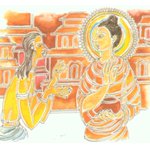
Images-
Buddha meeting Sigalaka in Rajgir (Buddha taught Sigalovada Sutta to him)
Buddha preaching Sigalovada Sutta to Sigalaka.


This Dalit History Month, we celebrate Sant Ravidas (c. 1450–1520). Living amidst intense caste oppression in 15th CE Banaras, Ravidas — an "untouchable" Chamar — envisioned one of the first formulations of utopia in literature. He named it Begumpura: the city without sorrow. In his poetry, he described a "regal realm with the sorrowless name" that was fundamentally a "place with no pain". Strikingly, his vision dealt with tangible realities, dreaming of a society with "no taxes or cares, nor own property there," and a community where "none are third or second—all are one".
In Seeking Begumpura, Gail Omvedt calls this a remarkably "modern" subaltern perspective, arguing that democratic themes of equality and participation emerged during India's "early modern" period, dating centuries before colonialism or Western influence. While elite traditions romanticised Ram Rajya — a hierarchical, village-based society rooted in an idealized past — Ravidas imagined an urban, classless society entirely free of temples and hierarchy. Begumpura was profoundly "this-worldly," confronting material realities like property and taxes head-on rather than offering a purely mystical escape.
The most radical assertion comes in the poem's climax. Ravidas proudly declares himself a "tanner now set free," announcing that he and his friends can "walk where they wish" and "stroll through fabled palaces unchallenged". For a Dalit in 15th CE India, Omvedt reminds us, the simple right to walk freely in any settlement was a revolutionary matter. To wander freely and safely with friends was an unreachable dream for a Dalit in the actual streets of Banaras.
Through Begumpura, Ravidas boldly linked social equality to the physical freedom of movement — doing so centuries before the vocabulary of civil rights existed. His enduring vision is a powerful reminder that subaltern intellectuals were already forging radical blueprints for a just, equal, and sorrowless world as early as the 15th CE and onwards.
This Dalit History Month, we bring you the story of Dalit women for whom liberation came with conditions applied.
In 1909, Pune reformer Shivram Janaba Kamble and other activists petitioned the British to end the 'murali' practice — a custom dedicating Mahar and Mang girls to the god Khanderao, obligating them to provide sexual services to men across all castes. Historian Shailaja Paik situated these reforms within a broader battle for higher social status in her book ‘Dalit Women’s Education in Modern India’. While vital in protecting girls from caste-based sexual violation, these efforts were simultaneously about elevating community status through strict regulation of female sexuality.
To counter upper-caste stereotypes of Dalit women as 'unruly' or sexually available, reformers advocated imposition of rigid middle-class codes of ‘respectability’ for Muralis — dictating dress, restricting participation in 'jalsaa' performances, and enforcing monogamous marriage. They didn't just attack the system; they denounced the stigmatised women themselves for living ‘immoral’ lives. Any choice they made other than marriage was seen as deviant and potentially criminal.
However, this imposition was not seamless, and the women directly affected exposed its hypocrisies. 'Murali' Shivubai Lakshman Jadhav publicly challenged this hypocrisy, declaring in the press: "This question cannot be resolved by criticising us." She pointed directly at Dalit men — superstitious fathers and ignorant male leaders who had forced their daughters into these lives in the first place.
Paik's argument is unsparing: the reforms liberated some Dalit women from one form of exploitation while reintroducing gender hierarchies through another for not just Muralis but eventually all Dalit women. Men could get away with their choices but women became the moral ledger of the entire community — their chastity the measure of collective morality.
Paik’s research points to the fact that when the burden of a community's dignity is placed on women's bodies, it is not liberation; it is merely a change of warden.


What does it take to crack centuries of caste oppression? For Ayyankali of South Travancore, it began with a bullock cart.
Born in the lowest caste in the region's hierarchy, Ayyankali's father had received 5 acres of land from a benevolent landlord and the family was relatively well off within their community. The spark for Ayyankali’s rebellion was a rebuke from a Nair over his caste. He bought a bullock cart—a luxury reserved for upper castes—dressed in their attire, and rode through the marketplace. When upper-caste bullies tried stopping him, he jumped off with a dagger, threatening dire consequences, and they ran. To break his people's fear, he organized a "walk to freedom" to Chaliyar Street. An upper-caste mob intervened, sparking the Chaliyar Riot which spread across the area for days. By 1900, Pulayars won the right to use most public roads. When Pulayar children were refused entry into government schools, Ayyankali announced his people would not work in upper-caste paddy fields until admitted. On 1 March 1910, the government of the princely state of Travancore, relented.
In the decades before Ambedkar, struggles against caste oppression, as Anand Teltumbde documents in Dalits: Past, Present and Future, shared a common grammar. Bengal's Namashudras submitted a memorandum demanding they be treated as Brahmans. In Maharashtra, leaders like Gopal Baba Walangkar claimed a Kshatriya past. In 1922, Swami Achhutanand opposed Congress's boycott of the Prince of Wales' visit, instead organising a conference at Purana Quila with 10,000 untouchables and presenting a 17-point charter seeking extensive socio-economic rights. Iyothee Thass in Tamil Nadu spent decades reconstructing a Buddhist past. Yet, even in their boldest acts of defiance, each still sought legitimacy by claiming a higher status or appealing to a higher authority.
Ayyankali, formally uneducated unlike almost every Dalit leader of his era, refused that grammar entirely. He did not claim a glorious past. He did not petition a higher authority. He occupied public space—bodily, visibly, defiantly.
Illustration Credit : From Book Cover - ‘Ayyankali : Dalit Leader of Organic Protest’ by M. Nisar and Meena Kandasamy

“Buy, Borrow, or Steal" — this was Ambedkar's motto in the war against gatekeeping of knowledge.
For centuries, gatekeeping education was one of the ultimate tools of caste subjugation. As a child, Ambedkar was forbidden from studying Sanskrit — the "language of the Gods" — for being an 'untouchable'. He squatted on a gunny sack in the corner of his classroom, his notebooks untouched by teachers who openly questioned why a lowly Mahar boy needed to learn English.
His response: a radical, insatiable hunger for learning. Books became his weapon against Brahmanical monopoly. At Columbia on Sayajirao Gaekwad's scholarship, he took 29 economics courses, 11 in history, 6 in sociology, 5 in philosophy, stretching his days to 18 hours, surviving on $1.10 daily — coffee, 2 muffins, 1 meat or fish dish —spending every penny on books, scouring Manhattan's secondhand bookshops, amassing 2,000 volumes in 3 years. In London, he survived on fish, tea, and bread, substituting lunch with just a piece of bread while devouring volumes in the British Museum from 8 a.m. to 5 p.m.
Between 1923 and 1929, he proudly recalled stuffing books into his coat pockets and walking out of libraries — justifying the "theft" as no sin, since the hoarded knowledge would be used to liberate oppressed people. Between 1930 and 1946, he borrowed countless books from the Bombay Government and University libraries and simply never returned them. The bibliophilia became an absolute obsession that drove him into severe debt; he was eventually forced to sell one of his properties, "Char Minar," just to pay off his book-related debts.
But Ambedkar never hoarded knowledge for himself. He founded the Bahishkrut Hitkarini Sabha with the motto "Educate, Agitate, Organize," established the People's Education Society, and started Siddharth College. Drawing on his own struggles, he scheduled classes from 7:30 to 10:30 a.m. so that students from impoverished backgrounds could work in mills or offices during the day and pursue their degrees in the morning.
For Ambedkar, education and reading were the ultimate tools for anti-caste rebellion — a reclamation of the intellectual capital violently denied to his ancestors.


On Ambedkar’s birth anniversary, we remember him as a lawyer who became one of India's earliest crusaders for civil rights, long before he led the making of the Constitution. He defended Communists, Congress workers and others whose politics he often disagreed with, against the colonial state's routine use of charges of "sedition," "illegal assembly," and "causing public hardship" to crush dissent. The stakes were never just individual freedom, but civil liberties itself.
Caste, however, shaped his experience in the courtroom. While Jinnah argued a matter worth ₹2.57 lakh, Ambedkar appeared the same day for a schoolteacher in a case valued at ₹24. "There is no hope to gain from legal practice," he said, "because it depends on touchable people." He chose it anyway.
By the 1930s he had become a leading lawyer for trade unionists. When leaders of the All India Textile Workers Conference were charged with organising an illegal strike, his cross-examination led to the confession that the owners refused to negotiate not because demands were unreasonable, but because organisers were "of communist colour." All accused were acquitted.
His fight was not only against colonial repression but against social power, entrenched in the Brahminical hierarchy. In the Chavadar Tank case, savarna Hindus claimed a public tank as private property after violently excluding Dalits — Ambedkar won, the court holding that centuries of exclusion conferred no legal ownership.
His fight also extended to defending civic rights against the 'hurt sentiments' of dominant communities. When the Dalit writer of Deshache Dushman faced defamation for calling Tilak "an enemy of the nation," he argued the defamed was dead and the complainant, no close relative, had no legal standing. When educator Raghunath Karve's journal on sex education was charged with obscenity, he argued it would only reach readers already seeking such knowledge — not the general public the law was designed to protect.
In a world where legal measures are increasingly used to silence marginalized voices, Babasaheb’s legacy is a timely reminder of the power of legal activism.


Ambedkar believed the city would set Dalits free. But it didn't. He argued villages were caste's natural fortress — rigid, inescapable. Cities offered anonymity; liberation from caste structures. Shailaja Paik's ‘Dalit Women's Education in Modern India’ documents how that promise collapsed.
As Paik documents the example of Pune, its inner core — Sadashiv, Narayan, Shaniwar peths had been Chitpavan Brahman territory since the 17th CE. Peshwas deliberately engineered Sadashiv peth into the city's most prosperous space — water supply, markets, finest schools. Within these peths grew a "true Puneri" culture — ‘pure’ Marathi, specific manners — that strategically locked out Dalits. Dalit settlements were pushed to the outer rings: Yerawada, Vishrantvadi, Hadapsar. With the Poona Cantonment's establishment in 1818, Dalit localities sprouted around military barracks and the Khadki ammunition factory — spatially tethered to servitude. Droughts in 1966, 1967, 1972 and 1973 drove fresh waves of migrants into these same slums. By 1981, SCs were 9.87% of Pune's population but overwhelmingly concentrated in slums — by 1984, 340 slum pockets housed 33% of the city, most of it Dalit.
Peripheral geography meant peripheral citizenship. In the 1930s, of 1,370 Fergusson College students, only 14 were Backward Class boys, zero were girls. By the 1980s, 54.43% of Pune district’s SCs remained illiterate. By 2001, the enrollment gap between SCs and the general population diminished considerably, SC girls' primary enrollment reached 43% nationally.
But spatial segregation persisted, only its form altered. In the early 20th CE Dalit children sat in dust outside classrooms and in 2002 Prakshoti Pawar found accessing Sadashiv peth for classes practically impossible — finances stretched, patriarchal rules demanded she be home before dark, and the polis remained culturally alien. Even mobile Dalit families moving from Yerawada into flats on its margins remained stranded — rickshaw drivers refused to enter after dark, dropping passengers at main road landmarks.
This Dalit History Month, Paik's research reminds us — a century after Ambedkar placed his faith in the city, the city has failed.


A deal in a French villa, a mountain of gold, and a plan to move the center of the Islamic world to India—this was the "Wedding of the Century."
When we think of the fall of the Ottoman Empire, we rarely look toward the Deccan. Yet, as detailed in The Indian Caliphate, the 1930s saw an audacious attempt to resurrect the Caliphate, abolished by the new Turkish Republic, which had exiled the once-mighty Ottoman dynasty.
In 1931, in a villa in Nice, an extraordinary alliance was forged between the exiled Ottoman Caliph, Abdulmejid II— bearing the world’s most prestigious lineage—and the 7th Nizam of Hyderabad, Mir Osman Ali, then the wealthiest man on Earth, as noted in the book. The deal, brokered by Khilafat leader Maulana Shaukat Ali, was far more than a marriage. The contract joining the Nizam’s sons, Princes Azam Jah and Moazzam Jah, with the Caliph’s daughter Princess Durrushehvar and his niece Niloufer, included a wassiyat (will) aiming to transfer the Caliphal title to the Nizam’s line. Prince Mukarram Jah, son of Azam Jah and Durrushehvar, was intended to one day lead the global Muslim community from Hyderabad—turning the Deccan into a “Vatican of the East.”
The arrival of Princesses Durrushehvar and Niloufer in Hyderabad sparked a quiet revolution. Raised in Europe and highly educated, they became the state’s public diplomats—seen driving cars, playing tennis, and founding vital institutions, from girls’ orphanages to a cancer hospital. As the Caliph’s daughter, Durrushehvar famously rebuffed the Turkish Prime Minister in London, refusing to “play nice” with the government that had exiled her family.
But history moved too fast. The 1947 Partition and 1948 annexation of Hyderabad ended the “Indian Caliphate” dream. Though the political vision vanished, the legacy of these women endured. They weren’t relics of an empire but modernizers who used prestige to champion women’s education and healthcare. History often views the Caliphate’s fall as purely Mediterranean, yet Durrushehvar and Niloufer’s story reveals an overlooked chapter—when two dynasties sought to bridge tradition and modernity through a marriage that nearly shifted the spiritual axis of the world.
More in @Imran_posts ‘s The Indian Caliphate, published by @HarperCollinsIN


"The Cry of an Indian Woman from Fiji" — and how it helped bring down one of the British Empire's most exploitative labour systems.
As documented by Gaiutra Bahadur in her book Coolie Woman, it began in August 1913 as a letter to a Calcutta newspaper, written in the voice of Kunti — a low-caste cobbler deceived into indenture in Fiji with her husband. Sent alone to weed a deserted banana patch, an overseer and a driver made improper advances. She leapt into a nearby river, preferring death to dishonour. A boy in a dinghy pulled her out.
When she complained, officials branded her a liar and a slut. The Fiji government denied any systemic sexual abuse of indentured women.
Yet her letter spread, taking on a life of its own and in 1914, many Indians encountered her story through the polemical autobiography of ex-indentured labourer, Totaram Sanadhya. Sanadhya cast Kunti’s ordeal in overtly religious terms, evoking her as Sita, praising her defending her 'satitva'.
The ripple effect had political consequences. In 1914, Indian newspapers like Bharat Mitra demanded an end to indenture; the Indentured Coolie Protection Society was founded in Calcutta; and about Twenty thousand pamphlets were circulated warning people in Bihar against recruiters. In 1915, Mahatma Gandhi, returning from South Africa, where he had led indentured labourers alongside other Indians in an anti-imperial struggle — joined the abolition campaign. On 20 March 1916, an orthodox Brahmin member of the Imperial Legislative Council moved for abolition. Elite Indian women entered the struggle; a deputation led by Sarojini Naidu called on Lord Chelmsford.
Then came a decisive shift. Reverend C. F. Andrews denounced indenture as “a legalised form of prostitution,” publicising an overseer’s admission that unmarried women were allotted to men. Indentured labourers themselves called their barracks 'kasbi ghar' — brothels. The indelicate details cut through.
On 15 February 1917, recruitment was suspended. By 1919, indenture contracts across the empire were cancelled, and no new system replaced them.
Kunti’s story helped move an empire. Yet in the telling, she was rarely allowed to remain herself — recast instead as symbol: the chaste woman to be saved, or the fallen woman to be pitied or blamed.


A Hindu queen’s ship, carrying Muslim pilgrims, seized in 1613 — and a fallout that irreversibly changed the balance of power in global trade.
When we think of 17th CE global commerce, we rarely picture women at the helm. Yet, as pointed out by Ira Mukhoty in her book, Daughters of the Sun, half of all documented Mughal noble traders were women. Among them was Harkha Bai, better known as Maryam-uz-Zamani, mother of Jahangir, who held the mansab of 12,000 cavalry — one of only four at court to do so, and the only woman. She was also one of the wealthiest traders in the empire.
From Surat sailed her flagship, the Rahimi. With a capacity of about 1,500 tons and 1,500 passengers, it was among the largest vessels in Indian waters. In 1613, it carried goods valued at £100,000. It also carried pilgrims to Mecca for the Hajj. That autumn, the Portuguese seized Rahimi, diverted it to Goa, and took 700 passengers captive, all to assert naval dominance and deter growing Mughal engagement with the English.
Jahangir immediately halted trade through Surat, suspended Portuguese privileges, closed the Jesuit church in Agra and ordered action against the Portuguese base at Daman. These measures marked a sharp shift in Mughal policy, considering how the Mughal empire had till then either ignored or accommodated Portuguese aggression.
In 1612, an East India Company fleet under Captain Thomas had already defeated a Portuguese armada off Surat. Jahangir recorded this in his personal memoir, the Jahangirnama — the only European event he ever documented. After the Rahimi's seizure, he moved decisively toward the English, who over the next few years replaced Portugal as the primary foreign power at the Mughal court, paving way for the end of Portuguese ambitions on the Indian sub-continent.
Harkha Bai never recovered her ship. She died in 1623, at 81. But this Women's History Month, her story highlights an oft-ignored fact: Mughal women were traders, financiers, shipowners and participants in global commerce — and in this case, central to a turning point in the world of Indian Ocean.
#womenshistorymonth


Indian History Collective retweeted

Nehru’s views on jazz on AIR: “Surely, you do not mean to suggest that the jazz type of music should be encouraged at the expense of classical music.” nehruarchive.in/documents/to…

Some of the most Arab countries were once part of the British administered Indian Empire but this was not merely an administrative or technical fact. The cultural and economic ties ran deep and the imprint of British India lingered long after the protectorates had been severed from the mainland.
Our co-founder, @pragyatiwari, speaks with @SamDalrymple123 on Shattered Lands, his fascinating account of the five partitions that shaped modern Asia.
Indian History Collective retweeted

It was an absolute pleasure to build this archive and we are grateful to the Jawaharlal NehruMemorial Fund for giving us the opportunity.

The Selected Works of Jawaharlal Nehru are now available online in an easy-to-read format. They shall be used by scholars, students, and history buffs, though it may be too much to hope that the Congress High Command avails of them.
Here is the link: nehruarchive.in/selectedwork…