

India Modern Monetary Theory, initiative of Rajendra Rasu, Research Fellow, Global Institute for Sustainable Prosperity https://xitter.cf/t.co/dMaPDUMEZP
Chennai, India
Joined December 2018
- Tweets15.9K
- Following871
- Followers1.2K
- Likes4.1K



Pinned Tweet
Response to Dr Raghuram Rajan's post on monetization, in consultation with Warren Mosler @wbmosler in his words:
Raghuram Rajan: monetization is neither a game changer in stressed times nor a catastrophe. It helps a little at the margin.
1/n

Raghuram Rajan, the quintessential central banker-professor, is back.
Explains the process and consequences of monetisation in detail in a LinkedIn post.
“Monetisation Is Neither A Game Changer Nor A Catastrophe.”
His views explained below 👇🏽
bloombergquint.com/coronavir…
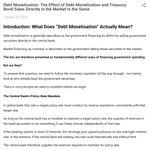
Debt Monetisation: The Effect of Debt Monetisation and Treasury Bond Sales Directly in the Market Is the Same
poornomore.in/2026/08/debt-m…


Chapter 4: "The Effects of Modern Monetary Theory on the Structure of Production" by @DrPatrickNewman
"This chapter analyzes the debt monetization proposals of MMT from an Austrian structure-of-production perspective. It shows that debt monetization raises societal time preferences and reduces the number of higher-order stages in the economy, leading to a higher interest rate, lower economic growth, and increased prices of consumer goods." - p. 92
Indeed, this is something most other schools of thought miss. Government spending doesn't simply add to "aggregate demand." It changes the allocation of scarce resources throughout the structure of production, redirecting labor and capital away from the production of goods and services that consumers want and need.
But first, Dr. Newman makes an important point: Government spending is consumption, not investment.
"It is impossible for governments to produce goods with the expectation of earning interest or profits, which means it is impossible for them to invest in the catallactic sense." - p. 95
Why? Because government revenues are disconnected from voluntary exchange. Unlike private businesses, governments don't have to earn profit by producing goods and services that consumers value more highly than the resources used to produce them.
The result? "The monetary return cannot genuinely be calculated, meaning that factors of production will tend to be inefficiently used." - p. 96
One particularly interesting part of this chapter is Dr. Newman's discussion of how government spending came to be included in national output statistics in the first place.
Even Simon Kuznets, the pioneer of national income accounting, recognized the problem with including government spending.
Newman shares Kuznets's concerns:
“Then, there is the related problem that while the ‘charges for the services rendered by industry to consumers . . . are established on a comparatively free market. . . . the charges by the government to business units and to individuals are not established on the free market, since the government has the right to and does tax, not in accordance with services rendered but in accordance with ability to pay’" - p. 100
If the government spends $1 billion to provide some service people don’t want, the full $1 billion still gets counted in GDP.
Then Dr. Newman gets into the effect of government spending on the structure of production. Since it is properly counted as consumption, not investment, government spending shifts the use of resources toward a shorter and steeper structure of production.
"The result of the shorter and steeper structure is a reduction in the amount of capital goods created in the higher orders, which translates into fewer capital goods in the lower orders and eventually a decrease in consumer goods." - p. 110
And here's the point MMTers need to grapple with: Kelton and other MMTers say there’s no crowding out problem, and that inflation is the real constraint on government spending, but…
"Even if taxes and contractionary monetary policy limit the effects of debt monetization on total spending, the result still raises the prices of consumer goods by diverting capital goods from marketplace production and wasting them in the government sector." - p. 111
Furthermore, without the profit-and-loss test, how can government officials know that they're allocating resources to more valuable uses rather than less valuable ones?
Read the full chapter here: mises.org/library/book/anti-…

More than influencing household & firm decisions through interest rate. the productive capacity required to meet basic needs can be organised as a permanent public responsibility
Why should the satisfaction of essential human needs depend on the profitability of supplying them?


BREAKING NEWS
The Royal Swedish Academy of Sciences has decided to award the 2026 Sveriges Riksbank Prize in Economic Sciences in Memory of Alfred Nobel to Robert E. Hall and Michael Woodford “for microeconomic foundations of macroeconomic stabilisation.”
#NobelPrize

The Resource Standard raises a question that conventional micro-foundations leave largely outside their frame: why should the satisfaction of essential human needs depend on the profitability of supplying them?

I doubt even @INCIndia has the understanding to bring about growth which do that. If it knows, it could very well display it in the states ruled by it.
GDP per person is far greater measure than the cumulative GDP!
But, the ultimate measure is how many people are pulled out of distress and the wage increase of the last man in the queue.

बांग्लादेश ने भारत को प्रति व्यक्ति GDP के मामले में पछाड़ दिया है।
बांग्लादेश की प्रति व्यक्ति GDP 2,886 डॉलर है, वहीं भारत की 2,749 डॉलर है।
2014 में जब मोदी PM बने थे, तब बांग्लादेश प्रति व्यक्ति GDP के मामले में भारत से बहुत पीछे था।
तब भारत की प्रति व्यक्ति GDP 1,554 डॉलर थी और बांग्लादेश की सिर्फ 1,094 डॉलर थी।
लेकिन मोदी ने अपनी खराब आर्थिक नीतियों से सब बर्बाद कर दिया। आज बांग्लादेश भी हमसे आगे निकल गया।
मोदी ने वादा अच्छे दिनों का किया था, लेकिन जनता को मिले तो सिर्फ बुरे दिन।

What the 2026 Nobel Misses: Real-Resource Deployment as the True Micro Foundation
Counter to the 2026 Nobel Prize Framing: Why Real-Resource Deployment - Not Individual Agent Optimization - Is the True Micro Foundation

BREAKING NEWS
The Royal Swedish Academy of Sciences has decided to award the 2026 Sveriges Riksbank Prize in Economic Sciences in Memory of Alfred Nobel to Robert E. Hall and Michael Woodford “for microeconomic foundations of macroeconomic stabilisation.”
#NobelPrize
A framework for making the 660,000 villages in India, Global Model Villages, which will ensure the women, the backbone of the villages!
Framework for Continuous Full Deployment, Price Stability, and Rising Living Standards
poornomore.in/2026/03/operat…


On the International Day of Rural Women, I salute the courage, resilience and enterprise of our rural women, who strengthen our farms, sustain our families and drive our villages forward. Their contribution deserves not just recognition, but sustained opportunities, economic independence and dignity.
Under the leadership of Hon’ble Prime Minister Shri @narendramodi Ji, initiatives such as DAY-NRLM and Lakhpati Didi are creating pathways for rural women to build sustainable livelihoods and increase their incomes. The implementation of VB-G RAM G further strengthens the framework for rural employment and durable village assets.
Our coalition government in Andhra Pradesh is committed to creating meaningful opportunities for rural women through self-help groups, livelihood generation, entrepreneurship and stronger village infrastructure. Our focus is on enabling every rural woman to turn her skills and hard work into lasting prosperity.
When a rural woman gains economic strength, an entire family gains security, a village gains momentum and the nation moves closer to inclusive development. Let us invest in rural women’s skills, enterprises and leadership, expand access to finance and markets, and work together to build an inclusive future in which every rural woman has the opportunity to prosper.
- @PawanKalyan
#InternationalDayOfRuralWomen #WomenEmpowerment #RuralDevelopment

Readable soft copy of electoral roles are denied to the public!
Even after the Supreme Court was moved in 2018, it was continued to be denied all along.
Believe nothing wrong with the electoral roles.
"Believe", as we say so.
Rule of Law exists in the country.

Everyone wish CJP represents real change!
The doubt would've creeped-in, when your demands don't ask for comprehensive solution!
Instead of NEET ban, minister's sacking was the demand;
CEC removal is the demand, not EVM ban.
Look at it with an open mind.
Country need a CJP.

When CJP was granted permission to protest, many were quick to float conspiracy theories that we were planted by the BJP.
Yesterday, the INDIA bloc held a massive protest, but there was no crackdown like the one we witnessed on October 10.
This is exactly how the govt plays us against each other. By treating different protests differently, they create suspicion and mistrust among people who are ultimately fighting for the same cause.
My only request to everyone is to see through these tactics. Today, they may allow one protest and crush another. Tomorrow, they could reverse the roles. The idea is to keep us doubting each other instead of questioning those in power.
Don’t let conspiracy theories divide us. Don’t fall into the trap of fighting among ourselves when we should be standing together.
The fight is against Gyanesh Kumar and those protecting him. Don’t lose sight of that.
"தவிர்க்க முடியாத ஏழ்மை" எனும் பொய் | Part 2 | PoorNoMore
youtube.com/shorts/bXOSh5dlB…

"தவிர்க்க முடியாத ஏழ்மை" எனும் பொய் | Part 1 | PoorNoMore
youtube.com/shorts/8qNZx0XSh…

The Myth of Inevitable Poverty | Part 9 | PoorNoMore
youtube.com/shorts/bXOSh5dlB…
The Myth of Inevitable Poverty | Part 8 | PoorNoMore
youtube.com/shorts/Z2MTEgLzX…

The Myth of Inevitable Poverty | Part 7 | PoorNoMore
youtube.com/shorts/0KLXScyYd…

The Myth of Inevitable Poverty | Part 6 | PoorNoMore
youtube.com/shorts/oewWATh_B…
The Myth of Inevitable Poverty | Part 5 | PoorNoMore
youtube.com/shorts/T1QP9hzew…