

Sharing the good and the bad of electron microscopy and related ❄️🔬Ice crystal hall of fame 🧊🏆 #ElectronMicroscopy #CryoEM #TeamTomo
Joined September 2019
- Tweets3.3K
- Following2.3K
- Followers2.9K
- Likes1.4K



Pinned Tweet
Want to ask a #CryoEM #TeamTomo or #ElectronMicroscopy question anonymously? Send an email to [email protected] to have it shared from this account.


Imaging_Artifact retweeted

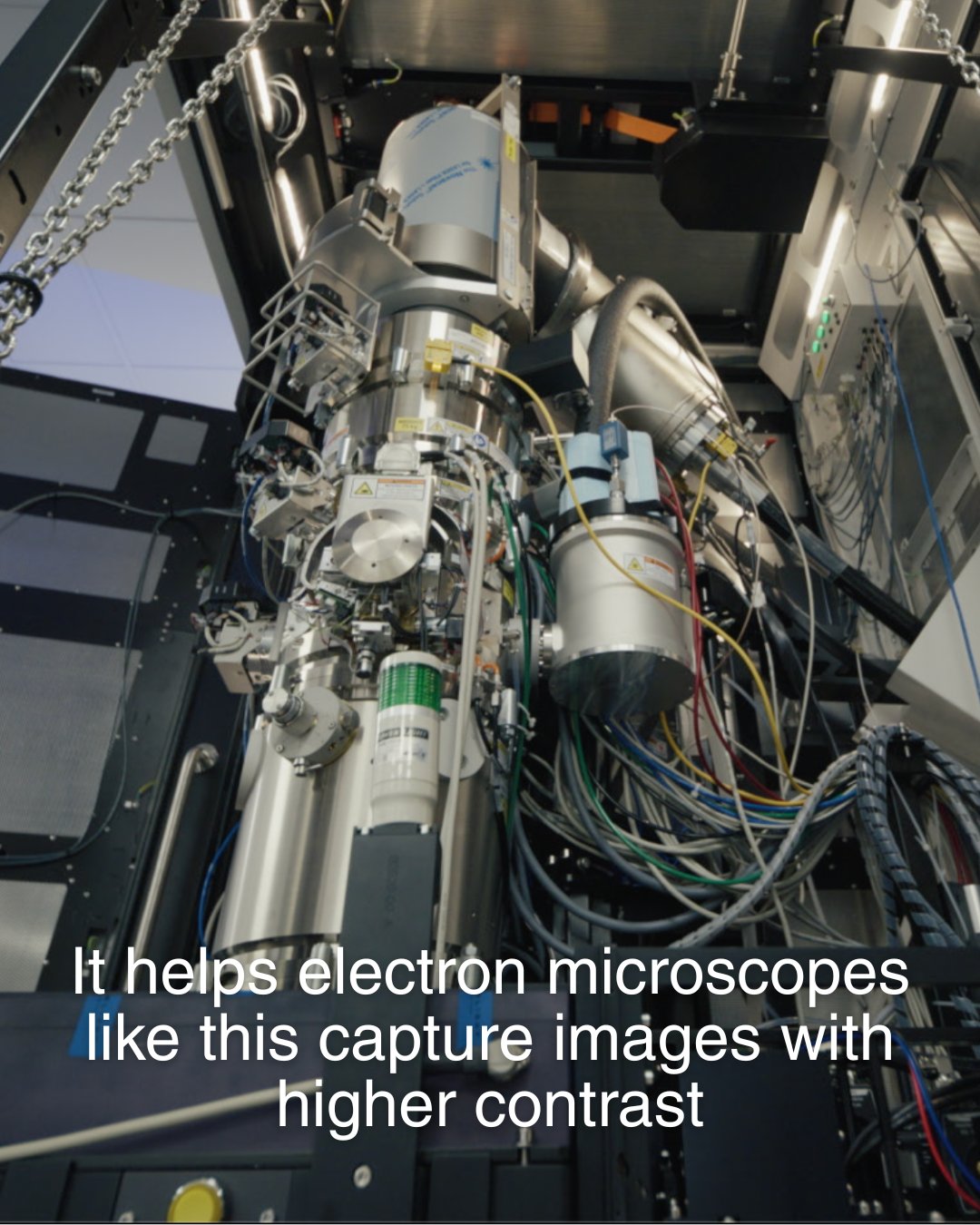
The laser phase plate is leveling up cryoEM so we can see biology like never before. Learn more: bit.ly/4vIPC1U



Imaging_Artifact retweeted

Together with UC Berkeley we are announcing the laser phase plate - a breakthrough in atomic resolution imaging. This is the brightest continuous wave laser in the world, 100 million times the intensity of the surface of the sun.
Phase contrast plays an important role in microscopy, but it was thought close to impossible for electron microscopy, where it would require interfering with an electron beam. Holger Mueller and Robert Glaeser proposed exactly this using a standing wave laser. It has taken over 15 years to make this a reality. Biohub partnered with UC Berkeley and Mueller to support this work and to engineer and build the technology.
Contrast has been the critical barrier to achieving atomic resolution imaging of the cell. In cryo-electron tomography, a cellular imaging technology that uses electron microscopy, the low contrast makes it impossible to resolve anything but the largest proteins within their cellular context. The laser phase plate removes that barrier.
With advances in AI this breakthrough in contrast will start to open up a new frontier in structural biology, that will allow us to see the molecular machines of the cell, and how they assemble into far more complex and dynamic systems, and understand how they work.
Imaging_Artifact retweeted

AI for structural biology: given the right harness, tools, and compute, your preferred AI agent can tackle tasks such as building a protein structure from a cryo-EM density map.
In this case, Claude assembled a structure, compared its reconstruction to the published structure, then used ChimeraX to create these visuals and make this short presentation video.
Imaging_Artifact retweeted

🚀 Soft-launching BenchOS today.
An agentic OS for molecular & structural biology labs, combining ELN, biologics databases, equipment booking, cryo-EM tracking, cloning tools, and more.
Powered by state-of-the-art LLMs.
Learn more: BenchOS.ai
Imaging_Artifact retweeted

I think it's ODO1: 2-oxoglutarate dehydrogenase(E1)!
We recently solved the structure of this contaminant in our dataset (E.coli, His purified contaminant) and found out it was this. Here's 2D templates of our volume:

Imaging_Artifact retweeted

We are struggling to identify these class averages in a #cryoEM dataset. Does anyone recognize this protein complex from E. coli? Looks to be C2. Doesn't look like the usual culprits (ArnA, GroEL, Catalase, etc.). Sadly preferred orientation so can't get a useful map


Imaging_Artifact retweeted

Had a rare view 🔍 into the @thermofisher #Krios autoloader, when our #FSE changed the parts. Lasted ~656 cycles since the 2018 installation @ismb_london / @BirkbeckUoL 🦉#cryoEM ❄️🔬facility. Fascinating system that enables automation across TEM for life sciences.


🤔🧐

Reviewed a nice #CryoET paper in journal club today and it got me wondering... @ScienceMagazine has a very clear policy on data and computational methods. Why isn't this policy upheld for the #CryoEM and #TeamTomo communities? #OpenSoftwareAcceleratesScience

Imaging_Artifact retweeted

If you're not on the multi-thousand-person cryo-EM listservs... we (EZ lab @PrincetonCS, @FlatironInst, #CCPEM) just announced a new #heterogeneity challenge for cryo-EM! #CAHRA2025
Webinar this Fri Nov 14 at 12p ET. Datasets and more info here: heterogeneity.notion.site/ch…
We've been preparing this challenge for over a year 🥵 (designing the heterogeneity, collecting data, validating results and metrics). Super excited to finally share it with the community!
There are three mystery❓❔❓ datasets! Some fun facts about each:
1) comp-het: an experimental dataset containing a mixture of mystery❔complexes
2) conf-het: we're asking folks to submit *atomic models* instead of density maps for the first time ❗️❕
3) pose-entanglement: a simple dataset to test how much the pose distribution influences conformation estimation 🐎
Huge shoutout to the members of my group driving this work @FeathersRyan and Robert Heeter, @sonyahans + @PilarCossio2's groups @FlatironInst, and Joel Greer from Tom Burnley's group at #CCPEM.
Calling both methods developers and users to participate! Check out our website for more details!

Imaging_Artifact retweeted

That was a 2/3!
Thanks to @nm_razad @Pennywang925627 @valendraica for their help, @ImagingArtifact for reposting, and all for their nice suggestions.
Still one average missing, and I seriously doubt it is our sample.

Common E. coli contaminants. Thanks for sharing! @nm_razad


Imaging_Artifact retweeted
Please, #cryoEM community (and @ImagingArtifact), we need some help to identify some objects in our 2D averages. Probably, contaminants from e coli recombinant protein production. Any idea?

Imaging_Artifact retweeted

If you are looking for some TEM-related parts, check it out: ebay.com/usr/ucsc-cryoem

Imaging_Artifact retweeted
Successful replacement of the humidity inlet 🚿 for the TFS/FEI MARK-IV Vitrobot @ismb_london / @BirkbeckUoL 🦉 #cryoEM ❄️🔬. I Never realized how worn and dirty 🦠 these components can get.
Working a lot better now, hopefully holds up until the MARK-V is out 😉.

Imaging_Artifact retweeted

When particles have orientation bias, the resulting maps are often streaked along the missing directions. In this case study, we cover why orientation bias produces anisotropic #cryoEM maps and how you may be able to recover from it!
guide.cryosparc.com/processi…