

I'm a homeschooling dad. I love self-directed learning.
Idaho
Joined March 2023
- Tweets8.3K
- Following1.2K
- Followers477
- Likes6.4K






Pinned Tweet
I don't understand how the process of gaining knowledge or understanding of a skill could be the same for every individual. This requires thinking, and no one thinks the same.

Learning doesn't require a structured curriculum. Curriculum can be a useful resource, but it doesn't need to be followed explicitly for effective learning.
We keep kids in the artificial environment of school, tell them they have to focus on what we want them to learn. They lose their curiosity and desire to pursue their own interests. And apparently the solution is "knowledge rich" scripted curriculum?
I think the biggest issue here isn't that we learned a bunch of stuff in school that we don't use directly, but that we were forced to learn a bunch of unnecessary stuff that we didn't want to learn in the first place.

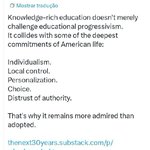
Am I understanding the argument of the scripted knowledge rich curriculum advocates correctly, that kids who aren't read to at home need to be explicitly taught background knowledge through scripted curriculum so they can learn to read?
Colby Lyons retweeted

The process of getting “order” in a classroom of six-year-olds requires convincing them that they have no agency, no sense, that they can do no real work, and that their curiosity is meaningless.
Is it any wonder that the schools fail to graduate responsible adults?

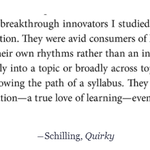
This seems to challenge the notion that innovative people need a great deal of direct, explicit instruction before they can innovate and create. To me, it looks like self-education is more important in cultivating innovation.

It's an odd coincidence. Suddenly, scripts are becoming trendy, just as science of reading legislation across the states is leading to the implementation of scripted "knowledge-rich curriculum." Who is pushing this and why?
I don't understand using "actors use scripts" as a justification for making teachers use them. Actors use scripts because they have to follow a predetermined storyline. Their fellow actors also use scripts, and the audience doesn't ask questions.
Colby Lyons retweeted

You know how frustrating it is when you ring the bank, a tech support line etc & you're stuck with someone reading a script & not really engaging? It's maddening on a 10 minute call. So now imagine having to put up with that all day, every day as a pupil with scripted lessons 🤦♂️

Colby Lyons retweeted

1,000 signatories protest against scripted lesson plans in Fort Worth, TX. Their letter reveals a sorry state that apply to schools beyond Ft. Worth.
Reading the letter (pictured) is a great opportunity for parents and educators to reflect.
Throughout the country, lesson plans and curriculum are created by faceless committees and delivered by overwhelmed and unaccountable teachers who are also paid for tenure over talent.
Yet, there are also schools that are just so bad, the best intervention possible given existing structures and rules might be a scripted lesson plan. 🤦♂️


Is this really the future of education, when the tools to create an individualized experience for every student are within reach? I hope not.

A letter signed by 1000 students gives an example of what many students think-
xitter.cf/MrAleoSays/status/2111…

“Bodily exercise, when compulsory, does no harm to the body; but knowledge which is acquired under compulsion obtains no hold on the mind.” ~ Plato, The Republic
I know a kid who can create some pretty impressive structures. There are so many skills that can't be measured by standardized tests, and they deserve to be nurtured.


Colby Lyons retweeted
Many times, I’ll see the phrase “start from first principles,” (usually regarding technology, business, and occasionally ideas) here on X, but rarely do I see people publicly ask, “Why is it appropriate for government to be involved in education at all?”
(Isn’t this an answer adult Americans should at least have for themselves?)
Colby Lyons retweeted
In 1860, Massachusetts schools stole 300 hours each year from a child. By 1920, 800 hours. By 1950, 900 hours.
By 2026, schools have taken away kids' home life with homework.
And yet, educators think that more school will solve a perceived literacy crisis?
This sounds similar to what a lot of kids experience in school- a lot of time spent on things they aren't interested in, will probably forget, and may never use anyway.

Millions and millions of dollars are spent on professional development in schools, much of it an utter waste of time. Useless icebreakers, infantilizing activities for trained professionals, and endless PowerPoint presentations that offer little value.
I’m still waiting for a professional development session that actually develops me professionally.
This is why the system used to impart knowledge matters as much as the content being taught. If the system was designed to instill conformity and compliance, as the public school system was, that's a problem that needs to be addressed just as much as the curriculum used.

Education is 100% replacable by AI if education is understood as downloading information. In fact, it can probably do that job much better.
But if education is fundamentally about formation, the cultivation of the right affections, a deep love of God, family, and country, and a relentless pursuit of truth, goodness, and beauty, AI doesn’t stand a chance. Only inspirational teachers, can do that.
Colby Lyons retweeted
"I hate educations sur un grande systeme. All men who have turned out worth anything have had the chief hand in their own education."
From a letter to his son-in-law.
We agree. Education happens best through freely chosen effort, not from a grand system or curricula.