

A majority mad-identified, peer-reviewed academic journal that aims to promote Mad Studies. First published Jan 2023. [email protected]
- Tweets82
- Following104
- Followers633
- Likes52




ALT Our vision and values Diverse voices and perspectives Oppose hegemony and seek to challenge power Embrace marginalised epistemologies and privilege mad and unheard voices Provocative and critical Founded on human rights, social justice, resistance, and desire for real change Accessible and independent, transparent and responsive

ALT Mad hats. A reflection on mad leadership Chris Maylea This paper considers the problem of how Mad leaders might be authentic without resorting to discriminatory identity policing. The paper briefly charts the contemporary role of consumer/survivor/ex-patient/mad activism in mental health reform before drawing on the author’s failed attempt to grapple with authentic mad leadership. Drawing on Mad Studies theory and the wisdom of Lewis Carroll’s Mad Hatter, the author argues that the consumer/survivor/ex-patient/mad movement should welcome all experiences of madness, but only those who can exercise authentic leadership should lead the movement. This requires resistance against non-Mad ways of knowing and exercising power and for established power hierarchies to transform to allow authentic mad leadership.


ALT Bring People Home from Psychiatric Hospital Campaign led by People with Learning Difficulties/Disabilities and Autistic People Day of Action at Westminster and Department For Health and Social Care Date 29th April 2025 Time 11.30 am - 3.00 pm For more information on online & in-person campaign activities: www.inclusionlondon.org.uk/BPHH Contact Simone Aspis Email [email protected] Telephone Number : 020 3327 0333 Mobile Number : 07749 892 843

ALT Our hands quake as we stretch them out, naked pain. Lightning strikes in pulses that tattoo lines across our skin. We are sailors weathered from red storms, waged within. White fire licks our feet, ebbs and creeps back like foam. Fireflies dance shadows flickering into these barnacled bones. From the poem Akathisiacs by Rosiel Elwyn


ALT Mad hats. A reflection on mad leadership Chris Maylea This paper considers the problem of how Mad leaders might be authentic without resorting to discriminatory identity policing. The paper briefly charts the contemporary role of consumer/survivor/ex-patient/mad activism in mental health reform before drawing on the author’s failed attempt to grapple with authentic mad leadership. Drawing on Mad Studies theory and the wisdom of Lewis Carroll’s Mad Hatter, the author argues that the consumer/survivor/ex-patient/mad movement should welcome all experiences of madness, but only those who can exercise authentic leadership should lead the movement. This requires resistance against non-Mad ways of knowing and exercising power and for established power hierarchies to transform to allow authentic mad leadership.

ALT Asylum Magazine online launch Thursday 13 March 18:30-19:30 GMT Join us to launch the new issue of radical mental health magazine Asylum, featuring: contributors speaking about their articles, questions and discussion contributing poets reading their poems, information about Asylum Register here: https://bit.ly/Asylum-launch-Spring25

ALT “It is our intention to foster a space that is inclusive of mad voices and mad thinking, including voices that might be otherwise excluded. To this end, we think of ourselves as a community – of mad and critical thinking – rather than a faceless journal. Please do get involved!”

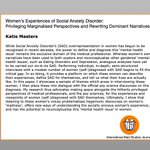
ALT overrepresentation in women has begun to be recognised in recent decades, the power to define and diagnose this ‘mental health issue’ remains the exclusive domain of the medical professional. Whereas women’s own narratives have been used to both explore and reconceptualise other gendered ‘mental health issues’, such as Eating Disorders and Depression, analogous analyses have yet to be carried out vis-à-vis SAD. Performing individual, in-depth, semi-structured interviews with a modest number of women (self-)diagnosed with SAD begins to fill this critical gap. In so doing, it provides a platform on which these women can describe their experiences, define SAD for themselves, and tell us what their lives are actually like. In this paper, I showcase a sample of themes which arose in interviewing these women. I then place these into dialogue with the official psy science discourses on this diagnosis. My research thus advocates making space alongside the hitherto privileged perspectives of me

ALT International mad studies journal. Now calling for submissions.

ALT “Together, we wanted to challenge the dominance of traditional mental health discourse, both inside and outside the academy. We wanted to actualise the visions that have been held by many in the past about showcasing and celebrating Mad knowledge and perspectives."