

Student Reading Success Through Research and Collaboration. Research, resources, and information for educators and families.
- Tweets6.9K
- Following1.1K
- Followers4.5K
- Likes1.7K






ALT A young girl holding books and wearing a backpack alongside the IRRC logo.

ALT Effective Literacy Instruction eLearning Module Components of Effective Instruction Specify Objectives Devise Instructional Strategies Select Examples and Non-Examples Sequence Skills Provide Practice and Review In-Depth Learning Self-paced and interactive Videos of classroom examples Section quizzes and post-tests

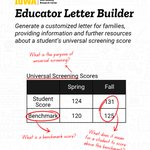
ALT Educator Letter Builder Generate a customized letter for families, providing information and further resources about a student’s universal screening score What is the purpose of universal screening? What is a benchmark score? What does it mean for a student to score above the benchmark?

ALT How do you build a letter? Plug in your assessment information Check which terminology you would like defined Press “Create PDF”

ALT And just like that, the Educator Letter Builder will generate a custom letter, covering important assessment information and further resources, ready to be sent off to your student’s family!

ALT New Resource! Learning Disability Hub

ALT What Is the Learning Disability Hub? A collection of free resources to build understanding and support for students with learning disabilities. The hub includes five sections to support educators and caregivers in their learning: Understanding and Recognition Explore the characteristics of learning disabilities and learn how to recognize them in students. -Dyslexia Overview eLearning Module -Advocating for Your Student eLearning Module -What Is Dysgraphia - Blog Post

ALT Instruction and Intervention Learn instructional strategies and access tools to support students. -Tip Sheet -Teaching Students with Dyslexic Characteristics -Handwriting Instructional Resources and App -Why the 13 Disability Categories Matter Blog Post Support and Advocacy Access parent-teacher communication resources and blog posts on the lived experiences of students with learning disabilities. -Communication Resources -Blog Posts and Q&As

ALT Accommodations Learn about accommodations such as assistive technology. -Assistive Technology eLearning Module -Reading Graphic Organizers -Accommodating Note-Taking Blog Post Iowa Resources Visit webpages for information on dyslexia that is specific to Iowa. -Iowa Department of Education Dyslexia Webpage -Iowa Dyslexia Handbook -Iowa Dyslexia Board Webpage

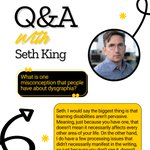
ALT Q&A With Seth King What is one misconception that people have about dysgraphia? Seth: I would say the biggest thing is that learning disabilities aren’t pervasive. Meaning, just because you have one, that doesn’t mean it necessarily affects every other area of your life. On the other hand, I do have a few processing issues that didn’t necessarily manifest in the writing, so just because you don’t see it, doesn’t mean it isn’t there.

ALT Can You Tell Me a Bit About Your Learning Disability and How It Impacted Your Experience in School? Seth: I was identified as having a learning disability and being academically gifted, or “twice exceptional.” This really wasn’t something that was widely recognized at the time. My school first maintained that I had to either choose special education services or be involved in the gifted program: I couldn’t do both. I was very disorganized and struggled in most subjects until about the third grade. A pivotal moment was when I practiced words for the spelling test with one of my mother’s friends. We broke the words apart phonetically, which is not something I had been taught to do in school. After spelling tests, my classroom teacher used to call out the names of people who made a 100. My name never got called, of course. But the first spelling test I took after practicing, I made a 100, and when the teacher called my name, everyone whipped their head around to look at me in surprise.

ALT How Do Your Experiences Guide Your Work as a Researcher? Seth: I go back to the story about the spelling test. I had tried to do well on the tests before, but nothing really stuck. Then I found a way of learning that worked, and I was able to stick with it and even guide myself through studying without assistance. I guess I see my work as helping students come into contact with things that work for them, so that they can experience success in ways that they value.


ALT Graphic Organizers for Morphology Instruction

ALT Morpheme Practice Graphic Organizer Help students understand new words by using the word’s component morphemes to derive meaning. This graphic organizer guides students to identify and define individual morphemes in a longer word. Then, they piece the word back together again, using their understanding of morphemes to derive a definition of the whole word.

ALT Morphemic Analysis Graphic Organizer This graphic organizer helps students break down words into their roots, prefixes, and suffixes and record the meaning of each. Then, students combine the individual parts and infer the meaning of the whole word. Finally, students test whether the word makes sense in its original context.

ALT Word Building Graphic Organizer By applying the Word Building Strategy, students combine morphemes to create new words and meanings. Through the strategy, students apply their understanding of how word parts contribute to meaning and grammatical function. The Word Building Strategy consists of three basic steps: building new words with morpheme cards, recording the words in the graphic organizer, and using the new words in written sentences.

ALT blog post What Is Contextual Fit? Contextual fit is the alignment between an intervention and the values, skills, resources, and daily demands of individuals responsible for implementation. Reaping the rewards of an evidence-based intervention requires instructors to implement the approach with fidelity. However, adaptations may be necessary to ensure that personnel in different educational settings can actually use the intervention. Staff training, available time, student needs, and other unrelated institutional policies can all influence whether an intervention is feasible.

ALT Balancing Fidelity and Contextual Fit Selecting and continually evaluating the success of an intervention in practice involves considering necessary adaptations while preserving its fundamental effectiveness. For example, a multi-component literacy intervention might require word-study activities, fluency practice, and explicit comprehension strategy instruction in every lesson; however, the school may only allot 30-minutes for supplemental reading instruction. A solution might be to cycle through the various components on a rotating basis across sessions, rather than to try to address all the components at the same time. Fidelity Contextual Fit

ALT Tips for Addressing Contextual Fit Consider contextual fit prior to implementation: Before training to implement an intervention, instructional teams should consider factors such as the most important intervention outcomes, likely interventionists, available instructional time, and other potential barriers to implementation. Assess early, assess often: Initial fidelity assessments should occur almost immediately following training as well as on a regular basis throughout the school year. Go beyond the numbers: Assessing contextual fit involves qualitative data about instructors’ experiences—What is working for you? Why did you make this change? How does the intervention fit into your instruction? Continue monitoring and assessing: Changing instructional practice at a school level is a long-term project that may require introducing multiple iterations of an intervention.


ALT Activities & Games to support literacy skills

ALT Paraphrase Game Players describe nouns so that other players can guess them. This game provides practice using paraphrasing strategies. Reading Race- Track Teach students how to recognize sight words, which helps students read effortlessly and focus on decoding difficult words.

ALT Word Match Match nouns and adjectives to expand their vocabulary skills and morpheme awareness. LIFTER Coloring Sheets Pair letter transcription practice with a fun coloring activity!

ALT Staff Spotlight “In my free time, I enjoy doing Pilates and swimming. I also love cooking and drawing.” Gamze Karaer Assistant Research Scientist Hometown: Eskisehir, Turkiye Ph.D., Special Education, Eskisehir Osmangazi University, Türkiye “One of my favorite novels is Blindness by José Saramago, and I also really enjoyed The Blind Watchmaker by Richard Dawkins.”


