

'Emergia' talent attraction research fellow. Departamento de Filosofía, Lógica y Filosofía de la Ciencia. Universidad de Sevilla
Joined August 2015
- Tweets256
- Following810
- Followers1K
- Likes560



The "paramilitary experiment". Are there pre-conditions for a paramilitary force in the US in 2026? Gambling on autocratic breakdown: even if unlikely, the problem is accepting low-probability risks with catastrophic institutional repercussions.
economist.com/briefing/2026/…

Genuine question: Where are libertarian philosophers protesting Trump’s clear abuse of power? Imposing tariffs means usurping legislative authority under the false pretext of “emergency.” Conservatives, of all people, should oppose executive overreach and despotic taxation.
Hoy reportaje de @ElisaSilio que a mi parecer solo presenta la punta del iceberg: casos que han ido a juicio. Lo normal sería que actuasen las universidades de oficio. No es el caso (1/2). (Continúa)
elpais.com/educacion/2025-03… a través de @el_pais


Please donate to Wikipedia. knowledge is a public good. And it’s still one of the most visited sites in the internet! And it’s mostly run by volunteers! newsweek.com/elon-musk-takes…


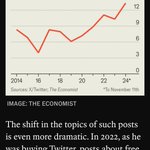
If you saw more and more fake news about immigrants on this platform shared by the platform owner, there has been a very consistent pattern:
economist.com/briefing/2024/…


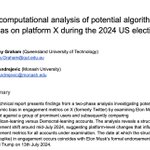
Is this legit? New study by University of Queensland researchers finds what other previous studies (and common observation) have found. Note that it is not easy to reproduce precisely because this platform cut access to its academic API.
eprints.qut.edu.au/253211/1/…

Hugo Viciana retweeted

The government doesn't operate like a private company, so laying off federal employees and closing agencies will do little to increase efficiency, explains @FukuyamaFrancis.
Read his recommendations for what will actually help in @JoinPersuasion. ↘️ ow.ly/wFEz50U5upm

Elon Musk’s $1M lottery to boost Trump’s voter base in swing states is a dangerous step towards plutocracy. This is a blatant attempt to buy political influence with money.
vox.com/politics/378912/musk…

When billionaires can offer cash incentives to vote, democracy is at risk #PlutocracyAlert
economist.com/leaders/2024/1…

Hugo Viciana retweeted

🦀🐝🧠🤖 How should we make decisions when faced with systems of uncertain sentience? My new book The Edge of Sentience: Risk and Precaution in Humans, Other Animals, and AI is available online for free at academic.oup.com/book/57949. Please download it! Just click on PDF to get a PDF of the whole book. Individual chapters are also available as PDFs - just click on whichever chapters you want. The book is completely free to everyone and I'm grateful for all shares and forwards.

6/🇪🇸 Additionally, our nationally representative data on Spain revealed insights into how scientific controversies are perceived. Political orientation plays a crucial role in what citizens consider to be the scientific view on contested issues. #MySideBias #ScienceAndSociety
5/ ❌ Interestingly, it wasn’t education level per se that predicted immunity to pseudoscientific claims, but rather an understanding of the philosophy behind scientific inquiry. #Pseudoscience
3/ 👩💼📺📻🗞️After presenting scientific communications on controversial topics, participants with higher epistemological literacy showed an increased propensity to adopt beliefs aligned with those scientific results—even two months later! #ScienceCommunication
2/ 📚 We found that citizens with a better grasp of how science generates knowledge (epistemology) are more receptive to ideologically incongruent scientific results i.e. they’re more likely to embrace beliefs that align with communicated scientific results. #ScienceCommunication
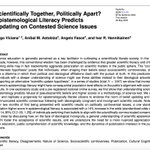
1 / 🌟 Excited to share the results of our latest research on how understanding the philosophy of science impacts how people process scientific (and pseudoscientific) communications! 🧠🔬 #ScienceLiteracy #Epistemology
osf.io/preprints/psyarxiv/va…
