
Retired nuclear engineer. Climate action and nuclear power advocate. Supporter of tech-neutral climate policies.
Tracy, CA
Joined October 2020
- Tweets17.5K
- Following210
- Followers8.3K
- Likes8.1K
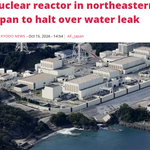



Another news story that wouldn't have been a news story if it were any other energy source or industry. Such media behavior is a big part of the reason why people think that nuclear poses a uniquely large hazard, despite the statistics that say the opposite. Article link in reply.

Indiana's Advanced Nuclear Ready Communities program supports local communities that are interested in hosting new nuclear plants. The program is now ready to receive applications. Article link in reply.
The program "empowers local communities with a strategic road map to clear the way for clean energy investment."
Indiana has no nuclear plants.

Nuclear power is now classified as a clean source in Colorado. However, the Common Sense Institute Colorado (CSIC) identifies 7 state policies that support renewables only. Article link in reply.
Like the EU, Colorado classifies nuclear as a clean source (just like renewables), but true tech neutrality in govt. policy remains elusive.
The CSIC also presents an energy cost analysis that concludes that nuclear would cost 21%-24% less than solar and wind, if you include "grid reliability costs" (i.e., storage, grid, and curtailment costs associated with high penetration levels of intermittent sources).
They appear to compare all nuclear to all solar and wind. The lowest cost grid would probably have a mix of all three.

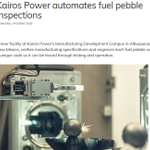
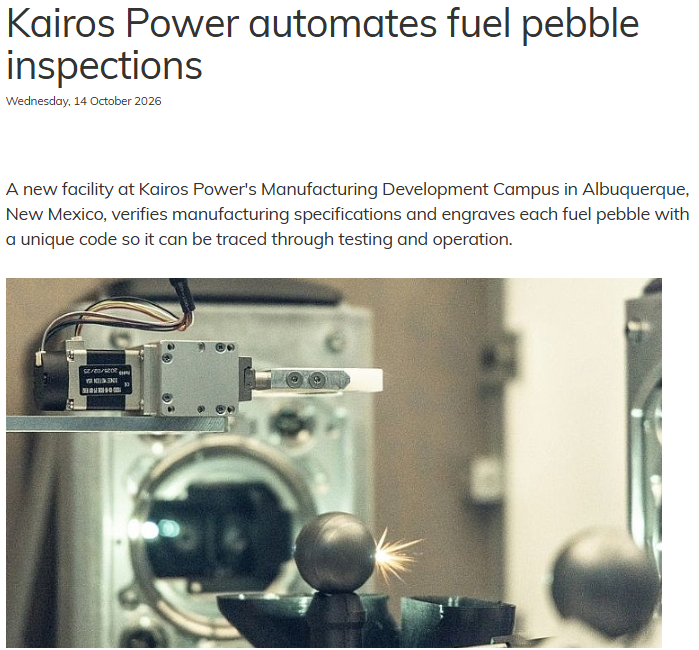
Kairos has developed an automated process that will verify the quality of the TRISO fuel pebbles that will be used in their reactors. Article link in reply.
An effective, economic process for verifying fuel pebble quality is essential for TRISO-fueled reactors. For TRISO-fueled reactors, the fuel pebbles themselves are the primary source of radioactive material containment. As long as the pebbles are performing as designed, there aren't many (or any?) realistic scenarios that could result in a significant radioactive release that would have any significant public impacts.
The NRC has updated and renewed the AP1000 reactor's design certification. The updated certification is consistent with the as-built AP1000 reactors at Vogtle. The certification will be valid until 2066. Article link in reply.

NRC has approved the license amendment that was required to resolve an incident that occurred during loading fuel of the (restarting) Palisades reactor. Article link in reply.
I'm not sure if there's any other industry that requires licensing activities in response to an operational event. But I gotta hand it to the NRC. They approved the license amendment very quickly!

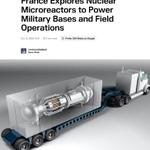
France is taking a cue from the US, and is considering deploying micro reactors at military bases. Article link in reply.

This chart shows that the BWRX-300 is the leading SMR, with a large order book and the most interest.
It's looking like a large number of these reactors will be built. If that happens, we will finally know what this SMR will cost after a large number are built. After there is a developed supply and they've got construction experience.
It's a good thing that one SMR design is garnering a large fraction of the market. To reduce cost, we need to choose just a few designs and build large numbers of carbon copies.

This chart shows how much momentum GE Hitachi's BWRX-300 has in the global SMR race.
The American-Japanese consortium has captured as much interest as the Russian and Chinese state-owned companies, according to @omrglobal. The reactor has multiple projects underway: Darlington in Canada is already under construction and the TVA project just got its construction permits from the U.S. NRC.

Background info video:
xitter.cf/Gen_Atomic/status/2067…

I recently joined Generation Atomic video producer Kiersten Sundell on a tour of a hot cell facility that is currently being used by Zeno. Kiersten has produced a video of our visit. A while ago, she also produced a video that gives an in-depth description of Zeno’s plans. Links to the videos are shown in replies to this post. Almost all of the info below is from her videos.
The hot cell facility is part of the old Vallecitos site in northern California. Vallecitos was the site of the first privately owned, commercial reactor that was connected to the grid. It was a 5 MW BWR that operated from 1957 to 1963. The reactor and site are being decommissioned, with the exception of the hot cell facility.
Zeno will use the hot cells to fabricate Sr-90 and Am-241 powered nuclear batteries. The Sr-90 came from an Oak Ridge facility that was storing the isotope, which was produced a long time ago. The Am-241 came from France’s La Hague reprocessing facility, where it was separated from used nuclear fuel. For both isotopes, the (expensive) extraction process had already been performed. Zeno buying the isotopes will reduce the cost of continued storage of the isotopes for the two facilities. The use of already produced isotopes also greatly reduces the costs for Zeno.
Zeno’s nuclear batteries will be used to provide power for remote places and/or applications that can not be served by other energy sources, such as solar. Such places include a moon base at the lunar South Pole and the ocean floor. Applications include providing heat and power for space probes and rovers, and for ocean floor sensors and autonomous vehicles. Many extremely cold locations and applications may just need heat, which is directly generated by the isotopes.
NASA has been using Pu-240 to generate heat and electricity for space probes and rovers for a long time. So why use Sr-90 or Am-241? Those two isotopes are much more available, and much less expensive, than Pu-240.
Zeno will also use a different way to convert heat (produced by the isotopes) into electricity. The traditional thermo-electric process uses a temperature gradient and special materials to generate electricity. Zeno will use sterling generators where heated, pressurized gas physically drives a piston. The sterling method is actually 3-4 times as efficient than the traditional thermo-electric process, in terms of converting heat into electricity.
In 2023, NASA awarded Zeno $15 million to develop a Am-241 nuclear battery for their Artemis Program, to power the planned lunar South Pole base. They finished the Final Design Review in April. Their battery actually produced 3.5 times the originally specified power output. Terrestrial demonstrations are targeted for early 2027, with lunar flight qualification planned for 2028.
Traditional nuclear batteries were custom built for each project, which resulted in high cost. Zeno plans to factory build nuclear batteries at scale. That will hopefully lead to much lower nuclear battery costs, and use of nuclear batteries for many more applications.

