
Assistant professor and research scientist at AI2 | boosting scientific discovery with AI, NLP, IR, KG, HCI
Joined April 2011
- Tweets569
- Following1.5K
- Followers1.4K
- Likes1.4K



Pinned Tweet
Scimon🧪: Scientific Inspiration Machines Optimized for Novelty.
LLMs + inspiration retrieval from papers + 🚀iterative novelty boosting🚀:
1. LLM (e.g. GPT4) generates idea
2. Compares to detected prior work
3. Refines idea novelty
4. Repeat until sufficient novelty reached


Tom Hope retweeted

Come and check our poster at Grand Ballroom 119 #colm

Tom Hope retweeted

Old Ideas, Novel Problems
The Instability of LLM-Based Novelty Evaluation
paper: huggingface.co/papers/2610.0…

Are you building AI scientists and using LLMs to judge the novelty of their ideas? Then you’ll want to read this.
Great work led by my student Noy.
@allen_ai

Enjoyed being interviewed by @JeffreyBrainard @ScienceMagazine on AI for scientific novelty assessment—a problem that is still unsolved by SOTA LLMs in my experience. Stay tuned for more on this!
science.org/content/article/…

Tom Hope retweeted

🚨Our Review in Nature just got published on "Designing physics experiments with artificial intelligence"
nature.com/articles/s41586-0…
Experiments are our way to ask questions to the Universe. Using AI, we have now enormously powerful techniques to find new questions that are too unintuitive and "weird" for humans to find based on their experience and intuition. AI however can explore the space of all possibilities in a completely different way, thus can discover very different solutions.
We overview this ability in vastly diverse the fields of physics: quantum optics, light & electron microscopy, gravitational wave physics, high-energy physics, neutrino physics, matter wave physics.
For myself this is very special: 12 years after building the first automated design algorithms in quantum experiments, being able to overview the development of the field with my group and friends was an exciting opportunity.
Thank you a lot to @PhylomatX for spear-heading this! Thanks a lot to @soerenarlt @cruizgo_ @carlardrguez96 @GuXuemei Philipp Haslinger, @pietrovischia Christian Haack, Yehonathan Drori, @RanaXAdhikari Markus Arndt, Michael Kagan, @lukasheinrich_ for helping developing this Review, bringing insights from so many different directions of physics. So excited about what will happen in the next years!
#AI4Science

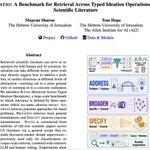
New paper: We’re building retrieval models for AI scientists (and human ones, too)—retrieval trained to directly support inspiration💡:
🫠Problem-solution latent links,
⏫Zooming out (abstraction),
⏬Zooming in (specification).
Cognitive theories of ideation suggests these are fundamental ways humans traverse idea spaces and reframe problems, while brainstorming and connecting different areas.
Our new work, RATIO, with my student @maayansharon10, brings these operations into scientific retrieval. Given for example a query on “reward hacking in RL-trained LLMs,” the goal is to retrieve a direct solution (e.g., reward-model ensembles), broaden the problem (e.g., to Goodhart’s law), or specify that principle in a new setting (e.g., recommender systems).
Our focus here is on defining the task and creating a new automatic way for data collection from literature.
The overarching goal: retrieve not just according to standard notions of topical relevance, but according to more latent, abstract links that help scientists take the next ideation step. I've been exploring this line of work in multiple papers over the years, excited to take a first step toward training models for this, and for more upcoming work in this space. This is also related to the recent notion of oblique retrieval (@lateinteraction): retrieving latent and implicit connections rather than relying only on surface similarity.


Tom Hope retweeted
Very glad to share that our paper has been accepted to EMNLP 2026! My greatest thanks to my exceptional mentors Qingyun @eagle_hz , Tom @Hoper_Tom , and Zhiyong.
🌐 Homepage: xhguo7.github.io/Anagent/
📄 Paper: arxiv.org/abs/2602.10081
Happy to share three papers accepted to #EMNLP2026 with students and colleagues:
- A new self-improving agentic memory method for agentic RAG applications
- A system for exploring the evolution of scientific concepts by analyzing Wikipedia page revisions
- A benchmark and agentic framework for multimodal scientific chart and table understanding.
WikiSTAR: A System for Shedding Light on the Hidden History of Scientific Wikipedia Articles
arxiv.org/pdf/2607.12441
With @Nitzan_Barzilay @EhrlichOmer @rona_av
Iterate Until Retrieved: Factual Nugget Optimization for Discoverable Continual Corrections in Agentic RAG
arxiv.org/pdf/2605.25641
With @HazoomMoshe @GalNLP @AlonTalmor
Anabench For Enhancing Scientific Table & Figure Analysis
arxiv.org/pdf/2602.10081
Led by @eagle_hz and @XuehangG

We're building a knowledge base for AI scientists (and humans, too) to discover fine-grained technical research problems, solutions and their *rationales* , extracted from full-text papers across all domains on arXiv.
We introduce MUSE, containing 36,960 Problem–Solution–Rationale triplets across scientific domains. MUSE is built by curating an expert-annotated dataset and using it to train a modular extraction pipeline designed for complex, full-text passages. We explore the use of the P-S-R data for training LLMs (Qwen, DeepSeek) for rationale-guided scientific problem solving (see more in 🧵).

We explore using rationale supervision with SFT on human rationales, followed by GRPO with rewards for correctness and novelty. It's a preliminary result but we're seeing improved solution generation on complex, multi-constraint problems—but not on simpler ones where the rationale training actually hurts results. Much more to explore here, in this paper we're focused on the automated data collection.

Led by my student Tsofia Cohen.
Annotated dataset, trained extraction and problem-solving models (e.g., Qwen-32B), and the MUSE knowledge base are openly available (see links in paper).
arxiv.org/abs/2608.10974

Tom Hope retweeted
📢📢Huge news: We founded @FeyerLabs , an AI lab for automated innovations of crazy new industrial hardware, together with my former group members @PhylomatX and @soerenarlt , and received €3 million in non-dilutive funding in the Next Frontier AI Challenge by @SPRIND
Stage 1: one of the 10 teams from 530 competitors €3M/6months;
Next: Stage 2: €8M/8 months, Stage 3: €15,5M/9 months, SPRIND's goal: several unicorns in 24months.
For more than ten years, we have been developing AI systems that autonomously design new physical experiments and technologies for basic research -- ranging from quantum systems and novel microscopes to gravitational wave detectors. With Feyer, we are bringing this technology into industrial application. We aim to become a key driver of unexpected hardware innovations in the European high-tech sector -- spanning everything from laser, quantum, and microscopy technologies to microchip production and new solutions for the energy sector.
This is also especially exciting for me as an group leader and supervisor. Sören (our CTO) was my first PhD student and even before his defense, he co-founded a company. Jonathan (our CEO) decided - after a mere one year into his PhD that this AI technology could have enormous impact in society and economy, and it is time to get things done.
Very thankful to SPRIND for organizing this wild competition towards creating european unicorn-level frontier AI labs, @Cyber_Valley and @uni_tue for the support.

Our new system for tracing the evolution of scientific concepts by analyzing Wikipedia page revisions. For example, we used an LLM to sift through over 18K edits in the AI wiki page, finding scientifically meaningful changes and summarizing them over time.
Try it out!
Great work by my students @Nitzan_Barzilay @EhrlichOmer and collaborator @rona_av.


Tom Hope retweeted

Such an honor presenting CHIMERA at #ACL2026 😌
CHIMERA is the first KB of scientific idea recombinations, and captures how scientists blend concepts and take inspiration across areas.
🔗 noy-sternlicht.github.io/CHI…
Shout out to my advisor @TomHope who guided this work 👏

If you're attending #ACL2026 later today, check out these talks from my students and colleagues (along with all the other cool work from @allen_ai )!
@NoySternlicht @NirMMazor Lior Forer Hiba Arnaout @IGurevych @UKPLab @aclmeeting
See details in the image.

Tom Hope retweeted
Looking forward to presenting CHIMERA at #ACL2026 tomorrow (Sun. July 5)!
If you're interested in automated ideation and science of science analysis, come check it out!
📍Harbor E-F
🕓 11:00-12:30 (Oral Session A: NLP Applications 1)
Joint work with @Hoper_Tom
Details below ⬇️
🚨 New paper!
We present CHIMERA — a KB of 28K+ scientific idea recombinations 💡
It captures how researchers blend concepts or take inspiration across fields, enabling:
1. Meta-science
2. Training models to predict new combos
noy-sternlicht.github.io/CHI…
👇 Findings & data:
Tom Hope retweeted

I'll be at ACL presenting our Ai2 Asta Theorizer system: an AI-for-Science super-deep-research system that synthesizes theories for your hardest research problems. If you'd like to help test a web-based version of Theorizer, sign up to express interest here: forms.gle/gTTgAPvzxdtnsRAt8
Paper: aclanthology.org/2026.acl-lo…
Poster: Tuesday July 7, 11-12:30, Session 17


We're at #ACL2026 with papers & talks across the conference. Come say hello and learn about our latest research!

