

Award-winning Creative Agency, we work w/ startups, entrepreneurs, and fast-growth companies to tell their story and introduce their brand to the world.
Detroit, MI
Joined November 2008
- Tweets4K
- Following4.3K
- Followers1.2K
- Likes4.2K


the honos group 〽️ retweeted

I spent 48 hours in SF hanging out with billionaires, data labs and AI founders and execs running $1B to $100B companies.
My observations:
1. Sooo MANY stories of data brokers making like $2M a WEEK selling company data to labs. I can't tell if it's the beginning or a bubble, and I kept wondering which niches are left. Digging into it actively.
2. At dinner, someone asked the table, "If a new model drops next month, does your company get better or worse?" HALF the table went quiet! I think that's the best question to ask about any AI startup right now.
3. The bar people talk about now is hitting $1B in revenue in 12 months (I guess that's the new unicorn?). What I didn't hear much about is retention. AI revenue can come in fast and leave fast, and I think we're going to see a lot of stories of AI companies with huge revenue and terrible retention.
4. It's pretty clear we're living through the reinvention of the computer. The model is the CPU, the harness is the operating system, and skills and plugins are the apps. Thinking about it that way makes it easier to see where the whitespace is.
5. We're maybe 12 months from an agent that can watch you work for a week and then do your job without any instructions. The screen recording plus agent memory plus local model combination makes this possible right now.
6. Agent harnesses feel like the new GPT wrappers, in a good way, especially vertical ones. The best teams I talked to treat the model as swappable. One founder walked me through routing different models to different jobs: one for taste and visuals, a cheaper one for the everyday stuff, another for text.
They use prompts they can move across models over fine-tuning, and A/B test the output on what users actually do with it: do they edit it, export it, share it? A vertical harness is basically four things: the connectors for that industry's data, evals written by people who know the work, rules for what the agent can and can't touch, and a clean screen for a human to review. The model is maybe 20% of it.
7. There's a lot of reverse engineering going on/cloning going on more than I've ever seen. People are decompiling software and rebuilding it with agents, and someone showed a suite of like 10 apps that are worth $5B+ each all that he cloned open source. Me and everyone are still thinking through what it means when software gets this easy to copy.
8. My guess is the value moves to data. If the software can be rebuilt quickly, what's worth paying for in a legacy SaaS company is the years of customer data and workflows inside it. Some SaaS companies are secretly data companies.
Gets me thinking about how do you truly value data for this saas companies? Like if we were buying these dying saas companies at 2x ARR before (as example), maybe there is a better metric. Idk, just thinking out loud here.
9. It feels like a good chunk of legacy software won't make it to the agentic era, especially anything built around people clicking through a lot of screens.
10. Every company I talked to wants to pipe its internal data into one place and expose it to agents through MCP. Then they look at the data and realize it's a mess: five versions of the same customer, old Slack channels, PDFs nobody can search. Cleaning that up feels like a big consulting opportunity!
11. A lot of founders are building the basic building blocks for agents: APIs, data layers and tools. Some of the companies I saw barely have a UI because the main user is an agent. I really believe the startups that build primitives to this agentic era will do extremely well. Building blocks is the best way to think about it.
12. Labs can get plenty of training data, but it's harder to get real examples of agents failing inside companies. Whoever has those logs has something valuable.
13. Someone running a big consumer company told me the next fight is over memory. The model that remembers the most about you wins, and the smartest model matters less than people think.
14. Physical AI came up a lot. Astra I think was the first model that got people into AI can actually do CAD, and I think a lot of people are thinking what does vibe manufacturing really look like. The line I keep thinking about came from a robotics founder: the hardest problems in AI are deployment problems now, not research problems. Their robots work on their own, call a human when they get stuck, and every one of those calls becomes training data.
15. Cybersecurity companies are having a moment and are actually cool companies to build now, especially the ones that clean up after a breach. Every agent with access to your systems is a new door into your company, and a lot of those doors were left open.
16. Some startups are worth more dead than alive now. A shutdown company with 5 years of Slack, email and code can get paid for licensing all of it. I wouldn't be surprised if founders start factoring that into when they shut down.
17. People are starting to talk about monetizing the agent web. It feels really early, but when the most popular user of the internet is an agent, what startups should you be building?
18. I think agent insurance is coming. Once an agent makes an expensive mistake, insurers will want audits before they cover anyone.
19. Several people said the hire they want most is someone with taste who can write evals. The models are getting good at generating ideas, so the hard part is judging which ones are good.
20. New trend I observed: startup raises VC, uses venture dollars to become a creator, startup fails, founder falls back on being a full-time creator and incubates other products bootstrapped.
21. Getting SIGNIFICANT distribution is HARD right now. Founders are sponsoring buses, buying billboards like crazy and throwing parties with famous DJs to get noticed. Kinda feels dotcom era in that sense.
Attention is what's scarce! The growth guy going viral sharing his UGC strategy from Wispr Flow is a good example. It's the sauce everyone wants, and I truly believe there are probably only 50 people on the planet who know how to scale these types of businesses efficiently in this era.
Always good to get that dose of SF. I felt sooo lucky to have such an incredible trip during such an incredible time in building businesses. Surreal in so many ways.
Happy to be home and locked in.
Until next time!


the honos group 〽️ retweeted

Photoshop costs $60 a month. Someone just put a free version on the internet, and the weirdest part is who it was built for.
Each of these apps ships with a control port that lets an AI agent open files, edit layers, and export finished work with no human at the keyboard. That one detail tells you what this project really is.
ArtCraft, the team behind it, makes AI image tools. Their problem is that a model can generate a picture in seconds and then everything stalls, because the finishing work (masking, color grading, layout, export specs) happens inside Adobe software designed for a person holding a mouse. Adobe sells seats. An agent can't sit in one.
So they pointed Claude Opus 5.5 at the problem and rebuilt the production layer itself. Seven clean-room apps in Rust, pushed to GitHub over two days. Headless command line, JSON batch control, agent hooks in all of them. The Photoshop clone is already past 6,600 stars.
I'll be honest about where it stands. Only two of the seven have even reached early alpha, and the project's own docs put the Photoshop clone around a quarter of the way to real professional use. Nobody is canceling Creative Cloud this month.
But Adobe spent 36 years building Photoshop. The surface of all seven flagship apps got rebuilt in about a week, by a tool that takes instructions from another tool.
Adobe built the best creative software for human hands. This is the first production suite that doesn't need hands at all.

AI is now being used to recreate Adobe’s software, a developer has released seven free, open-source apps as clean-room alternatives to Adobe’s main tools:
- PhotoCraft → Photoshop
- VectorCraft → Illustrator
- FilmCraft → Premiere Pro
- LightCraft → Lightroom
- EffectCraft → After Effects
- DesignCraft → InDesign
- PrintCraft → Acrobat Pro
Built in Rust with help from Claude Opus 5.5, they run on Windows, Linux, and macOS under MIT/Apache licenses without using Adobe’s source code.

the honos group 〽️ retweeted

Sometimes I can just sense that my fleet of agents aren't operating as effectively as I want them to.
That's when I tell my chief engineer, Ahad, to do an analysis of all my conversations and clean up whatever could be causing my frustration with my agents.
I did that this morning, and here's his response.

the honos group 〽️ retweeted

Your AI isn't bad at design. It has just never seen good design.
I've tested 100+ vibe coding resources this year. These are the 40 I actually kept, grouped by what you're stuck on.
Bookmark this 🔖
1. 👑 scrolltide.co
Why it's different from everything below:
- Every one is a complete prompt, not a snippet you wire up yourself
- 3 steps: copy the prompt, paste it into your AI, launch it live
- 300+ award-winning prompts, all in one place
- Full source code to download and edit
- Works with Claude Code, Cursor or v0
Built for founders and freelancers who want award-level sites without a design team or a week of tweaking. If you only open one link in this post, make it this one.
2. designmd.ai - design systems as markdown your agent can read
3. vibeprompts.dev - ready-made prompts for dashboards and landing pages
4. minimal.gallery - curated high-end sites
5. kage.design - real UI inspiration mapped to prompts
6. styles.refero.design - 2,000+ real product styles with typography
7. component.gallery - 2,600+ examples of how top design systems solve the same element
8. godly.website - curated collection of beautiful websites
9. awwwards.com - the best of web design, recognized and ranked
10. landing.love - showcase of the best animation websites
11. land-book.com - curated landing pages
12. mobbin.com - mobile design patterns
13. hoverstat.es - experimental web design projects
14. navbar.gallery - navigation patterns
15. footer.design - footer layouts
16. cta.gallery - conversion-tested forms, popups and buttons
17. supahero.io - curated hero sections
18. pricingpages.design - the best pricing page examples
19. 21st.dev - community component marketplace that plugs into agents via MCP
20. ui.shadcn.com - still the gold standard
21. ui.aceternity.com - 200+ animated React and Tailwind components
22. magicui.design - 150+ animated components and effects
23. motion-primitives.com - advanced interactions
24. uiverse.io - open-source UI elements
25. smoothui.dev - animated components built on Motion and GSAP
26. shadcnblocks.com - 2,000+ pre-built section blocks for shadcn/ui
27. kinetics.colorion.co - 150+ motion effects with React code and prompts
28. microkit.co - micro-interactions
29. glass.samasante.com - glass refraction components
30. animejs.com - lightweight animation engine
31. threejs.org - the most popular web 3D library
32. shadertoy.com - the standard online shader editor and community
33. thebookofshaders.com - free interactive intro to fragment shaders
34. threejs-journey.com - full Three.js course with shader chapters
35. kitbitz.art - 2,000+ hand-drawn illustrations
36. 3dicons.co - 3D icons
37. claude.com/product/claude-co… - command-line AI coding agent
38. cursor.com - AI-first code editor
39. v0.dev - Vercel's prompt-to-component tool
40. lovable.dev - AI app builder in the browser
Which one should I add next?
the honos group 〽️ retweeted

Uber publicó cómo armó su infraestructura de MCP y hay varias ideas muy buenas acá.
imaginate una empresa con miles de servicios internos y muchos equipos conectando agentes a esos sistemas por su cuenta.
cuando eso empieza a crecer, terminás con tooling fragmentado, infra duplicada, distintas formas de exponer tools y poca consistencia en seguridad, discovery y operación.
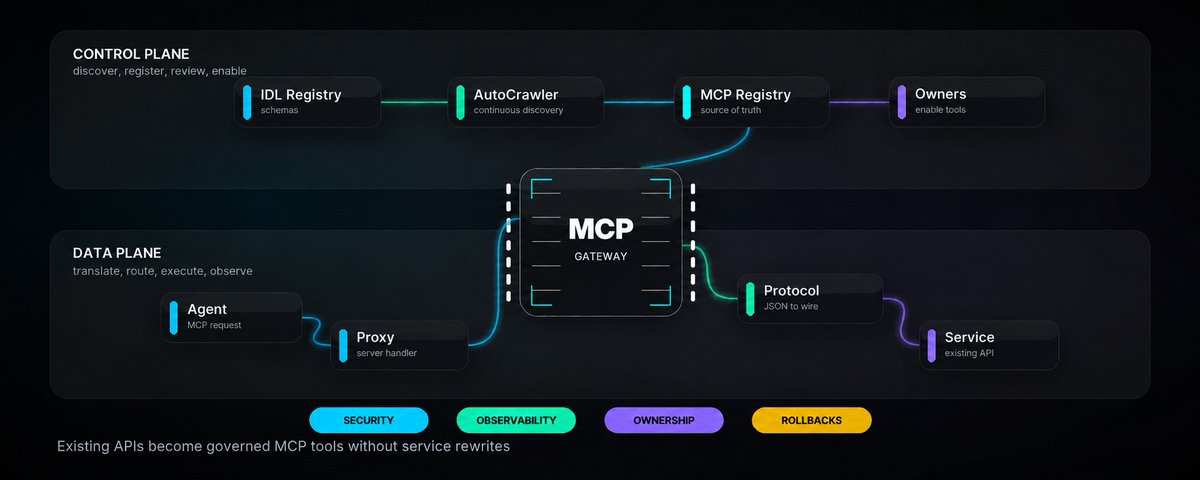
por eso Uber hizo un MCP Gateway: una capa central entre los agentes y sus servicios internos.
el agente habla MCP y el gateway se encarga de routing, permisos, ejecución y de traducir las llamadas a HTTP, gRPC o TChannel según corresponda.
como Uber ya tenía miles de APIs internas, también hicieron AutoCrawler: recorre sus definiciones, detecta métodos y schemas y genera MCP tools automáticamente. incluso usan un LLM para mejorar las descripciones.
hoy tienen +800 MCP servers y +5000 tools. y ahí aparece otro problema: no podés cargar todas esas definiciones en el contexto del modelo.
para eso crearon Omni MCP. en vez de pasarle miles de tools al agente, este va descubriendo qué server necesita, qué tools tiene disponibles, carga el schema de la correcta y recién ahí ejecuta.
me parece un muy buen ejemplo de cómo cambia la arquitectura cuando los agentes pasan de usar unas pocas tools a trabajar con miles.
terminás necesitando algo muy parecido a un API Gateway para agentes.


the honos group 〽️ retweeted

43 places to find B2B buyers, already ranked for you:
1. Inc. 5000 (fastest growing US companies)
2. Deloitte Fast 500 (tech, by revenue growth)
3. Forbes Cloud 100 (private cloud companies)
4. Clutch 1000 (B2B agencies)
5. MSP 501 (managed service providers)
6. CRN Solution Provider 500 (IT resellers)
7. MSSP Alert Top 250 (security MSPs)
8. Am Law 200 (law firms by revenue)
9. Accounting Today Top 100 (CPA firms)
10. Vault Consulting 50 (consultancies)
11. NLJ 500 (biggest firms by lawyer count)
12. Barron's Top 100 RIA Firms (wealth managers)
13. PEI 300 (private equity firms)
14. SIA Largest Staffing Firms (US, $100M+)
15. ENR Top 400 (general contractors)
16. Builder 100 (home builders)
17. BD+C Giants 400 (design and build firms)
18. ENR Top 600 (specialty contractors)
19. Architectural Record Top 300 (architects)
20. Qualified Remodeler Top 500 (remodelers)
21. ENR Top 500 (design firms)
22. Roofing Contractor Top 100 (roofers)
23. Lawn & Landscape Top 100 (landscapers)
24. PCT Top 100 (pest control)
25. SDM 100 (alarm and security dealers)
26. Solar Power World Top Contractors (solar)
27. IndustryWeek US 500 (public manufacturers)
28. Food Processing Top 100 (food makers)
29. Medtech Big 100 (medical device companies)
30. Industrial Distribution Big 50 (distributors)
31. Transport Topics Top 100 (for-hire carriers)
32. CCJ Top 250 (trucking fleets)
33. FreightTech 100 (freight software)
34. Transport Topics Top 100 Logistics (3PLs)
35. Automotive News Top 150 (dealer groups)
36. NRF Top 100 (retailers)
37. Restaurant Business Top 500 (chains)
38. Franchise Times Top 400 (franchise systems)
39. NMHC 50 (apartment owners and managers)
40. Washington Technology Top 100 (fed contractors)
41. NPT 100 (largest nonprofits)
42. FT 1000 (Europe, by growth)
43. Sunday Times 100 (UK, by growth)
Every company on these has a rank it's proud of.
Search the list name on LinkedIn and you'll find the person who posted about making it.
That's who you message, and the rank is your first line.
the honos group 〽️ retweeted

i couldn't sleep after reading this
Sam Altman just explained how he uses his own AI agent, and it feels illegal:
he leaves it one long voice note as he's drifting off. by morning the thing is built, and it already "did the next seven steps"
his agent is called Dotty. it sorts the morning fires and only pings him when something is urgent. in his words, it gave him "space for creativity or to just hang out with my kids"
that's literally what openai dots does now. the launch post hit 13.7 million views three days ago. each dot gets its own computer in the cloud, plugs into 4,000+ apps, and you message it inside chatgpt, slack or teams. your laptop stays shut
getting the same morning out of your own dot takes five moves, and the first one matters most:
→ give it one job and keep the chain short. in openai's own safety tests, handing a dot 10 tasks in a row instead of 5 more than doubled the slip-ups
→ write the brief as four answers: what must get done, which sources it reads, what deserves your attention, what it must not do yet
→ skip scheduling the follow-ups. it can "decide when to pause and wake up to continue work", so give it the goal and let it pick its own hours
→ ask for a handful of versions. Altman leaves Dotty notes on how a feature should work and gets several builds back to pick from
→ write repeat jobs like a calendar invite: "every friday at 17:00, post the summary in the team channel. only what's in the summary. ask me first before posting anywhere else"
dots are live on chatgpt pro and business premium, and your first dot comes included in the plan
it learns from your feedback over time. six months from now, the people who started this week will have a dot that knows how they work, and everyone else starts from zero
full playbook in my article below. bookmark this before tonight's voice note


the honos group 〽️ retweeted

Teach Claude your business once, so you stop explaining it every chat.
This is the folder I'd set up first for any small business. Every file is plain text, and Claude reads the right ones before it touches a job:
> prices: your price list, and the floor you never go below
> customers: who they are, what they bought, who pays late
> wins: the five quotes and emails that actually closed
> voice: how you write, with real examples
> rules: what Claude can do alone and what waits for your yes
> jobs: one file per job you hand over, starting with the one you hate most
Open a fresh chat and Claude knows nothing about you. Point it at this folder and it has your prices, your customers and your voice before you type a word.
Save it for the next time Claude quotes a job below your floor.


the honos group 〽️ retweeted

Fun fact:
When a buyer asks ChatGPT about your brand BY NAME, your website gets cited 77.6% of the time.
When a buyer asks "who is the best in this category," your site gets cited 2.2% of the time.
Here is how to close that 14x gap.
Oh, and if you want to see where your site stands across Google, ChatGPT, Claude and broader AI search, start here (it's free):
rightcited.com
According to Foundation Marketing and AirOps's April 2026 study of 57.2 million AI citations across 50 brands in 7 B2B verticals, branded queries generate 14x more citations for brand-owned websites than unbranded discovery queries.
The brands that do appear in unbranded AI recommendations share a fairly consistent profile: deep expert content on their own site that establishes category authority, combined with editorial coverage from trusted industry publications that puts their brand name in front of the AI's retrieval system across multiple authoritative sources.
Basically, when a buyer asks AI about your brand by name, the AI searches specifically for your website and your content, so of course it finds you.
But then when a buyer asks "best CRM for mid-market companies" or "top cybersecurity platforms for healthcare," the AI is looking for the most authoritative, comprehensive answer it can assemble from every source in the category.
Every industry has a different set of sources that AI draws from for these unbranded queries.
The brands that close the 14x gap are the ones that show up across both their own site and the editorial sources AI trusts in their vertical.
That takes two things working together - both of which SEO Stuff (seo-stuff.com) has been helping customers with all year.
Expert content on your own website that demonstrates deep category authority: this is what gives AI platforms a reason to include your brand when it finds you.
And editorial backlinks + mentions (authority) from trusted publications in your vertical: this is what puts your brand name across multiple authoritative sources so the AI encounters your brand repeatedly when searching for the best answer to a category query.
Again, if you want to see how your brand performs on branded versus unbranded AI queries and where the 14x gap is in your category, start here (it's free):
seo-stuff.com/free-audit
The expert content is doing two things simultaneously.
First, it creates a comprehensive resource that AI can cite directly when it finds the brand during category searches: the more sub-questions your content answers, the more entry points AI has to discover and recommend your brand.
Second, it creates something that editorial publications want to cover and link to: original data, expert frameworks, and comprehensive buyer guides are what industry publications write about.
Every editorial placement where a trusted publication mentions your brand and links to your site creates another source the AI can encounter during unbranded category queries.
A brand that has been covered by 10 or 15 editorial publications in its vertical gives the AI multiple authoritative references to draw from.
Reddit alone accounts for 20.8% of all external AI citations, but editorial publications, review sites, and industry sources collectively represent a massive portion of the citation landscape that brands can actively build presence on through expert content and earned editorial coverage.
This is the system SEO Stuff (seo-stuff.com) was built around.
The done-for-you package:
seo-stuff.com/gold-plan-pack…
Expert-attributed content backed by DR50+ backlinks: the content builds category authority on your site that AI cites directly, and the backlinks put your brand across the editorial sources AI draws from during unbranded discovery, closing the 14x gap
The content package:
seo-stuff.com/premium-conten…
60 pages of expert-attributed content covering every question buyers ask in your category: the content depth that gives AI a reason to cite your brand and gives editorial publications something worth covering
The authority building package:
seo-stuff.com/premium-backli…
Editorial placements on trusted publications that put your brand name across the authoritative sources AI searches during unbranded category queries, turning your brand into a recommendation for buyers who have never heard of you
And if you want to see where your site stands across Google, ChatGPT, Claude and broader AI search, start here (it's free):
rightcited.com


There is a massive AI Search opportunity right now that I think a lot of businesses are measuring completely wrong.
A new ecommerce study analyzed 96.4 million sessions and 976,668 orders across 73 online stores.
AI referral traffic over the course of a year?
Basically flat.
Orders attributed to that traffic?
Nearly tripled.
Let's go through it.
By the way, if you want to see whether your business is appearing across Google AI, ChatGPT, Claude, Perplexity, Grok and broader AI search, start here. It's free:
rightcited.com/
Shero analyzed GA4 data from 73 ecommerce stores across Shopify, Magento, BigCommerce and WooCommerce.
In September 2025, AI assistants were sending those stores about 896 visits per day.
One year later: 917.
So only about 2% growth.
If you looked purely at traffic, you understandably wouldn't be too impressed.
Now look at orders attributed to that traffic.
September 2025: 5.9 per day.
September 2026: 16.1.
That is almost 3x as many orders.
AI search users are different now. Their intent is much more direct.
Someone clicking through from an AI recommendation may arrive very differently from someone browsing traditional search results.
A traditional search might be something like "running shoes" - which means the customer still needs to browse, compare, read reviews and figure out what actually fits.
Meanwhile an AI user can ask something like, "What are the best running shoes under $150 for someone who weighs 190 pounds, runs 20 miles a week on pavement and wants extra cushioning?"
The AI can do a lot of the filtering before the customer ever reaches a website.
By the time that person clicks, they may already understand what they want, why the product fits and what the alternatives are.
That can create a much more qualified visitor, and Shero's data is consistent with that possibility.
Among 61 stores with at least 200 AI visits in 2026, AI visitors converted better than Google organic visitors on 41 of them.
The median store saw AI traffic convert 25% better than Google organic.
AI visitors also generated 23% more revenue per visit, especially because the Google organic comparison INCLUDED branded searches.
There was another interesting finding: 51% of AI visits started directly on product pages.
And among stores with at least 500 AI visits, those where 50%+ of AI traffic landed on product pages had a median AI conversion rate of 1.62%.
Stores below that threshold: 1.06%.
That does not prove product-page landings caused the higher conversion rate, but it does show how AI can change the customer journey.
The user may not need to land on your homepage, browse categories, use filters and eventually find the right product.
They can go from Question to AI recommendation to Product page to Purchase.
That means every important product page increasingly needs to work as a landing page.
It should clearly explain what the product is, who it's for, what it costs, what specs matters, what makes it different, what customers should know before buying, how it compares with alternatives, etc.
This is why SEO Stuff focuses so heavily on the questions customers ask before buying:
seo-stuff.com/gold-plan-pack…
Best X for Y.
X vs. Y.
Alternatives to X.
Is X worth it?
Best X under $500.
Which X works with Y?
What should I look for when buying X?
Those questions can put your company into the research process before the customer ever reaches your website.
Then the destination needs to help them finish the decision.
That is what the Premium Content Bundle is designed to build:
seo-stuff.com/premium-conten…
And if you want to see whether your business is already appearing across Google AI, ChatGPT, Claude, Perplexity, Grok and broader AI search, start here.
It's free:
seo-stuff.com/free-audit


the honos group 〽️ retweeted

Send this prompt to Claude.
It finds 40 real people who need what you sell this month, shows you where it found each one, and writes every one of them a pitch.
One rule inside it does most of the work: no prospect without a public link. You get real people, not made-up leads.
Full prompt below:


