

The Hines lab studies bumblebee bee genetics, evolution, and conservation.
State College, PA
Joined September 2016
- Tweets83
- Following322
- Followers963
- Likes20

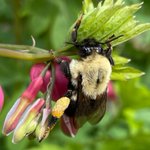
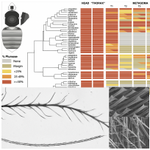


A new collaborative paper with the Tian lab showing an abdominal Hox genes locus is a hotspot repeatedly targeted for bumble bee coloration, but a Hox ncRNA is involved: academic.oup.com/mbe/article…

A new study by the lab shows heat response in bumble bees is impacted by many factors: Variance in heat tolerance in bumble bees correlates with species geographic range and is associated with several environmental and biological factors onlinelibrary.wiley.com/doi/…


Wonder where bumble bee queens go at night when they haven't found a nest? Videos from our owl box show a queen going in at sundown, not moving all night, and leaving at dawn: going to bed - youtu.be/BHTISFIBkic
waking up - youtu.be/AQ2o6mxbgks
Many bumble bee queens (B. impatiens, B. perplexus, B. bimaculatus) were buzz pollinating my bleeding hearts and dead nettle last week, but this week the garden is quiet...the late-May incubation lull

Just published by our lab: Local habitat type influences bumble bee pathogen loads and bee species distributions academic.oup.com/ee/article-…
Why are bumble bees so furry? We just published a study describing the diversity and evolution of setal types that coat these bees @PeerJLife peerj.com/articles/14555 #Biodiversity #Entomology

Article featuring an ant-gall mutualism (and my sons discovery of it) led by our gall group here at PSU
psu.edu/news/research/story/…

Hines Lab retweeted

It’s that time of year again! Do you or someone you know want to chase bumble bees this summer? We are looking for field techs to work in both NC and PA. DM me if you have questions!
psu.wd1.myworkdayjobs.com/en…
The lab is recruiting a postdoctoral researcher and graduate student for genetic research on mimetic color diversity in bees. Lots of fieldwork planned for 2022! If interested, please inquire! hineslab.org
The Hines Lab is recruiting a grad student and postdoc to perform research on the evolutionary genetics of repeated evolution of mimetic coloration bumble bees. Includes field trips, bbee rearing & devo, and genomics/transcriptomics. hineslab.org/blog/
Hines Lab retweeted

Our new paper with @DashSajal solves a problem in everyday bioinformatics; no need to rerun the entire BLAST job when db changes! Use iBLAST that searches only on incremental db, recomputes e-values to update results;(1 + δ)/δ times faster than NCBI BLAST! journals.plos.org/plosone/ar…

Hines Lab retweeted

Let’s give a final goodbye to Bombus fernaldae 👋🏼 academic.oup.com/isd/article…

Hines Lab retweeted
Are you an undergrad looking for a summer field tech job? Do you know an undergrad who wants a field tech job? I am looking to hire someone to join me in North Carolina this summer to chase bumblebees! Feel free to dm me with questions. Heres the link:
psu.wd1.myworkdayjobs.com/en…
Hines Lab retweeted

#Bees are the most loving and caring lovers in history and they deserve to be preserved! 🐝 Check out our latest article buff.ly/2PYW0E2 on what keeps bees healthy and what makes them sick! A #lessonplan included! @PSUPollinators @Hines_Lab @PSU_Entomology @PSUScience

Hines Lab retweeted
New paper out today! A single SNP in the protein-coding sequence of transcription factor cut is associated with mutant yellow coloration in Bombus terrestris! Please RT! @Hines_Lab
nature.com/articles/s41598-0…

Our research revealing the genetics of a Bombus terrestris color mutant published today in Scientific Reports: rdcu.be/ciwNv
Study: Bumble bees lacking high-quality habitat have higher pathogen loads | via @penn_state news.psu.edu/story/643015/20…
Our new study identifies factors in landscapes influencing bumble bee pathogen loads, identifying spring floral resources as a leading factor: disq.us/t/3tlwwor