
Head of UX at @Sephora
San Francisco, CA
Joined April 2009
- Tweets531
- Following1.5K
- Followers439
- Likes816








Morning thoughts:
In the future we’ll all be product builders with different majors and minors.
AI is already letting PMs design, designers code, and engineers shape product. The lines are blurring, but real depth will still matter...
Example: In the old world, a UX redesign needed a fully staffed PM/ENG/DES squad.
In the future, a builder who majors in Design and minors in Product can get it 90% there, then tap a builder who majors in Engineering for the trickier technical pieces.
I love this take!

Writing software, especially prototypes, is becoming cheaper. This will lead to increased demand for people who can decide what to build. AI Product Management has a bright future!
Software is often written by teams that comprise Product Managers (PMs), who decide what to build (such as what features to implement for what users) and Software Developers, who write the code to build the product. Economics shows that when two goods are complements — such as cars (with internal-combustion engines) and gasoline — falling prices in one leads to higher demand for the other. For example, as cars became cheaper, more people bought them, which led to increased demand for gas. Something similar will happen in software. Given a clear specification for what to build, AI is making the building itself much faster and cheaper. This will significantly increase demand for people who can come up with clear specs for valuable things to build.
This is why I’m excited about the future of Product Management, the discipline of developing and managing software products. I’m especially excited about the future of AI Product Management, the discipline of developing and managing AI software products.
Many companies have an Engineer:PM ratio of, say, 6:1. (The ratio varies widely by company and industry, and anywhere from 4:1 to 10:1 is typical.) As coding becomes more efficient, teams will need more product management work (as well as design work) as a fraction of the total workforce. Perhaps engineers will step in to do some of this work, but if it remains the purview of specialized Product Managers, then the demand for these roles will grow.
This change in the composition of software development teams is not yet moving forward at full speed. One major force slowing this shift, particularly in AI Product Management, is that Software Engineers, being technical, are understanding and embracing AI much faster than Product Managers. Even today, most companies have difficulty finding people who know how to develop products and also understand AI, and I expect this shortage to grow.
Further, AI Product Management requires a different set of skills than traditional software Product Management. It requires:
- Technical proficiency in AI. PMs need to understand what products might be technically feasible to build. They also need to understand the lifecycle of AI projects, such as data collection, building, then monitoring, and maintenance of AI models.
- Iterative development. Because AI development is much more iterative than traditional software and requires more course corrections along the way, PMs need be able to manage such a process.
- Data proficiency. AI products often learn from data, and they can be designed to generate richer forms of data than traditional software.
- Skill in managing ambiguity. Because AI’s performance is hard to predict in advance, PMs need to be comfortable with this and have tactics to manage it.
- Ongoing learning. AI technology is advancing rapidly. PMs, like everyone else who aims to make best use of the technology, need to keep up with the latest technology advances, product ideas, and how they fit into users’ lives.
Finally, AI Product Managers will need to know how to ensure that AI is implemented responsibly (for example, when we need to implement guardrails to prevent bad outcomes), and also be skilled at gathering feedback fast to keep projects moving. Increasingly, I also expect strong product managers to be able to build prototypes for themselves.
The demand for good AI Product Managers will be huge. In addition to growing AI Product Management as a discipline, perhaps some engineers will also end up doing more product management work.
The variety of valuable things we can build is nearly unlimited. What a great time to build!
[Original text: deeplearning.ai/the-batch/is… ]

I asked ChatGPT with Vision to entertain my niece and nephew with a scavenger hunt for household items. They’re having a blast running around and pointing my phone at various things like a spoon, pillow, etc. It’s so much fun!

Andrew Birgiolas retweeted

It’s extremely difficult to do great work in fear. Fight or flight blocks logical and creative reasoning.
This is why org health is paramount, and critical to the bottom line. These things are not separate, they’re parts of the functioning whole.
Andrew Birgiolas retweeted

Underrated and underleveraged: Prototypes as the PRD — visuals shape the product roadmap rather than mostly words.
Once upon a time this was how we built great products.
Today teams often agree on what they'll build in Notion/Google docs, only to find the visual rendering of their written requirements exposes a bunch of issues they didn't anticipate.
But by then all the stakeholders have "aligned" and it's too late to tap the brakes.
This isn't the only reason why B2B/SaaS software is often bloated and unusable. But it's a significant contributor.
The best outcomes happen when roles are fluid and everyone does a bit of everything.
We should all take extreme ownership of the final product including doing whatever it takes to get it out into the world.
This quoted post is unavailable.


Andrew Birgiolas retweeted


ALT Meme titled "Tech org structures be like" showing a married couple kissing with label "Product and engineering" and another person standing beside them holding flowers with a disappointed look, labeled "Design"

Not sure if this is just an ADHD thing buuuuut
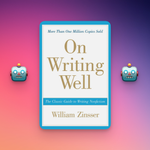
My biggest daily use for ChatGPT has been converting my rapid-fire, nonlinear stream of consciousness into clear, succinct text using:
"ZINSSER MODE."
No other prompt has come close. Obsessed.
🧵

I was curious to find the minimum viable prompt, so I tried:
"Rewrite the following in Zinsser mode:"
and it worked! It inferred my exact intent.
Remember how to spell ZinSSer and you're set for life!
Results could differ slightly but they're usually pretty close. Worth it.
I hope it's a game changer for helping you sound sharp and effective. Try it for work emails, decks, and docs where efficiency matters most!
❤️ Like it if you liked it
➕ Follow me on my product design, neurodiversity, and leadership journey
xitter.cf/HeyBirgi/status/165099…
