







There's a free open access book out now that covers advanced learning analytics methods. It's a solid find if you want to see how data science actually applies to educational tech.
The content gets into the weeds with machine learning and predictive analytics. It also explores natural language processing and how large language models fit into the picture.
You'll find specific sections on explainable AI and BERT. It looks like a useful reference for anyone building tools that need to provide personalized feedback or analyze student performance data.
xitter.cf/gp_pulipaka/status/209…
#MachineLearning #DataScience #NLP #LLM


Advanced Learning Analytics Methods — Free Open Access Book!
• Learning Analytics
• Artificial Intelligence
• Machine Learning
• Explainable AI
• Individualized Explainable AI
• Predictive Analytics
• Natural Language Processing
• Large Language Model
• BERT Language Models
• Complex Dynamic Systems
• Psychological Networks
• Recurrence Quantification Analysis
• Transition Network Analysis
• Precision Education
A comprehensive guide to advanced learning analytics combining AI, explainable machine learning, NLP, LLMs, complex systems and precision education, with step-by-step tutorial, code and datasets for applying modern analytical methods.
#BigData #Analytics #DataScience #AI #MachineLearning #IoT #IIoT #PyTorch #Python #RStats #TensorFlow #Java #JavaScript #ReactJS #GoLang #CloudComputing #Serverless #DataScientist #Linux #Books #Programming #Coding #100DaysofCode
Free Complete Book — Springer:
geni.us/Advanced-Learning
Amazon Book:
geni.us/Advanced-Methods

Setting up a heavy orchestrator like Airflow is often overkill for simple automation tasks. If you just need to wrap your scripts and SSH commands in a proper workflow, dagu is a solid alternative. It is written in Go and comes as a single binary with a built-in Web UI.
The tool requires no external database or message broker to function. You define your workflows using declarative YAML files. It handles cron scheduling, retries, and parallel execution without forcing you to rewrite your business logic. It runs on Linux, macOS, and Windows.
You can trigger shell commands, Docker containers, or Kubernetes Jobs directly. The project even includes an MCP server for inspecting runs and applying changes via AI tools. It is a great fit for teams that want production grade scheduling on limited hardware resources.
github.com/dagucloud/dagu
#DevOps #Golang #SelfHosted #Workflow

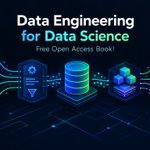
There is a free open access book covering the intersection of data engineering and data science. It is a solid resource if you need to understand how these two fields actually fit together in a real production environment.
The text goes deep into the full lifecycle. You will find chapters on data integration and fusion plus specific sections on data governance. It covers the stuff that usually breaks when you try to move a model from a notebook to a server.
It also gets into the hardware and architecture side of things. There is detailed info on CPU and GPU setups along with MLOps pipelines and federated learning. It even digs into time series data and feature selection methods.
This is a great reference for anyone building ML pipelines or managing complex data flows. Having all these topics in one open source volume saves a lot of time spent hunting through documentation.
xitter.cf/gp_pulipaka/status/209…
#DataEngineering #DataScience #MLOps #MachineLearning

Data Engineering for Data Science — Free Open Access Book!
• Data Engineering
• Data Science Lifecycle
• Data Governance
• Data Integration
• Data Fusion
• Feature Selection
• Time-Series Data
• MLOps & ML Pipelines
• CPU–GPU Architectures
• Federated Learning
• Explainable Machine Learning
• Data Lakes
• Adversarial Learning
• Fraud Detection
• Approximate Inference
• Traffic & Trajectory Analytics
A comprehensive guide to the modern data engineering stack from governance, integration and scalable processing to MLOps, federated learning, explainable AI, data lakes and advanced analytics.
#BigData #Analytics #DataScience #AI #MachineLearning #IoT #IIoT #PyTorch #Python #RStats #TensorFlow #Java #JavaScript #ReactJS #GoLang #CloudComputing #Serverless #DataScientist #Linux #Books #Programming #Coding #100DaysofCode
Free Complete Book — Springer:
geni.us/DataEngg-DSci

Mobile testing usually involves fighting with flaky drivers and complex setups. Maestro changes that by using a single binary that works across Android, iOS, and web. It drives apps through the accessibility layer and uses simple YAML files to define every test flow.
The project includes a built-in MCP server so you can connect it to coding agents like Claude or Cursor. This allows your agent to control a live device, inspect the screen, and verify its own work. It handles the taps and scrolls while you focus on the logic.
It is framework agnostic and works for React Native, Flutter, or native builds. You can run these flows on emulators, physical devices, or browsers. There is also a visual IDE called Maestro Studio for building tests without writing code manually.
github.com/mobile-dev-inc/Ma…
#MobileDev #SoftwareTesting #OpenSource #Kotlin

Expo just dropped a repo called expo/skills to help AI agents handle mobile dev workflows. It gives agents focused knowledge on Expo APIs and EAS constraints so they stop hallucinating mobile architecture.
You can use the tool to generate native-feeling Expo Router screens or set up EAS workflows for pull request previews. It also helps with SDK upgrades and monitoring EAS Update rollouts for health checks.
It works with Claude Code as a plugin or via a CLI for agents like Cursor and Windsurf. You just install the skills in your project root and your agent picks up the context.
The project is basically a bridge between the official docs and your LLM. It helps agents apply React Native and Android or iOS rules correctly without you having to copy-paste documentation constantly.
github.com/expo/skills
#Expo #ReactNative #AI #MobileDev

There's a massive batch of paid technical courses currently available for free to the first 4500 people who sign up. It covers the core stack most of us are trying to master right now.
You can find tracks for Python, data science, and big data. They also included materials for AWS certification and ethical hacking if you're looking to branch out into infrastructure or security.
The AI specific section is pretty deep. It covers prompt engineering, machine learning, and specific workflows for Claude, ChatGPT, and Grok. Grab these before the seat limit hits.
xitter.cf/Jerin_AI/status/209856…
#Python #MachineLearning #AWS #ArtificialIntelligence


All Paid Courses (Free for First 4500 People)
𝗣𝗮𝗶𝗱 𝗖𝗼𝘂𝗿𝘀𝗲 𝗙𝗥𝗘𝗘 (PART - 1)
1. Artificial Intelligence
2. Machine Learning
3. Prompt Engineering
4. Claude,Chatgpt,Grok
5. Data Analytics
6. AWS Certified
7. Data Science
8. BIG DATA
9. Python
10. Ethical Hacking
(72 Hours only )
Like + RT + comment ' Drive '
Must Follow me so I can DM you.

Managing IT infrastructure and service desks usually requires a pile of expensive licenses. GLPI is a free alternative that handles asset management, data center tracking, and ITIL service desk tasks in one place. It covers everything from software auditing to hardware lifecycles.
The tech stack is straightforward for most web devs. It runs on PHP and needs a standard web server like Nginx or Apache. For the database, you will need MariaDB 10.11 or MySQL 8.0 at a minimum. It relies on standard PHP extensions like bcmath for QR codes and curl for remote inventory agents.
It includes native dynamic inventory management and full support for incident, problem, and change management workflows. There is also a built-in knowledge base and contract tracking system to keep your documentation and vendor relationships organized.
github.com/glpi-project/glpi
#OpenSource #ITSM #SysAdmin #PHP

Building a game solo with AI often leads to messy code and zero structure. This new project turns a single Claude Code session into a full studio environment. It uses Shell scripts to organize your workflow just like a professional dev team.
The setup includes 49 specialized agents and 73 unique skills. It mimics a real studio hierarchy with directors to guard the vision and specialists for hands-on tasks. You get dedicated agents for design review and QA to catch mistakes early.
It relies on custom slash commands and a specific project structure to keep everything coordinated. The system adds quality gates so you don't end up with spaghetti code or broken logic. It’s a solid way to manage complex game projects without losing control.
github.com/Donchitos/Claude-…
#GameDev #ClaudeCode #AI #SoftwareArchitecture

Building a career as an AI engineer feels overwhelming because the field moves so fast. Most people get stuck trying to learn every single thing at once. The secret is following a structured roadmap that starts with basic programming instead of diving straight into complex models.
You need a solid foundation in Python and object oriented programming before you touch anything else. Managing your code with Git and platforms like GitHub is also non negotiable. It makes your workflow predictable and lets you collaborate on real projects.
Don't skip these fundamentals to chase the latest hype. Mastering the core tools first will make learning the actual AI concepts much easier later on. It is about building a path from total beginner to someone who can ship real software.
xitter.cf/AdarshChetan/status/20…
#AI #Python #SoftwareEngineering #CareerPath


AI Engineer Roadmap: From Beginner to Building Real-World AI
Want to become an AI Engineer but don’t know where to start?
Don’t try to learn everything at once. Follow a structured path 👇
1️⃣ Programming Fundamentals
Start with the foundation:
* Python basics & OOP
* Git & GitHub
* SQL
* Data Structures & Algorithms
2️⃣ Mathematics for AI
Build enough mathematical intuition to understand models:
* Linear Algebra
* Calculus
* Probability
* Statistics
* Optimization
3️⃣ Data Analysis
Learn how to work with real-world data:
* NumPy & Pandas
* Data Cleaning
* Data Visualization
* Exploratory Data Analysis (EDA)
4️⃣ Machine Learning
Understand how machines learn from data:
* Linear & Logistic Regression
* Decision Trees & Random Forest
* SVM
* K-Means & PCA
* Feature Engineering
* Model Evaluation
* Hyperparameter Tuning
5️⃣ Deep Learning
Move from traditional ML to neural networks:
* Neural Networks
* Activation & Loss Functions
* Forward & Backpropagation
* Optimizers
* TensorFlow / PyTorch
6️⃣ Computer Vision
Learn how AI understands images:
* OpenCV
* CNNs
* Image Classification
* Object Detection
* Segmentation
* Transfer Learning
7️⃣ NLP
Teach machines to work with language:
* Text Preprocessing
* Tokenization
* Embeddings
* RNNs & LSTMs
* Transformers
* BERT & GPT Models
8️⃣ Generative AI
This is where modern AI development gets exciting:
* LLM Fundamentals
* Prompt Engineering
* Embeddings
* RAG
* Vector Databases
* Fine-Tuning
* AI Agents
* Multi-Agent Systems
9️⃣ AI Frameworks & Tools
Turn concepts into applications:
* LangChain
* LangGraph
* LlamaIndex
* Hugging Face
* Ollama
* OpenAI APIs
* Gemini APIs
🔟 MLOps & Deployment
A model isn't useful if you can't ship it:
* FastAPI
* Streamlit
* MLflow
* Model Monitoring
* CI/CD
* AWS / GCP / Azure
1️⃣1️⃣ Build Projects
Projects are the most important part.
Build things like:
* AI Chatbot
* RAG Application
* AI Resume Analyzer
* Recommendation System
* Image Classification App
* AI Agent
* Multi-Agent Application
* End-to-End AI Product
1️⃣2️⃣ Advanced Topics
Once your fundamentals are strong:
* LLM Fine-Tuning
* LoRA & QLoRA
* Model Quantization
* Reinforcement Learning
* Distributed Training
* AI Safety
-🎯 The ultimate learning path
Python → Math → Data Analysis → Machine Learning → Deep Learning → NLP → Generative AI → AI Agents → MLOps → Deployment → Real-World AI Products
The goal isn't to collect certificates.
The goal is to build. Ship. Iterate. Repeat. 🚀
Save this roadmap and use it as your AI Engineering checklist.
Do Follow @Adarschetan on LinkedIn & X for more AI roadmaps, tools, and practical content.

NVIDIA just dropped Dynamo, a distributed inference serving framework written in Rust. It handles LLM serving across multiple GPUs or nodes at datacenter scale. The project focuses on efficiency by disaggregating prefill and decode steps so you can scale them independently.
One of the standout features is KV-aware routing. This helps you avoid redundant prefill computations by sending requests to the right nodes. It also includes a Kubernetes Inference Gateway plugin that handles this routing logic directly inside your standard K8s setup.
The framework aims to hit latency SLAs while keeping your total cost of ownership low. It supports fast cold-starts for new replicas and automatic scaling. If you need to coordinate complex inference workloads across a large cluster, this is worth a look.
github.com/ai-dynamo/dynamo
#Rust #LLM #Kubernetes #Inference

You don't need a two year degree or a massive 500 hour course to master agentic workflows. Spending years studying theory is a waste of time when the tech moves this fast. The real way to get ahead is to understand the core logic of how these systems function and then just start building.
Andrew Ng released a specific course that covers the foundations of AI agents. It focuses on how these models actually work under the hood without the fluff. It is a solid shortcut for anyone trying to bridge the gap from basic prompting to building autonomous tools.
Learning by doing is the only way to stay relevant in this space. Practical implementation beats academic theory every time. Grab the resource below and start shipping your own agentic systems instead of waiting for a certification to tell you that you are ready.
xitter.cf/HarshBisen143/status/2…
#AIAgents #MachineLearning #SoftwareEngineering #GenerativeAI


Don’t waste 2 years learning how to become an AI agentic engineer in 2026.
You don’t need another 500-hour course.
You need to understand how AI agents actually work — and start building.
Andrew Ng, one of the pioneers of modern AI, has a complete course that walks through the fundamentals of AI agents from scratch.
And it’s FREE.
Here’s what you’ll learn:
• 00:00 — AI agent basics
• 12:12 — Agentic workflows & design patterns
• 53:27 — Practical tips for building AI agents
• 1:20:30 — Self-improving AI agent loops
• 1:30:19 — Multi-agent AI systems
The most valuable part isn’t memorizing concepts.
It’s understanding the mental models behind agents:
→ How agents reason and plan
→ How they use tools
→ How workflows can be chained together
→ How agents can evaluate and improve their own outputs
→ How multiple agents can collaborate on complex tasks
I watched it last night.
And halfway through, I realized something:
The gap between “I want to work in AI” and “I can actually build AI systems” is much smaller than most people think.
You don’t necessarily need years of theory before you start.
You need the fundamentals.
Then you need to BUILD.
Start with something simple:
→ A research agent
→ A coding agent
→ A customer-support agent
→ A data-analysis agent
→ A multi-agent workflow
Build one.
Break it.
Improve it.
Build another.
That’s how you turn AI knowledge into an actual skill.
And if your goal is to work at companies like Anthropic, OpenAI, Google DeepMind, or other AI startups, understanding agentic systems is becoming increasingly valuable.
So don’t just bookmark this and forget about it.
Watch the course.
Take notes.
Build your first agent this week.
Then build 10 more.
Your future AI career won’t be built by watching courses.
It’ll be built by shipping systems.
🔖 Bookmark this.
🤖 Watch the course.
💻 Build your first AI agent.
Running massive MoE models usually requires a cluster of expensive GPUs. Colibrì changes that by letting you run frontier models like GLM-5.2 or Kimi K3 on the hardware you already have. It is written in pure C with zero dependencies.
The engine treats VRAM, RAM, and NVMe storage as a single hierarchy instead of separate silos. It uses a JIT for weights and streams experts from disk based on routing heat. This means you can run a 744B model even if you lack the VRAM to fit it all at once.
It handles heterogeneous execution across CPU, CUDA, and Metal. The project uses batched expert unions and overlapped reads to keep things moving. You get token-exact validation to ensure the model output stays accurate even when memory is tight.
github.com/JustVugg/colibri
#LLM #OpenSource #MachineLearning #CPP

Stanford just uploaded their complete CS221 Artificial Intelligence curriculum to YouTube for everyone to access. This is the exact course that helped train the engineers currently leading major AI labs and building the latest frontier models.
You can now dive into the same technical foundations used by top devs at the most competitive companies in the industry. It covers everything from search and logic to machine learning and graphical models. It is a rare chance to get an elite education without the massive tuition bill.
It is definitely worth checking out if you want to understand the math and theory behind the tools we use every day. Having this kind of high level academic content available for free is a win for the whole dev community.
xitter.cf/cyrilXBT/status/209829…
#ArtificialIntelligence #Stanford #MachineLearning #ComputerScience


STANFORD JUST PUT ITS ENTIRE ARTIFICIAL INTELLIGENCE CURRICULUM ON YOUTUBE FOR FREE.
CS221.
The same course that produced engineers now running AI labs, building frontier models, and getting paid $500,000 a year at the companies everyone is trying to work for.
Most people have never heard of it.
The ones who have are not telling you about it.
Here is what the course actually covers:
Search algorithms. The mathematical foundation behind every AI that finds optimal solutions in complex environments.
Constraint satisfaction. How AI reasons through problems with thousands of interdependent variables simultaneously.
Markov decision processes. The probabilistic framework behind every AI agent that makes sequential decisions under uncertainty.
Machine learning from first principles. Not how to use sklearn. How the math actually works underneath it.
Neural networks. Built from the ground up before jumping to applications.
Logic and knowledge representation. How AI systems reason about the world formally.
Natural language processing. The foundation of everything happening in LLMs right now.
Robotics and computer vision. How AI perceives and acts in physical environments.
Every concept that powers every AI product you use daily is in this curriculum.
Not a surface level overview.
The actual mathematics. The actual algorithms. The actual reasoning.
This is what separates engineers who build AI from operators who use it.
Stanford charged $60,000 a year for students to sit in this classroom.
They put the whole thing on YouTube.
Bookmark this before you open any other AI resource today.
Setting up an autonomous trading agent just got a lot easier for TypeScript devs. CloddsBot is a self-hosted terminal built on Claude that covers over 1000 markets. It handles everything from Polymarket and Kalshi to Solana DEXs and five different EVM chains.
Getting started only takes a simple npm install command. The project includes an onboarding wizard that walks you through your credentials setup. Once you're in, it can fetch live 15-minute BTC prediction markets from Polymarket in real-time.
The interface feels familiar because it uses a Claude-style sidebar with tabs for chats, projects, and code. You can organize your different trading conversations into specific project folders. It even includes an agent commerce protocol for machine-to-machine payments.
github.com/alsk1992/CloddsBo…
#TypeScript #TradingBot #OpenSource #Blockchain

Handling inference at scale on Kubernetes usually turns into a configuration mess. KServe acts as a standardized platform to deploy both generative and predictive models without reinventing the wheel. It handles the heavy lifting for frameworks like PyTorch, TensorFlow, and XGBoost.
The project really shines with its support for optimized backends like vLLM. You get an OpenAI-compatible inference protocol out of the box. This makes it much easier to swap models or integrate with existing LLM tools without rewriting your client code.
Resource management is baked in with request-based autoscaling. It supports scale-to-zero for predictive tasks and handles GPU acceleration for large models. It also uses KV cache offloading and model caching to keep latency low.
You can manage complex workflows using canary rollouts and InferenceGraph for pipelines. It simplifies the jump from a local model to a production grade service on a cluster.
github.com/kserve/kserve
#Kubernetes #MachineLearning #LLM #DevOps

Matt Mullenweg claims he is back in control as CEO of Automattic only days after the board voted to oust him. The situation shifted fast after the board initially put him on paid leave and named CFO Mark Davies as interim lead. Employees confirmed seeing a Slack message where Mullenweg announced the board is back in agreement.
There is plenty of chaos behind the scenes at the WordPress parent company right now. Sources say Mullenweg removed all other Slack admins and that the interim CEO account was deactivated. It follows a weird stretch where he posted about being a pirate and asked for help moving his personal data off company servers.
The official status is still murky because the board has not released a formal statement to staff yet. Mullenweg seems to be lean into the drama by posting music videos and dismissive comments about the situation. We are waiting to see if this is a legitimate return to power or just a very public fight for control.
techcrunch.com/2026/09/11/ma…
#WordPress #Automattic #TechNews #OpenSource

Keeping project context straight when switching between repos or chat sessions is a massive headache. You usually end up re-explaining the same architectural decisions to your AI agent every single time. OpenContext solves this by acting as a personal knowledge store that gives your assistants persistent memory.
The project works with the tools you already use like Cursor, Claude Code, and Codex. It includes an MCP Server so these agents can call the store as a tool to load, search, or update information. You get a global library for your docs and manifests without needing a new agent subscription.
It comes with a CLI for managing the library and a desktop app for a better visual experience. You can also use the local web UI to browse your data without installing anything. It basically lets your agent load history first and persist new knowledge after shipping code.
github.com/0xranx/OpenContex…
#ArtificialIntelligence #SoftwareDevelopment #GitHub #CodingAgents

Setting up a private AI control plane is usually a headache but synaplan makes it pretty straightforward. It lets you manage various models and MCP agents through a single interface that you control. You can use it to build chat widgets for support or handle document processing using their built-in RAG search.
The project uses a smart DAG routing system to break down complex tasks into smaller steps. It sends simple jobs to cheap models and saves the heavy reasoning for expensive ones to keep token costs down. Everything stays encrypted at rest in your own database instead of sitting in plaintext files on your disk.
Updates happen instantly so you don't have to deal with restarts or rebuilds when changing settings. You'll need at least 8 GB of RAM to run it but 16 GB is better if you want to include local models. It supports plugins written in Go, Rust, Python, and NodeJS which makes it very flexible for custom workflows.
github.com/metadist/synaplan
#OpenSource #SelfHosted #AI #DevTools

The current state of AI research is getting pretty wild. While some labs are focused on solving millennium math problems, others are busy testing actual cures for cancer. The scale of these scientific breakthroughs is impressive for the industry.
Then you have Meta dropping a new AI Agent into the mix. It feels like a massive pivot from the hard science goals we see elsewhere. It raises a lot of talk about whether these tools actually solve real problems for people.
It is a strange contrast in the tech world right now. You have these massive theoretical and medical wins happening alongside product launches that might not even find an audience. We will see which approach actually sticks in the long run.
xitter.cf/jun_song/status/209790…
#OpenAI #Anthropic #Meta #ArtificialIntelligence


Google just released Agent Development Kit (ADK) for developers who prefer a code-first approach to building AI agents. It is an open-source framework that handles the orchestration and deployment of multi-agent systems. You can define your logic directly in code instead of fighting with rigid UI abstractions.
The toolkit is model-agnostic and works across Python, TypeScript, and Go. It includes a built-in ecosystem for pre-built tools and custom OpenAPI specs. You can compose multiple specialized agents into hierarchies to handle more complex tasks without losing control over the execution flow.
It also comes with native tracing and monitoring to help you debug what is happening inside the agent logic. When you are ready for production, it is built to be containerized easily for Cloud Run or GKE. It is a solid option if you want to treat agent development like standard software engineering.
github.com/google/adk-docs
#GenerativeAI #OpenSource #SoftwareEngineering #GoogleCloud
