

Live in minutes, Herald investigates novel incidents without runbooks, runs securely from a CLI and is free. Formerly RunLLM. Try now: https://xitter.cf/t.co/jeLOKlB3mX
San Mateo, CA
Joined April 2022
- Tweets576
- Following14
- Followers806
- Likes330




Your systems call the same database payments-db, payments-postgres, and cloud-sql-payments. An engineer knows it's one database. No string comparison does.
Our CTO, @cgwu0530, covered three key problems that make building a context graph for an AI SRE harder than it looks.
👉 Read the article here: tinyurl.com/mrxjxxvy
🤖 Made with AI

A backend service slows down. Within a minute, a hundred alerts fire — the gateway, the API layer, every downstream metric reporting the same failure.
Somewhere in that pile is the one alert that actually matters. Finding it under the noise is what costs on-call teams the most time.
Momento Co-Founder and CTO @dymxzvf shared her fix with our CEO @vsreekanti Sreekanti, and it isn't "alert less" or "alert more." It's alerting at the right layer.
"If the backend errors, the gateway in front of it is going to error too, because one depends on the other. Page on both as independent failures, and you've turned one problem into two."
Knowing where to place an alert also requires knowing the dependency graph underneath it — which services fail into which, and which signal actually points to something new versus which one is just an echo.
That's a hard problem for a human to hold in their head across hundreds of services. It's an even harder one for an AI SRE agent trying to decide what's worth paging someone about at 2 a.m.
👉 Read the full piece here: tinyurl.com/yvjbkfb8
🤖 Made with AI

Herald retweeted

Teams want AI to help debug the flood of AI-written code hitting prod.
That demands an always-current understanding across all infra and code.
To make sure those memories aren't lost like tears in rain, they need to rebuild new tribal knowledge.
👉 tinyurl.com/4dwswjf8

Are engineering teams actually better off with AI coding? Spoiler: nobody seems to know yet. And we made a video: "The Last Architect"
Code volume is up. Velocity is up. And token bills are definitely up.
But when @cgwu0530 talks with engineering leaders, many still cannot say whether productivity or ROI has improved, or even how they would measure it. He wrote about that recently in a post called "Winter Is Coming for AI Engineering."
But here's where it got interesting, at least when it comes to how crazy ideas take shape inside companies. At our Thursday All Hands, Kaveh Karimiyanha hosts Kaveh’s Corner, part tech-news comedy monologue, part “guess which company name is fake,” and occasionally an AI-generated song about something company or industry related.
Quick aside: Kaveh brings good energy. So Kaveh turned Chenggang’s blog post into a song. And that song was mighty catchy.
Caught up in the excitement of the moment, the marketing guy, Peter Farago, blurted out: “That’s so cool. I’ll turn it into a video!”
Several days and an unreasonable number of hours later, after rebuilding the song, rearranging lyrics, developing characters, constructing an entire visual world, and repeatedly asking AI to generate scenes that were not nonsense, here we are.
Peter looks haggard.
The result is The Last Architect, a story about token maxxing, growing review loads, code sprawl, lost context, and what happens when engineering organizations reward output volume without knowing whether the system is actually getting better.
Peter is pretty sure the video has a beginning, a middle, and an end. Either way, the song is definitely a banger.
The original post that started all of this:
Winter Is Coming for AI Engineering
tinyurl.com/2jwhus78
Herald retweeted

"We're spending about five figures a month on coding agents. I think it's making the team more productive. I'm not sure. But I think."
That's from a VP of engineering running a team of ~100. It's obvious that coding agents are faster than human engineers, but it's not obvious how you manage your spend.
For decades, the constraint on shipping software was headcount. You had N engineers, you pointed them at the highest-priority work, and you shipped what you shipped.
Today you can spend 2-3x the cost to produce the same software in a tenth of the time. The recent port of Bun from Zig to Rust took 11 days and $165k in API costs. That's obviously a net improvement over what it would have cost to have engineers do it by hand, but choosing to do that requires a new calculus.
Because faster production is not the same as better economics.
The fact that you can generate more code, faster, doesn't mean you should. Every task is now a choice: which model, how much speed, how much accuracy, how much human guidance. Get those parameters wrong and you pay a lot of money to build the wrong thing very fast.
The challenge for engineering teams has always been picking the right things to build. Agents didn't fix that problem — it's faster but just as expensive: open.substack.com/pub/fronti…
Every VP of Engineering is spending money on Claude Code or Cursor right now. Most can't say what they're getting for it.
Adoption came first. Measurement hasn't caught up. And that can't last.
Broad coding agent usage is changing the way we build and how fast we produce code. But it also comes with a variable token tax and questions about code quality.
Are we really better off, and more importantly, can we even measure it well enough to know?
Herald Co-founder & CTO, @cgwu0530, breaks down why this is happening, and why a reckoning might be closer than most budgets are ready for.
👉 Read the full post: tinyurl.com/4htjer8d

Herald retweeted
Despite the fact that no one pays attention to benchmarks anymore, models are improving at a breakneck pace.
As models get better, they will likely dominate the most obvious applications, which means that startups need to focus on problems that are harder to solve or harder to adopt.
Earlier this year, we wrote about how both hard technical problems and hard adoption problems ultimately create the same moat: data.
When you solve hard technical problems, you get more feedback on how those problems should be solved and where the models fail. This is what's made coding agents better so quickly, but the same process can be applied to other, less obvious problems.
When you solve hard adoption problems, you learn how humans fail with your agent. This might be a less obvious moat, but making your product easier to use and adopt in difficult circumstances has huge value.
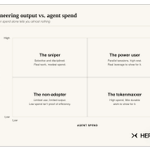
This 2x2 — technical depth and adoption complexity — helps us understand how businesses drive their growth: open.substack.com/pub/fronti…
Herald retweeted
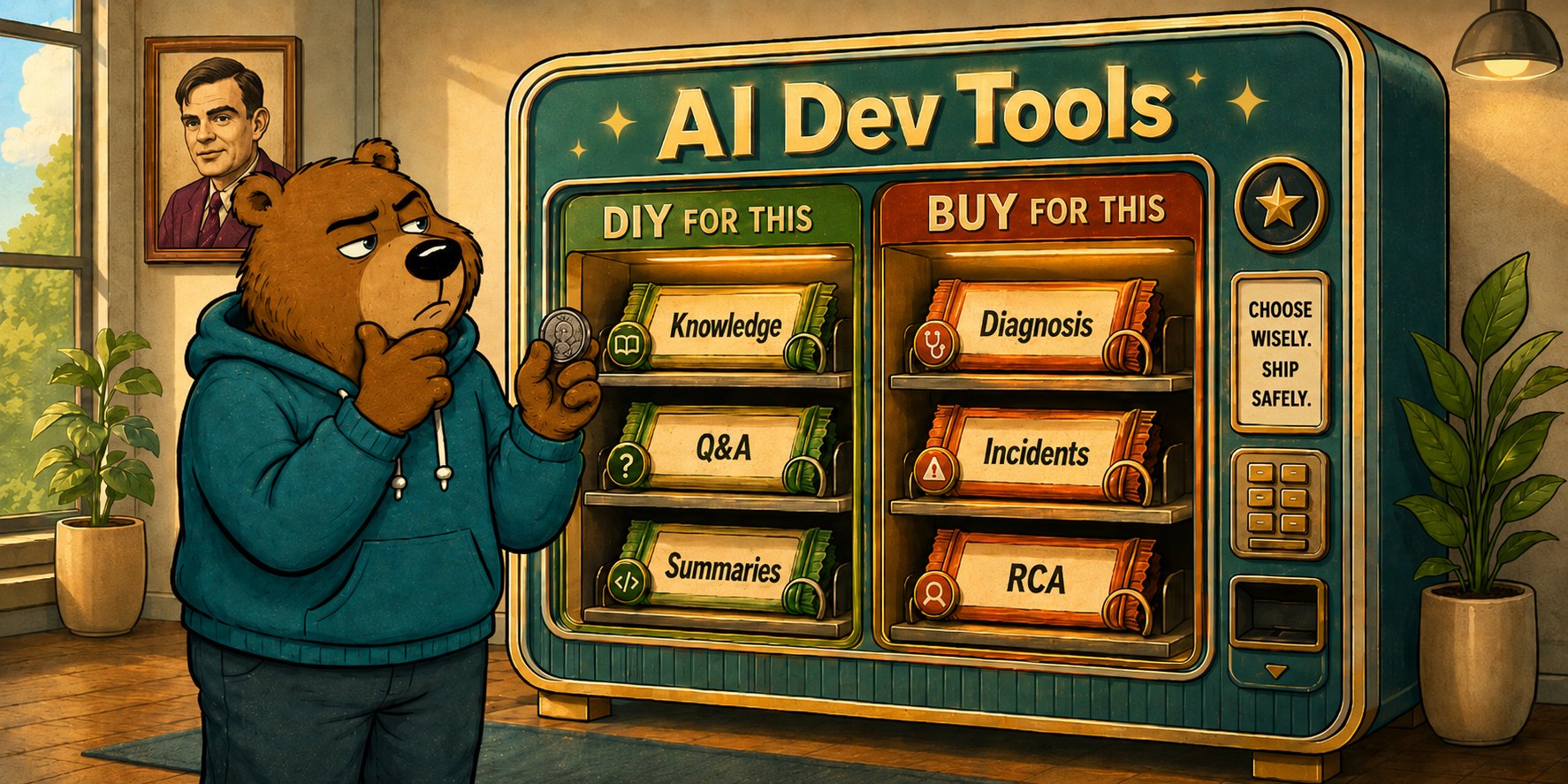
Build vs. Buy is a tension all engineering teams face, and now AI makes it easier than ever to DIY.
So when is building your own dev tool with AI a good use of the team's time, and when is it not?
👉 My thoughts: tinyurl.com/nvt8djzx
🤖 Made with AI
Herald is excited to partner with @ClickHouseDB to bring AI DevOps intelligence to every team on ClickStack, with up to $25,000 in free usage.
Now teams can reason over everything ClickStack aggregates — logs, metrics, traces, session replays, and errors — to catch incidents early, find root cause in minutes, and answer any question about their systems.
Store it all on ClickHouse. Understand it all with Herald.
👉 Read the blog post: tinyurl.com/5ck7a63w
👉 Check out the program: tinyurl.com/3t3n763h

Herald retweeted
Token leaderboards are not a great idea.
Now we're hearing about budget freezes and per-employee token limits.
Both are the same mistake.
Treating AI as one number on the budget is like treating all your salary spend as one number. Nobody does that. A staff engineer and a contractor aren't the same line, and you'd never set one headcount budget and call it strategy.
But that's exactly how most teams are handling AI right now. One bucket. One number to either brag about or panic over.
The value AI adds to shipping a feature that moves your top line is nothing like the value it adds writing cold email copy — or the value it adds when you're burning tokens recreating a tool you could have bought.
Lumping all of that together as "AI spend" is how you end up making bad decisions in both directions: tokenmaxxing to inflate the number, then slamming on the brakes when the bill scares you.
We've watched this play out. We've talked to teams blocked from spending on a tool that would solve a real problem for 1-2 orders of magnitude less than the salaries they're already paying to solve it by hand — because the "AI budget" was frozen.
The worst part is what the freeze kills: experimentation. When you cut that, you're betting the technology around you isn't changing. It is.
AI isn't a line item. It's a set of very different bets, each tied to a different part of your business. Start budgeting it that way: open.substack.com/pub/fronti…
Customer Case Study: @SnorkelAI hits 93% accuracy with Herald, no runbooks. Their demo of Herald won the team Snorkel's internal Engineering Excellence Award.
Snorkel AI connected four data sources to Herald and gave it nothing else. No runbooks. No historical root cause analyses. No Slack history.
Herald ingested all four in hours and returned its first correct root cause analysis within two days.
Their PM ran the agent through 90 real engineering tasks. It got 93% right.
In the first two weeks live in production, 27 engineers root caused 52 incidents.
Most #AIDevOps agents come with a setup tax. Weeks of writing runbooks, tagging incidents, and building a knowledge base before you see anything useful. Snorkel skipped all of it.
Kartik Mathur, Director of Engineering at Snorkel AI, co-authored the case study with Herald CEO @vsreekanti.
👉 Read the full case study: tinyurl.com/46u9c62n

Herald retweeted
Last week, a VP of Engineering told us his team had already built most of what we do.
We'd spent four meetings with the engineers who actually run reliability for him. We knew where their data lived, what systems they used, how they triaged incidents. So we knew the team was working almost entirely by hand — getting paged, spinning up channels, linking tickets manually.
He thought they were further along than they were. We knew more about the state of his org than he did.
This isn't new. Leaders have always been a few steps removed from the work. Enterprises have grown for decades despite that gap. But AI makes the gap expensive in a way it never was before.
Here's why: an agent only creates value when it conforms to how your team actually works. That requires a clear picture of the current state and a real definition of what "good" looks like. If you don't know what good is, an LLM won't tell you — it'll just help you get to the wrong place faster.
The VP was anchored on a demo built on hard-coded workflows and runbooks. It looked impressive. It also wouldn't survive contact with the complexity of his actual stack — a stack he'd partly lost track of. So the risk wasn't that he'd buy nothing. It's that he'd buy something that amplified the disorganization already there.
The fix isn't more diligence from the top. It's trusting the people doing the work to make the call. They're the ones living with the pain. They know what's worth automating and what good looks like, because they're standing in the ground truth every day.
The further you sit from that ground truth, the more likely you are to believe your team is light-years ahead — or behind — where it actually is.
That's the part AI doesn't fix for you: open.substack.com/pub/fronti…
Herald has been named to the The InfraRed 100, recognizing the top private companies defining the future of cloud infrastructure.
Thank you to the @Redpoint team for the recognition.
Want to try Herald? We now offer Herald CLI — completely free, full-featured, and up-and-running securely from your terminal in minutes.
Join the waitlist: lnkd.in/ge37zaaU
See the full list of 2026 InfraRed 100 honorees and accompanying industry report: redpoint.com/infrared/report…

RunLLM is now Herald. There's a story behind it, and it starts with a moment every engineer knows.
It's 3am, an alert fired, and you're looking at something you've never seen before, a novel incident. Your runbooks don't cover it. Your tools tell you something is wrong, but none can say why or how, or what to do about it.
For decades, that's been the deal. Something breaks, you fix it fast. Companies are pretty good at it. But it comes with real costs — alert fatigue, engineer burnout, and the moments when customers tell you something is down before you know it yourself.
So we asked a different question: what if you didn't have to wait for something to break? What if your systems could tell you what's about to go wrong, before alerts fire, before customers notice?
To herald something is to signal that it's about to happen. And that's the shift we're bringing to observability and reliability: from t₊₁ to t₋₁, where t is the moment something breaks.
To deliver on this promise, we're offering Herald CLI — a full-featured, completely free agent that runs securely on your laptop and gets up and running in minutes. Try it on your own stack to see how Herald moves you from always being behind problems to getting ahead of them.
👉 Sign up for Herald CLI early access here: tinyurl.com/2fyp4wnj
👉 Read more about the Herald brand from our CEO @vsreekanti: tinyurl.com/mvk7mnsh

Herald retweeted
Lots of exciting news to share today!
1. @RunLLM is now @Herald_Dev. The new name reflects the fact that our AI SRE is the only product on the market that operates autonomously — teaching itself about your product & infra, detecting early warning signs of incidents, and investigating without runbooks. Read more: herald.dev/blog/heralding-th…
2. Herald was named to the InfraRed 100, an annual list recognizing the most promising private companies defining the future of cloud infrastructure. Thanks to Redpoint for the recognition!
3. We're releasing the beta of the Herald CLI — an agent that runs securely on your laptop and gets up and running in minutes. Sign up for early access here: herald.dev/cli

The Redpoint InfraRed 100 is now live.
These are the companies building the infrastructure that powers everything happening in AI right now, from world models and agent runtimes to the sandboxes, databases, and security tools agents depend on.
Congratulations to this year's honorees!
Read the full 2026 InfraRed Report: our state of the union on AI and cloud infrastructure 👉 redpoint.com/reports/the-inf…

Herald retweeted
Why do on-call engineers often ignore expensive AI tools during incidents? I wrote about what's broken and what it takes to fix it: tinyurl.com/y9e3k93n
