

Data Scientist | RTing quality content for continuous learning | Opinions my own
Indonesia
Joined March 2009
- Tweets8K
- Following221
- Followers494
- Likes373






Hendra respati retweeted

Seminggu ini gue hiatus dari X karena lagi banyak ngerjain project marketing klien wkwk. Asli sekarang kalo lo ngerti marketing gampang banget dapet kerja, especially sama klien di US.
Literally demand cracked marketers jauh lebih tinggi daripada supply-nya. Kalo ga percaya coba lo cek job portal.
This is just the beginning. 3-5 tahun lagi menurut gue kerjaan full stack marketing bakal meledak dan bayarannya gede, kayak kerjaan full stack dev di era ZIRP kemarin.
Kalo lo mau switch karir ke marketing di era AI, ini yg harus lo pelajari:
> Meta Ads + MCP. Belajar setup campaign dan baca hasil per creative. Pakai MCP buat set up campaign dan narik report, terus cari iklan mana yang layak ditambah budget dan apa yang perlu dites berikutnya.
> Programmatic content. Bikin workflow yang bisa ngolah satu ide jadi post teks, video pendek, dan carousel. Pakai workflow itu buat ngetes beberapa angle biar bisa scale. Pelajarin UGC, explainer, song ads.
> Data analytics. Belajar pasang tracking dari klik sampai pembelian. Kalau penjualan seret, lo harus bisa bedain masalahnya di iklan, landing page, atau checkout.
> Marketing end-to-end. Ambil satu produk. Riset siapa yg mau beli, susun offer, bikin creative, jalanin campaign, lalu ukur berapa penjualan yang masuk dan berapa biaya buat dapet satu customer.
Coba praktekin buat produk lo sendiri. Atau kalo lo males handle product, lakukan ini untuk produk affiliate. Hasilnya lo jadiin case study buat modal apply kerja dan interview.
Good luck!


Hendra respati retweeted

Dulu pas mulai join Sayurbox teamnya masih kecil (sekitar 9 orang). Engineering culturenya cukup lawas waktu itu
⌛ Deploy sebulan sekali
🫡 Pas deploy harus ceremony besar. PM, engineer, QA, devops ngumpul
🌒 Terus upacara ini dilakukan jam 10 malem, biar pas traffic kecil
📝 Ga ada code review jadi engineer juga ga jadi makin pinter
🤔 Kerjaannya sebelum dikoding ga dikomunikasikan dan didokumentasikan jadi banyak questionable architecture choices
At that moment aku tau aku harus menculik expert, ASAP. Can’t build a culture from nothing. Harus mulai dari orang yang pernah kerja di kumpeni yang culturenya bagus. Kumpeni yang culture engineeringnya arguably better than most unicorns back then. Di sana aku menculik orang2 ex-Sale Stock, @achmadmahardi dan @husniadil
Disana kita ngajarin cara kerja remotely yang efektif dan efisien
🔀 Async communication
📚 RFC engineering document sebelum ngoding
🪵Trunk-based development
🛠️ CI/CD
🔄 Misahin release dan deployment
🚦 Feature flags, gradual releases
🎛 Observability
Kita mulai culture infiltration-nya dari team kecil dulu (isi 3 orang). Dari team yang isinya junior2 - karena senior seringnya bebal dan ga mau diubah (apalagi team India)
Ketika junior mulai kerasan dengan cara kerja yang baru, lama2 yang senior jadi kena peer pressure untuk ngikut cara kerja yang baru. Lalu semua team lama2 jadi mengadopsi cara kerja baru. Dan kita sebagai leader pun mulai mendapatkan track record untuk bisa mengubah team menjadi ke arah yang lebih baik. Start accumulating social capital
Key takeaways:
1. Sebagai leader kita bisa mendikte dan mengkultuskan sebuah value dan culture. Tapi ga akan terjadi kalau kita sendiri dan team tidak mempraktekkan itu. Value menjadi culture ketika dipraktekkan, bukan ketika dibacotkan
2. Ketika join kumpeni. salah satu cara biar bisa mengubah culture yang udah ada membawa orang2 yang breathe and execute cultures yang mau kita eksekusi
3. Start small, dan start dari orang2 yang mudah diubah. Biasanya ini artinya start dari yang junior dulu. Tapi even better kalo ada senior yang masih bisa diajarin, karena mereka influencenya biasanya lebih besar sehingga kulturnya lebih gampang tersebar

@salestockindonesia beralih ke #GoogleCloud untuk membantu mengoptimalkan teknologi mereka.
CTO Garindra Prahandono, berbagi bahwa dengan pindah ke GCP, mereka kini lebih efisien dalam biaya dan infrastruktur serta struktur organisasi pun lebih simpel.
#GoogleCloudSummit


Hendra respati retweeted

Meta.
Google.
Microsoft.
These companies have spent years engineering faster vector-search systems.
A basic nearest-neighbor query computes the distance between the query and every stored vector.
Its cost grows linearly with the size of the database and becomes impractical across millions of candidates.
Every vector index reduces this computation differently, using clustering, graph traversal, compression, or a combination of these methods.
Here are five common approaches:
1. Flat index
A Flat index compares the query with every stored vector, selects the K smallest distances, and returns them.
It performs an exact search, so it is useful when accuracy matters and the dataset is small enough to scan.
The query cost grows linearly with the number of stored vectors.
2. IVF
IVF divides the vector space into clusters. Each stored vector is assigned to its nearest cluster centroid.
At query time, the database finds the closest centroids and searches only their clusters.
A probe parameter controls how many clusters it searches, and increasing it usually improves recall but also increases latency.
3. HNSW
HNSW stores vectors in a multilayer graph.
The upper layers contain fewer nodes and allow large jumps through the graph. Lower layers contain more nodes and support a finer search.
A query starts at the top, moves toward closer nodes, and descends through the layers. HNSW often provides low latency and high recall, but the graph requires extra memory.
4. IVF-PQ
IVF-PQ combines clustering with product quantization.
IVF limits the search to a few relevant clusters. Product quantization splits each vector into smaller parts and stores compact codes for them.
Comparing these codes is cheaper than comparing full-precision vectors. This reduces memory use and query cost, with some loss in recall.
5. ScaNN
ScaNN partitions the dataset and stores quantized vector representations.
During search, it selects relevant partitions, scores compressed candidates, and recalculates more accurate distances for the strongest candidates.
This makes it suitable for large datasets where throughput matters.
The choice depends on the system constraints.
- Flat prioritizes exact results.
- HNSW trades memory for speed.
- IVF provides direct control over the amount of search work.
- IVF-PQ and ScaNN reduce the memory and compute required for large collections.
Choosing an index requires deciding what your system can afford to trade.
For a concrete example, I previously explained how binary quantization can make RAG search 32x more memory-efficient while querying over 36 million vectors in under 30 ms.
Read it below.


Hendra respati retweeted

This might be the most useful paper on AI agents this year.
A team at Wavestone AI Lab took apart Claude Code, Codex and 9 more and found the 7-part blueprint every good agent is built on.
Their definition: an agent is a model plus a harness. All 11 agents build the harness from the same 7 parts. Only the size changes.
> Loop: Mini-SWE-Agent is a plain while loop. OpenHands logs every event so a run can be replayed
> LLM layer: one prompt template on one side, 29 provider profiles on the other
> Tools: some agents only have bash, the biggest has 43 typed tools loaded on demand
> Memory: from keep-the-whole-history to notes the agent maintains across sessions
> Safety: from a simple step limit to policy rules plus a reviewer model plus an OS sandbox
> Orchestration: Aider skips sub-agents on purpose, others fork them with their own context
> Extensions: hooks, skills and MCP. SKILL.md is in 9 of 11, MCP in 8
The paper ends with a 90-line harness covering all 7 parts, a solid starting point for your own.
Key pages:
> p.4: the 7-part map
> p.12: the 3 loop types, with Claude Code and Codex as examples
> p.53: why none of them use frameworks or embeddings
> p.67: 18 design recommendations
> p.71: the 90-line harness you can copy


Hendra respati retweeted

🚨NEW Whitepaper on AI Agents by OpenAI
The maker of ChatGPT shares how it builds AI Agents.
Get the 34-page white paper here:

Hendra respati retweeted

I don't understand why everyone isn't doing this yet. Anthropic released a guide for Claude that makes work much more efficient while burning a fraction of the tokens
Main Idea: Agent Teams in Claude Code
Instead of burning the expensive Opus 5.5 context on every line of code, tasks are delegated across an autonomous swarm:
Architect (Opus 5.5, high effort): Plans the structure and handles final PR merges
Developers (Sonnet 5.5, medium effort): Write code inside isolated git worktree environments (UI/UX, backend)
Adversary / Critic (Fable 5.1): Steps in at contract boundaries, recurring test failures, and pre-PR audits to catch vulnerabilities
Script Layer (Jev): Handles mechanical tasks (opening files, CLI invocations) in 16ms without involving LLMs
Launch the team via terminal:
claude --teammates ux,backend,adversary
Configure my Claude Code workspace for autonomous agent teams:
In ~/.claude/teams, generate missing roles: set workers to Sonnet (medium effort) in separate git worktree branches, and the adversary to Fable
In ~/.claude/settings.json, set CLAUDE_CODE_EXPERIMENTAL_AGENT_TEAMS=1 and lock the main session to effortLevel: high
Initialize tasks.json with file-level locking for direct peer coordination
In CLAUDE.md, add a rule requiring an adversary review before opening a PR.
Show configuration diffs before applying edits
> code.claude.com/docs/en/advi…


Hendra respati retweeted

Uber publicó cómo armó su infraestructura de MCP y hay varias ideas muy buenas acá.
imaginate una empresa con miles de servicios internos y muchos equipos conectando agentes a esos sistemas por su cuenta.
cuando eso empieza a crecer, terminás con tooling fragmentado, infra duplicada, distintas formas de exponer tools y poca consistencia en seguridad, discovery y operación.
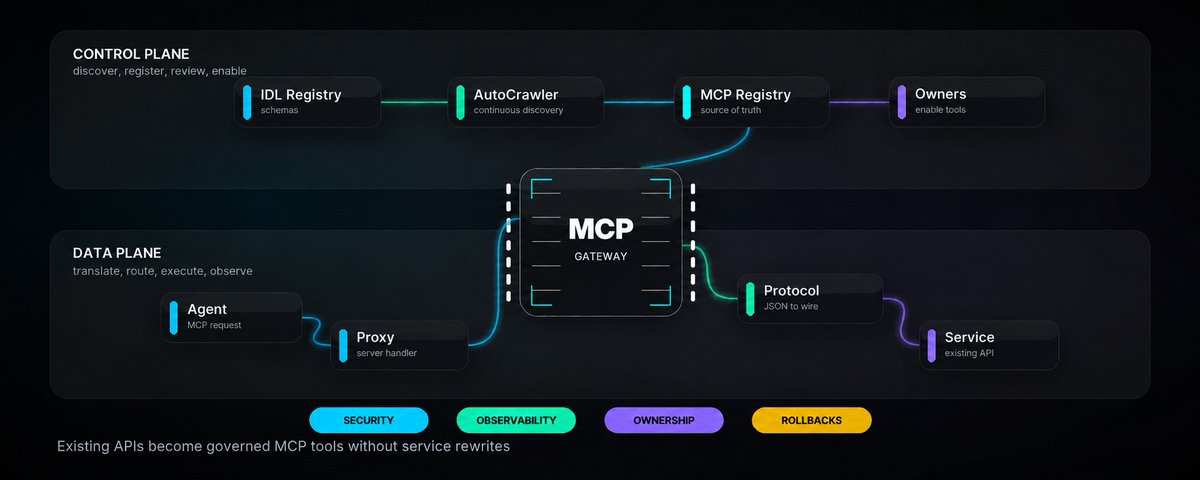
por eso Uber hizo un MCP Gateway: una capa central entre los agentes y sus servicios internos.
el agente habla MCP y el gateway se encarga de routing, permisos, ejecución y de traducir las llamadas a HTTP, gRPC o TChannel según corresponda.
como Uber ya tenía miles de APIs internas, también hicieron AutoCrawler: recorre sus definiciones, detecta métodos y schemas y genera MCP tools automáticamente. incluso usan un LLM para mejorar las descripciones.
hoy tienen +800 MCP servers y +5000 tools. y ahí aparece otro problema: no podés cargar todas esas definiciones en el contexto del modelo.
para eso crearon Omni MCP. en vez de pasarle miles de tools al agente, este va descubriendo qué server necesita, qué tools tiene disponibles, carga el schema de la correcta y recién ahí ejecuta.
me parece un muy buen ejemplo de cómo cambia la arquitectura cuando los agentes pasan de usar unas pocas tools a trabajar con miles.
terminás necesitando algo muy parecido a un API Gateway para agentes.


Hendra respati retweeted
Dosa paling besar tech industry adalah meyakinkan orang2 bahwa di platform marketplace itu yang penting adalah technya, bukan isi dan operationalnya
Terus orang2 pada bilang "tinggal bikin app" as if tenant, marketing, operation work are not important
There's no tech winter. It was just tech bubble bursting
Hendra respati retweeted
🚚 Jadi Gogo bikin 400+ commit per hari itu ngapain sih?
💩 And is that shit commits?
💾 Tiap save file di-commit?
📊 Emang ada hasilnya?
Awal 2025, semua orang masih pada pake Cursor/Windsurf. AI ngoding, kita review. Kita liatin itu kode satu-satu. Apapun yang masuk ke main branch kita perhatiin. Di sini kita kerja kaya mid level/senior engineer, jagain kerjaan intern dan junior engineer sambil kadang2 masih ngulik dikit2 untuk bagian2 yang kritikal yang kita ga terlalu percaya bisa dikerjain sama junior atau intern
Lalu akhir 2025, ketika Claude 4.5 rilis. Claude Code mulai mendapatkan traction yang signifikan. Di sini role kita berubah menjadi senior/staff engineer. Coding udah jadi kayak bernapas. We don't even think about it. Coding is just a means to an end. We start thinking in systems, not in code
Lalu awal 2026 muncul harness engineering, loop engineering, and eventually graph engineering. Di sini kita mulai kerja kaya TLM, engineering manager, then senior engineering manager. Ngurusin team of agents directly. Nyuruh mereka bikin fitur, nyuruh mereka refactor sampe beres, nyuruh mereka migrasi
Sekarang aku personally sedang kerja kaya Engineering Director
- We decide what metrics are important. Latency? Cost? Activation? User registration?
- Toolsnya apa aja? Ada feature flag? Boleh deploy terus2an atau sehari sekali? CI/CD?
- Kita bolehin gerakin metricsnya gmn? TDD cukup kah? Eksperimen ke end-user boleh ga?
- Guardrailnya apa? Apa yang ga boleh dilakukan? Testing ke user production boleh ga? Testing ke internal user boleh semua ga? Atau CEOnya bangsat jadi release ke semua internal user kecuali CEO?
- Kalo ada yang rusak policynya gmn? Revert? Kalo ada yang rusak, kita telen biar user experience enak atau kita bikin error merah gede-gede biar kita bisa cepet fix? Bagian produk mana yang error itu kritikal dan bagian mana yang kalo error yowis ae
- Gimana push product dari 80% jadi 99%? AI bisa bikin produk yang 80% bagus dengan cepat. UI-nya bagus. Bisa buat pamer, bagus buat demo, bikin orang pede "gw bisa 2 minggu u masa butuh 2 tahun?" Tapi bisnis butuh reliability, butuh hasil bagus yang konsisten, butuh governance. Dan kita ga bisa langsung dari 80% ke 99%. Butuh iterasi. Butuh beresin printilan edge cases kecil2 tapi buanyak yang baru ketahuan ketika produknya dah jalan di production. Butuh pikirin metrics2 baru yang mungkin sebelumnya ga kepikiran pas masih development. Butuh pikirin mana use case untuk semua orang, mana yang spesifik problem beberapa orang tertentu
Sehingga what matters now?
- Metrics understanding. Business metrics, product metrics, engineering metrics
- Figuring out levers and metrics that actually move the business. Just like in the Good to Great book
- Unblock Modern Engineering Practices. Observability, decouple deployment and release, feature flag, lead time to deployment, CI/CD
- Policies bergantung industri, organisasi, fase kumpeni lagi dmn, risk appetite dari management
- Be flexible on the approach and implementation. Be strict on results, metrics, verification
Kerja seperti Engineering Director
Apakah ada evolusinya? VP of Engineering dan CTO level?
Jujur, blom tau. VP + CTO itu set process, culture, hiring process, hiring bar, promotions, reward and punishment, technology standard, technology investment. Apakah AI butuh itu? So far sih ngga ya
Tapi mungkin nanti, eventually, tugas kita bukan bikin agent, tapi hire agent yang udah jadi dan sudah well-fine-tuned with strong domain expertise. Sehingga tugas kita set up organisasinya yang cocok dengan bisnis kita
Jadi jawabannya dari pertanyaan di awal:
🚚 400 commit per hari itu biasa, karena aku mengoperasikan AI-ku sebagai kumpulan product squad. I am the engineering director, not the manager, not the tech lead
💩 Ngga, tiap commit adalah satu full fitur atau eksperimen
💾 Ngga. Tiap hari aku biasanya punya 12 sesi. Per sesi spawn 1 agent, yang biasanya spawn 10-15 subagents. Masing2 subagents either dia riset, check grounding, menghasilkan sesuatu (coding, artifact), atau verifikasi (test result, screenshot, video)
📊 Iya semua sesi itu ada metricsnya ⬇️
- Cost saving (pindah dari Claude ke Deepseek. LLM cost dari $60k/month jadi $1500/month)
- Latency (dari 60sec jadi 3sec TTFT)
- Reliability (dari 60% jadi 99% delivered)
- Engagement (dari 20% jadi 50% user onboarded)
- Conversion (dari 0.8% jadi 2% converted jadi paying user)
Dan ini berlaku untuk fungsi di luar engineering juga. We can be our own marketing director, operations director, finance director. Tapi ga yakin apakah udah di level CMO, COO, CFO atau belum. I don't think so


Hendra respati retweeted

Ex-Google Jeff Dean just released 1-hour lecture on full AI engineering: LLM → prompts → agent teams → graphs from 0% to 100%:
0% → 1:45 - LLM from scratch - that made Google
30% → 17:22 - how to actually use AI models
65% → 30:03 - prompt engineering
100% → 52:35 - one human coordinating 100 agents
this is 27 years of AI in Google compressed into one hour, by the person who lived it
watch it today - then read how to build graphs in the article below ↓


Hendra respati retweeted

Hackathon hosted by @devpost …
Build with Gemini XPRIZE
💰 PRIZES: $2,000,000
📅 DEADLINE: Aug 17, 2026
📝 NOTE: Please check rules for specific eligibility criteria
🔨 Build a real, revenue-generating AI-native business using Google Cloud and Gemini across 5 categories including Education, Entrepreneurship, and Financial Access
🔗 JOIN HACKATHON: bit.ly/xprize26i

Hendra respati retweeted

Stop telling Claude, "do this."
Stop telling Claude, "write code."
Stop telling Claude, "fix this error."
You're actually treating a senior AI like a junior intern.
Here are 8 prompts you can copy and paste directly:
Hendra respati retweeted

Seorang solo developer sukses MENANG hackathon Anthropic x Forum Ventures. Dia bangun Zenith Chat cuma dalam waktu 8 jam dan dapet hadiah $15 ribu. 💰
Kerennya lagi, dia langsung open-source kan SELURUH setup AI coding-nya. Project-nya dinamain ECC (Everything-CLAUDE-Code)—kasarnya ini kayak "sistem operasi" khusus buat coding berbantuan AI.
Beberapa poin yang bikin project ini gila:
• Ada 11 agen AI siap pakai (buat review kode, planning, testing, dll.)
• Otomatis nyeken celah keamanan yang biasanya gampang kelewat kalau dicek manual.
• Sekali install langsung jalan di Windows/Mac/Linux dan bisa auto detect project setup lo.
• Udah built-in integrasi ke GitHub, Supabase, Vercel, sampai Railway.
• Dilengkapi 12+ skill dan 18+ perintah cepat—bikin banyak task rutin otomatis beres.
Dan semua tools ini dibagikan GRATIS secara open-source, bahkan sekarang udah nembus kisaran 190K stars di GitHub.
Bikin project solo dalam 8 jam, menang $15K, terus kodenya dibagikan gratis ke semua orang. Bener-bener legend.

Hendra respati retweeted

Formation complète Claude Code : 13 HEURES.
J'ai cherché partout. Rien de comparable n'existe.
Gardez-la précieusement en signet 🔖
De A à Z :
- CLAUDE.md : comment donner une mémoire long terme à Claude sur ton projet
- App complète : React frontend + Python FastAPI backend
- Skills : workflows réutilisables déclenchés en une commande
- Hooks : automatisations en arrière-plan
- MCP : connecter Claude à GitHub, browser, outils externes
- Sub-agents et systèmes IA spécialisés
- Agent teams en parallèle
Le tout sans écrire une seule ligne de code.( J'ai transcrit en français )
À la fin : tu utilises Claude Code comme un pro et tu monétises tes compétences.
Débutant ou avancé, tout est là en un seul endroit.
Ça vaut plus que tous les cours à 500$ que t'as failli acheter.
Hendra respati retweeted

We’re introducing a new GitHub Certified: Agentic AI Developer (GH-600).
As AI agents become part of modern development workflows, this role-based certification focuses on how developers and teams operate, supervise, and integrate agents across the SDLC.
If you’re already working with tools like GitHub Copilot or exploring agent-driven workflows, we’d love your input.
Learn more and get involved. msft.it/6013vRHHZ

ALT A dark blue gradient banner announces “GitHub Certified: Agentic AI Developer — New Exam GH‑600 (beta)” on the left. On the right is a badge featuring the GitHub logo above the text “GitHub Agentic AI Developer — Certification Program.”
Hendra respati retweeted

Anthropic pays $750,000+ a year for engineers who know how to build LLMs from scratch.
Stanford just released the exact lecture that teaches it - 1 hour 44 minutes, free, straight from CS229.
Bookmark this & give it 2 hours today. It'll teach you more about how ChatGPT & Claude actually work than most people at top AI companies learn in their entire careers.


Hendra respati retweeted

For Indonesian folks, just integrate your claude with @PasalKita MCP here pasal.id/hubungkan
Kudos to @ilhamfputra!


Anthropic acaba de lanzar el abogado más barato del mundo
Se llama claude-for-legal.
Y esto es lo que es capaz de hacer:
• Leer y revisar contratos
• Redactar respuestas legales
• Construir tablas de reclamaciones para juicios
• Vigilar fechas de vencimiento y renovaciones
• Conectarse solo a tus herramientas: Slack, DocuSign, Ironclad, Lexis+…
Todo eso sin salir de Claude
Cómo funciona:
→ Lo instalas en 60 segundos
→ Funciona en Claude Cowork, Claude Code o tu propia API
→ Es open-source y 100% gratuito
Qué áreas cubre:
• Contratos comerciales y privacidad
• Litigación y regulatorio
• Gobernanza de IA
• Formación jurídica
Lo que antes le llevaba horas a los abogados, ahora se hace en minutos
Enlace abajo👇