

Enabling global companies to translate 20x more on the same budget, making their customer and employee experience instantly multilingual
- Tweets646
- Following32
- Followers262
- Likes98







ALT Card: The State of Translation Automation 2026, Intento annual industry report, previously The State of Machine Translation. 57 AI models and MT engines, 229 different solutions, 10 translation quality requirements, 100 target languages.


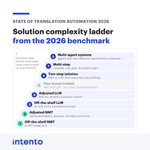
ALT Card: solution complexity ladder from the 2026 benchmark, State of Translation Automation 2026, eight levels with the simplest at the bottom. 1, off-the-shelf NMT: an MT model as is. 2, adjusted NMT: native parameters such as glossary and formality. 3, off-the-shelf LLM: an LLM with a translation prompt. 4, adjusted LLM: RAG for dynamic business context. 5, fine-tuned models, NMT and LLM: not in the 2026 benchmark. 6, two-step solution: NMT or LLM, then automatic post-editing. 7, multi-step: translate, LQA gate, bounded repair. 8, multi-agent systems: agents that own different requirements cooperate. Each level adds context and usually costs more to build, run and maintain.

ALT Card: 10 translation requirements from the 2026 benchmark, State of Translation Automation 2026, in three levels. Basic, for any company in this market: 1, general translation quality, MQM-based LQA minus the subjective requirements. Standard, for every company, with its own rules: 2, terminology, 3, tone of voice, 4, tags, 5, Unicode character integrity, 6, locale conventions, 7, HTML entities, 8, valid JSON, 9, spacing at tag boundaries. Advanced, for some companies and use cases: 10, gender neutrality.

ALT 2018: choose the less wrong model. 2026: build a solution that meets your requirements. 18 MT vendors in 2018, 105 vendors of MT and LLMs in 2026.


ALT A customer writes in French, “Ma commande n’est pas arrivée”, and the support agent reads “My order hasn’t arrived”. The support agent replies “It ships tomorrow”, and the customer reads “Elle sera expédiée demain”. Between them, a card with the Genesys and Intento logos, and checks for terminology, tone of voice, content safety, and email plus chat.

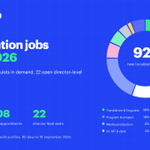
ALT Localization jobs in Q3 2026. AI labs are hiring, linguists in demand, 22 open director-level positions. 619 open positions, 308 recent appointments, 22 director-level seats. A donut of 927 new localization jobs by role type: translators and linguists 36%, management 20%, program and project 19%, engineering and i18n 7%, media production 6%, quality and LQA 4%, AI, MT and data 2%, other 6%.


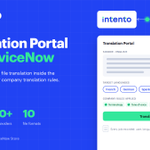
ALT Intento Translation Portal for ServiceNow: on-demand text and file translation inside the Service Portal, under company translation rules


ALT Cover: A good score is not a good fit — a customizable framework for requirements-based LQA. Daria Sinitsyna, Lead AI Engineer at Intento, with the AMTA Québec City 2026 logo.
