









aki.ts🦔 retweeted

あらあら、もう公式がAWS Bedrockって言っちゃった😅
僕らユーザーもそう表現できたら便利だとずっと思いつつ、公式名称に合わせて使ってるのに…
aws.amazon.com/about-aws/wha…
aki.ts🦔 retweeted
なんと、 #みのるん式 がAmazonで和書102位という過去最高のランキングを記録している…!!
ありがとうございます🥹
amazon.co.jp/dp/4297159392/

aki.ts🦔 retweeted
きょうの資料です! #JAWSUG_Tokyo
Kiro Crewで「みのるん式」仕事術やってみた
speakerdeck.com/minorun365/k…

aki.ts🦔 retweeted

21歳のドイツ在住、スペイン人作家さんによる読切「夏の嵐がやってくる!」を、本日ジャンプ+で掲載しました。
この空気感、ぜひ読んでみて欲しいです。
海外版ジャンプルーキー!のMANGA PlusCreatorsの投稿作品です。(投稿作はスペイン語でした)
shonenjumpplus.com/app/viewe…


aki.ts🦔 retweeted

バックエンドの知識地図
gihyo.jp/book/2026/978-4-297…

aki.ts🦔 retweeted

書影も出ました!!いよいよ感があってドキドキしています!!😂
gihyo.jp/book/2026/978-4-297…
aki.ts🦔 retweeted

Hi, I'm Felix. I'm an eng lead working on Claude. I love watching people take flight and do things they never thought possible.
We often describe that as "being more ambitious" when using AI, which is tricky advice to follow. I wrote a tutorial:
felixrieseberg.com/how-to-be…


aki.ts🦔 retweeted

New on our Engineering blog: Creating in-house source control.
In May, we merged around 2,500 code changes per day. In September, we merged more than 30,000 per day. As a result, we became bottlenecked by developer infrastructure built for human (rather than agent) scale.
Here, we share how we built a new version control system—and fully migrated our monorepo from git—in five months: anthropic.com/engineering/re…

aki.ts🦔 retweeted

Gemini 4 Argon is here! It is our frontier model built for complex workflows across real-world software engineering, tested across Google's own codebases on real production challenges. There, we have seen an improvement in both developer velocity, with a 35% increase in agentic code, and code quality, with a 30% decrease in post-submit rollbacks.
Rolling out now to Google AI Ultra subscribers, try it in the Antigravity app and the Antigravity CLI. Get inspired with what you can build today ↓

aki.ts🦔 retweeted

AIへの指示用に、"動画のカメラワークと切り替えの名前" をまとめました!
たとえばClaudeやCodexで動画を作るとき、「いい感じにおしゃれにして」だけでは、狙った演出はまず出ない。
「FPV」「ラックフォーカス」「ホイップパン」と名前で頼めば、思い通りの演出を再現できます。
保存推奨です🔖

aki.ts🦔 retweeted

Dusting off this tweet from April because this gap in shared understanding of LLM capability is *widening*. It's now less "two groups of people speaking past each other" and more a sharp funnel.
- Napkin math somewhere around 6B people (~75% of the population) have barely come in contact with LLMs at all.
- Around 1-2B (~20%) are casual and infrequent users of free-tier ChatGPT-like products. This group sees derpy chatbots and treats them a bit like a better Google search, a writing aid, or etc. Maybe an agent tries to book you a flight. I have non-tech friends who (reasonably, imo) say they have not much use for it at all. Even many professionals outside of math&code are in this tier. For example, execs and many other functions spend a lot of their time talking to other people, so while they understand what is happening intellectually, it is still second-hand and a bit abstract.
- Now we get to professional use of frontier-grade LLMs in math&code. Somewhere around 20M people (0.2%) see first-hand that large, complex projects that used to take them weeks/months can now be completed by agents with a prompt. Building apps, copying apps, translating apps, decompiling apps from binaries... This has all happened very quickly and recently - less than 1 year ago, I was writing code manually by hand, typing memorized computer code commands into a code editor character by character, occasionally pressing Tab to autocomplete a little chunk of code.
- And finally we get to the ~5,000 people (~0.00006%) with access to frontier-grade systems internally. The external world has seen the preview. It looks like swarms of thousands of agents collaborating over weeks on software mega projects: minting zero days, running cyber attacks and defenses at machine speeds, discovering new science, advancing the frontier of mathematics. Things that would have taken top professionals in the industry years of work. Meanwhile, human review and comprehension are starting to fall behind. For example, people are still involved in the "archeology" of the OpenAI-HF incident from many months ago. Mathematicians may be poring over the 722 manuscripts on frontier mathematics for a while.
The funnel is driven by a combination of factors:
1. The impact scales with ambition, problem size, and horizon. A question with a paragraph answer barely stresses the system. You need a reservoir of big, difficult problems that you really care about. This aspect drives the consumer / professional dimension of the funnel.
2. The jaggedness of the system (which I have written about a lot separately). Capability peaks in domains that are digital, verifiable and economically valuable. This is because LLM capability emerges from reinforcement learning on verifiable rewards on a curated environment mixture driven by revenue potential. This aspect primarily drives the area (e.g. math&code) dimension of the funnel.
3. Access. Free-tier, paid-tier, internal.
So this is the weirdness of the moment. The general public has mostly not interacted with these systems. When they have, it looks like a derpy chatbot. The majority of professionals still see only a modest uplift. And a small sliver of professionals are experiencing the vertigo of the curve going vertical. And it is all happening at the same time.

Judging by my tl there is a growing gap in understanding of AI capability.
The first issue I think is around recency and tier of use. I think a lot of people tried the free tier of ChatGPT somewhere last year and allowed it to inform their views on AI a little too much. This is a group of reactions laughing at various quirks of the models, hallucinations, etc. Yes I also saw the viral videos of OpenAI's Advanced Voice mode fumbling simple queries like "should I drive or walk to the carwash". The thing is that these free and old/deprecated models don't reflect the capability in the latest round of state of the art agentic models of this year, especially OpenAI Codex and Claude Code.
But that brings me to the second issue. Even if people paid $200/month to use the state of the art models, a lot of the capabilities are relatively "peaky" in highly technical areas. Typical queries around search, writing, advice, etc. are *not* the domain that has made the most noticeable and dramatic strides in capability. Partly, this is due to the technical details of reinforcement learning and its use of verifiable rewards. But partly, it's also because these use cases are not sufficiently prioritized by the companies in their hillclimbing because they don't lead to as much $$$ value. The goldmines are elsewhere, and the focus comes along.
So that brings me to the second group of people, who *both* 1) pay for and use the state of the art frontier agentic models (OpenAI Codex / Claude Code) and 2) do so professionally in technical domains like programming, math and research. This group of people is subject to the highest amount of "AI Psychosis" because the recent improvements in these domains as of this year have been nothing short of staggering. When you hand a computer terminal to one of these models, you can now watch them melt programming problems that you'd normally expect to take days/weeks of work. It's this second group of people that assigns a much greater gravity to the capabilities, their slope, and various cyber-related repercussions.
TLDR the people in these two groups are speaking past each other. It really is simultaneously the case that OpenAI's free and I think slightly orphaned (?) "Advanced Voice Mode" will fumble the dumbest questions in your Instagram's reels and *at the same time*, OpenAI's highest-tier and paid Codex model will go off for 1 hour to coherently restructure an entire code base, or find and exploit vulnerabilities in computer systems. This part really works and has made dramatic strides because 2 properties: 1) these domains offer explicit reward functions that are verifiable meaning they are easily amenable to reinforcement learning training (e.g. unit tests passed yes or no, in contrast to writing, which is much harder to explicitly judge), but also 2) they are a lot more valuable in b2b settings, meaning that the biggest fraction of the team is focused on improving them. So here we are.
aki.ts🦔 retweeted

RAG vs. Jev + RAG, clearly explained!
In a standard RAG setup, documents are split into chunks, converted into embeddings, and stored in a vector DB.
When a query arrives, the system embeds it and retrieves the top-k chunks with the closest vectors.
Many production setups add a reranker after retrieval.
The reranker compares the query with each retrieved passage, improves their ordering, and keeps the highest-scoring results.
Those passages are then placed in the context window, and the LLM generates an answer from them.
The problem is that ranking and answerability are different questions.
A passage can be more relevant than the other candidates while still containing weak, incomplete, or merely adjacent evidence.
The LLM receives it anyway and may produce a plausible answer from context that never supported one.
Jev + RAG keeps the retrieval stage as is but changes what happens before generation.
Instead of using a conventional reranker at this stage, Jev can judge every retrieved candidate against a typed question such as:
"Does this passage help answer the query?"
The query becomes the shared state, while the retrieved passages become individual candidates. Jev evaluates them together and returns a probability for each one.
Application code then applies a threshold.
↳ Candidates above the threshold continue to the LLM.
↳ Candidates below it are removed from the context window.
The same Jev request can also judge whether the remaining evidence is sufficient to answer the query.
If answerability falls below the threshold, the application can skip the LLM and return "not in the documents."
Jev does not replace the embedding model, vector database, or generation model. Retrieval still sets the cap because Jev cannot recover a passage that never entered the candidate set.
The diagram below depicts the complete flow.
- RAG retrieves a broad candidate set.
- Jev reranks and gates those candidates.
- The LLM generates an answer.
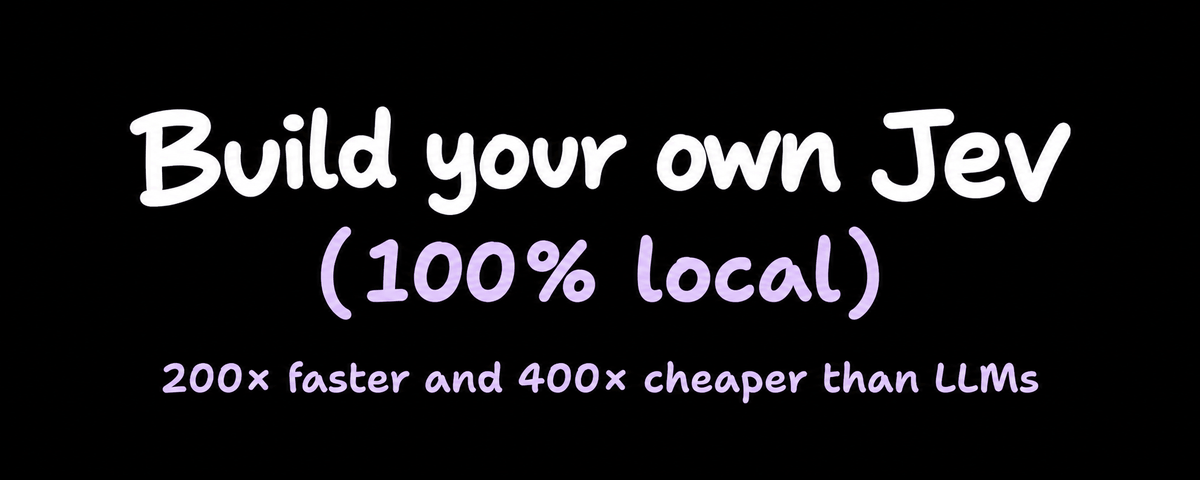
If you want to dive deeper, I have also written a hands-on guide showing how to build a Jev-style model with open models, entirely locally.
Read it below.

aki.ts🦔 retweeted

OpenClaw on AgentCore Runtime + AgentCore Memory でユーザー毎の会話履歴を永続化する解説記事です。
常駐型の Agent をサーバーレスな Runtime にホストする際の Tips (Runtime の仕様に合わせてラップ) や Memory の名前空間とメタデータの設計方法が解説されています。
aws.amazon.com/jp/blogs/mach…

aki.ts🦔 retweeted

Next.js 16.4
• Cache Components by default in new apps
• Static output guarantees and more control over prefetching
• Agent-guided upgrades and feedback
• 20–25% smaller Turbopack disk cache
• Faster development and smaller bundles
nextjs.org/blog/next-16-4

aki.ts🦔 retweeted

introducing @NanoBanana 2.1 🍌
our latest image generation model outperforms our previous models across the board:
- better visual design
- mask-based editing
- subject consistency
- more natural-looking images
try it out today in ai.studio


aki.ts🦔 retweeted
We'll be spending a lot more time trying to understand the outputs of language models. A few thoughts, tips & tricks:
Writing. Something I've had success with: Ask your LLM to explain something in ASD-STE100, it's a controlled language specification originally developed for aerospace maintenance documentation. LLMs well-versed in this language and it comes with heavy constraints on clean writing style that I often find a lot more readable. Sometimes I've tried to soften it a bit e.g. ask for "80% of the way to ASD-STE100" because the spec is quite stringent. But even better:
Diagrams / images. Instead of writing, ask your LLM to create a diagram. These can be a lot easier to process, parse, and understand. But even better:
Web pages. Ask for output "in HTML" to get a beautiful, interactive webpage. LLMs are getting really good at frontend and can create beautiful experiences, animations, etc. But even better:
Explainer videos. The output format I am most bullish on is fully custom / bespoke explainer videos generated on any arbitrary topic. Experiment with things like "Create a 3b1b style video explainer on X. Use my ElevenLabs API key for audio narration". (you'd need an API key for the latter or you can ask your LLM to find you decent free alternatives that use your local compute). This is actually starting to work!
In summary:
- As LLMs get better, they will do more and more of the legwork autonomously, and a lot more of our work will rise up the abstractions into oversight and understanding.
- Luckily, LLMs can help here too because as intelligence and code are increasingly abundant, you can ask for large, custom, discardable software artifacts (e.g. web apps, video explainers) that would have never made sense to create before. Push the boundaries here and you'll be surprised.

aki.ts🦔 retweeted
AgentCore での ambient agent の実装解説記事です。
S3 へのファイル格納をトリガーに、AgentCore Runtime 上で Agent 実行・HITL するパターンを実装レベルで解説しています。(stateは DynamoDBで管理)
アンビエントパターンの使い分けなどのベスプラも紹介されています。aws.amazon.com/jp/blogs/mach…

aki.ts🦔 retweeted
Anthropic の Claude による harness の評価設計や最適化の解説記事です。
評価データ設計の4つの原則や grader (評価器) と hillclimber による改善、過学習防止のための train/test split など、従来の深層学習ベースの改善アプローチが紹介されており、面白いです。
claude.dev/blog/automating-e…
