

Seven years past my best-by date. adjectives- Handsome/Handsomest https://xitter.cf/t.co/9iTXbn6QRx
Windsor, Ontario, Canada
Joined December 2020
- Tweets1.8K
- Following364
- Followers345
- Likes471







Pinned Tweet
The Daily Cognitive Misadventure Mission Statement
The Daily Cognitive Misadventure is founded on a simple idea:
Sooner or later, someone will do something astonishingly unwise.
We call this the Principle of Inevitable Cognitive Misadventure.
The principle is straightforward. Whenever enough people, experts, committees, politicians, executives, consultants, activists, or social media influencers become involved in a decision, the odds of a spectacular lapse in judgment steadily increase.
History offers countless examples.
Consider the Hindenburg.
Engineers built a giant airframe filled with highly flammable hydrogen gas, wrapped it in materials that were themselves flammable, attached a passenger compartment underneath, and then assured the public that transporting people through the sky in this manner was a perfectly reasonable idea.
For a time, it worked.
Then reality intervened.
The Hindenburg was not the result of one foolish decision. It was the result of many individually understandable decisions combining into one magnificent cognitive misadventure.
The same pattern appears throughout history.
Financial bubbles.
Government programs.
Corporate strategies.
Military campaigns.
Public policies.
Social movements.
Again and again, intelligent people convince themselves that this time will be different.
It usually isn't.
That is where The Daily Cognitive Misadventure comes in.
We regard ourselves as a public service.
While others report events, we examine the decisions that produced them.
Our mission is to identify, classify, document, and occasionally laugh at the world's most impressive cognitive misadventures before they become chapters in future history books.
Using tools such as the Principle of Inevitable Cognitive Misadventure, the Universal Stupidity Matrix, and a healthy appreciation for unintended consequences, we investigate the gap between what people intended to happen and what actually happened.
We do not claim that cognitive misadventures can be eliminated. Human history strongly suggests otherwise.
Instead, our goal is to provide early warning, satirical analysis, and occasional amusement as humanity continues its endless quest to relearn lessons it has already learned several times before.
If someone is going to drive civilization into a ditch, the least we can do is document the steering process.
Welcome to The Daily Cognitive Misadventure.
🤖 Made with AI

1
1
96
Today's Daily Cognitive Misadventure
Politicians love talking about cutting red tape—usually while standing in front of several thousand pages of freshly printed red tape. Every new rule seems to require another rule to explain it, another office to administer it, and another committee to study whether the first two rules are working. If bureaucracy were an energy source, Canada would never need another hydro dam. Today's Daily Cognitive Misadventure examines government's only truly inexhaustible renewable resource: regulations.
harrylauder.substack.com/p/g…
🤖 Made with AI

20
What if government departments had to survive the way small businesses do—by producing results instead of reports? Today's Daily Cognitive Misadventure explores the radical notion that prosperity is created by people who build, grow, and serve—not by endless planning sessions. Welcome to "The National Productivity Exchange where bureaucrats spend a month in the real economy... and reality gets the final vote.harrylauder.substack.com/p/t…
🤖 Made with AI

14
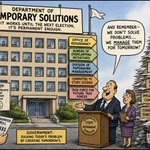
Every government promises to solve your problems. Curiously, many of those problems seem to multiply at roughly the same rate as government departments. Today's Daily Cognitive Misadventure investigates why every crisis now appears to require another committee, another task force, and another report—while food and housing somehow become even harder to afford. Grab a coffee and enjoy "The Department of Temporary Solutions."
harrylauder.substack.com/p/t…

8
Government's First Job (Hint: It Isn't Hosting Conferences)
Strip away all the politics, slogans, hashtags, and carefully staged press conferences, and nearly everyone on Earth has the same two primary concerns: finding food and keeping a roof over their heads.
Civilizations rise because they make those two tasks easier.
They decline when they make them harder.
Government can influence this equation in three ways. It can enhance your ability to provide food and shelter, it can have little effect, or it can make the job considerably more difficult.
The first is called good government.
The second is bureaucracy.
The third is usually announced with a smiling politician standing behind a podium promising to "build a better future."
Governments genuinely help when they provide stable laws, protect property rights, maintain basic infrastructure, enforce contracts, and keep inflation under control. Businesses invest. People work. Productivity rises. Food becomes more affordable. Housing gets built. Life improves—not because politicians become smarter, but because millions of ordinary people are free to solve ordinary problems.
Sometimes government simply gets out of the way. Surprisingly, this often works remarkably well. Farmers continue farming without a Ministry of Corn Optimization. Carpenters continue building without a National Hammer Equity Strategy. Grocery stores somehow manage to stock bananas without forming an Interdepartmental Banana Resilience Secretariat.
Then comes the third category.
This is where government decides that producing food and building homes are secondary concerns compared with producing reports, committees, regulations, strategic frameworks, and advisory councils to oversee the reports produced by the previous advisory councils.
The economy begins to resemble a football team where everyone wants to be the referee.
Policies that increase costs, delay projects, discourage investment, or create unnecessary complexity can reduce economic activity. When businesses face higher costs—whether from regulation, taxes, or compliance—they may respond by investing less, hiring fewer people, raising prices, or some combination of the three. Those effects ultimately influence the affordability of everyday necessities such as food and housing.
Into this already crowded meeting room walk initiatives like Diversity, Equity, and Inclusion (DEI) programs and Critical Race Theory (CRT), both of which have become subjects of significant political debate. Supporters argue these initiatives address historical inequities and improve opportunities for underrepresented groups. Critics contend that, when implemented poorly or expanded beyond their original purpose, they can divert attention and resources away from an organization's core mission, add administrative overhead, and encourage decisions based on group identity rather than individual merit.
From a satirical perspective, one might imagine a construction company desperately trying to finish a housing project while spending half the morning debating whether the cement mixer has completed its unconscious bias training.
The concrete remains stubbornly indifferent.
Likewise, a farmer attempting to harvest wheat before a storm is unlikely to improve yields by attending a three-hour seminar entitled Inclusive Grain Handling in a Post-Structural Agricultural Environment.
The wheat also remains indifferent.
None of this means fairness, respect, or equal opportunity are unimportant. They are fundamental values in any healthy society. The practical question is whether particular policies improve an organization's ability to accomplish its primary mission or make that mission more difficult. Reasonable people can disagree about where that balance should be struck.
A healthy economy ultimately depends on producing real goods and services. It depends on people inventing, building, transporting, repairing, growing, and selling things that improve lives. Every hour spent creating value tends to strengthen the economy. Every unnecessary hour spent navigating avoidable administrative complexity is an hour not spent creating that value.
Perhaps the Principle of Inevitable Cognitive Misadventure can be summarized this way:
Whenever a society spends more time measuring the diversity of the people baking the bread than making sure there is enough bread, eventually someone discovers that statistics are remarkably difficult to spread on toast.
Food and shelter remain stubbornly old-fashioned priorities.
They always have been.
They probably always will be.
🤖 Made with AI

2
52
Today's Cognitive Misadventure
Every government promises that the latest emergency program is only temporary. Then the emergency ends—but the department discovers an even greater crisis: unemployment... among bureaucrats.
Today's investigation examines the remarkable transformation of temporary government solutions into permanent institutions, complete with expanding budgets, growing staff, and an uncanny ability to find new reasons for existing long after the original problem has disappeared.
harrylauder.substack.com/p/t…
🤖 Made with AI

13
Before governments create a new office, committee, agency, or task force, they usually promise it will solve a pressing problem. Curiously, the problem often survives long enough to justify creating another office to oversee the first one. This edition of The Daily Cognitive Misadventure explores how temporary government solutions have an uncanny habit of becoming permanent bureaucracies—and why the paperwork always seems to multiply faster than the results.
harrylauder.substack.com/p/t…
🤖 Made with AI

12
Today's Daily Cognitive Misadventure
Have you ever noticed that every government promise to reduce bureaucracy seems to require creating...more bureaucracy?
Today's investigation follows the paper trail to the mythical Ministry of Common Sense, where every simple idea must survive an obstacle course of assessments, consultations, committees, and reports before anyone is allowed to say, "Let's just do it."
If you've ever wondered why straightforward solutions become five-year projects, today's misadventure may provide the answer.
harrylauder.substack.com/p/s…

17
**Today's Daily Cognitive Misadventure examines a curious modern phenomenon: everything is now an emergency. Housing. Healthcare. Affordability. Productivity. Before long, we'll need a National Emergency for Too Many National Emergencies. When every problem demands immediate action, extraordinary measures become ordinary policy—and common sense quietly slips to the bottom of the priority list.
harrylauder.substack.com/p/t…
🤖 Made with AI

1
15
**Today's Daily Cognitive Misadventure follows the remarkable journey of the government pilot project—a humble experiment that somehow evolves into a permanent institution. What begins as a temporary test soon acquires staff, committees, annual budgets, and an impressive instinct for self-preservation. The only thing more predictable than launching a pilot project is discovering, years later, that nobody remembers it was ever supposed to end.
harrylauder.substack.com/p/t…

17
Today's Daily Cognitive Misadventure asks a simple question: If government programs are always described as "temporary," why do they seem to outlive the problems they were created to solve? Somewhere along the way, emergency measures acquire office furniture, permanent staff, annual budgets, and an irresistible instinct for self-preservation. Welcome to the fascinating world where nothing lasts longer than a temporary government solution.
harrylauder.substack.com/p/t…
🤖 Made with AI

13
Today's Cognitive Misadventure
Every government promises a brighter tomorrow. New strategies, bigger programs, fresh announcements, and ambitious plans arrive with remarkable regularity. Yet somewhere between the ribbon-cutting ceremony and the final report, reality has an annoying habit of refusing to cooperate. Today's Daily Cognitive Misadventure asks a simple question that every taxpayer should ask after every grand announcement: Did it actually work? If the answer is "we're launching another strategy," you may already know the answer.
harrylauder.substack.com/p/t…
🤖 Made with AI

20
Today's Cognitive Misadventure
Governments often speak as though the economy were controlled by a giant thermostat hidden somewhere in the basement of Parliament. If inflation rises, turn one dial. If growth slows, turn another. If nothing improves, hold a press conference and announce a brand-new strategy. Unfortunately, real economies don't work that way. Today's Daily Cognitive Misadventure examines the comforting illusion that complex economic problems can be solved with a simple twist of the government's favorite knob.
harrylauder.substack.com/p/t…
🤖 Made with AI

16
Today's Cognitive Misadventure
Imagine a government where every new idea had to survive one final test: Does this actually make sense? It sounds simple enough—perhaps too simple. Which may explain why the Department of Common Sense has never quite made it through the approval process. Today's investigation explores the one government department that might save taxpayers billions... if only it could get past the committee reviewing whether common sense is really necessary.
harrylauder.substack.com/p/t…

Today's Daily Cognitive Misadventure asks a simple question:
If government programs are always temporary, why do they keep celebrating their 25th anniversaries?
Emergency measures have an odd habit of becoming permanent institutions, complete with larger budgets, additional staff, and committees to study whether they should continue existing. Today's investigation explores the remarkable ability of bureaucracy to outlive the problems it was created to solve—and why "temporary" may be the most optimistic word in government.
harrylauder.substack.com/p/t…
🤖 Made with AI

18
Ever notice that some government "pilot projects" seem to have longer careers than the people running them? Today's Daily Cognitive Misadventure examines the remarkable ability of temporary programs to remain permanently under evaluation.
harrylauder.substack.com/p/f…
🤖 Made with AI

10
Why does every government "solution" seem to create two brand-new problems? Today's Daily Cognitive Misadventure explores the remarkable law of unintended consequences—and why bureaucracy may be the only machine that manufactures more work by trying to eliminate it.
harrylauder.substack.com/p/t…
🤖 Made with AI

Today's Daily Cognitive Misadventure asks a simple question: What happens when governments become better at announcing solutions than delivering them? Somewhere between the press conference and the progress report, reality quietly slips out the back door.
harrylauder.substack.com/p/w…
🤖 Made with AI

5
The Department of Temporary Solutions
Every government promises permanent solutions. Most deliver temporary programs with permanent budgets instead. Welcome to the Department of Temporary Solutions, where every crisis inspires another committee, another strategy, and another announcement—but somehow the original problem survives to justify next year's funding. Today's Daily Cognitive Misadventure investigates why.
harrylauder.substack.com/p/t…
🤖 Made with AI

18
Today's Daily Cognitive Misadventure
Every government promises to solve problems. Unfortunately, some policies seem remarkably effective at creating entirely new ones.
The real challenge isn't coming up with another grand plan—it's remembering that people, markets, and businesses tend to react in ways no committee predicted.
Today's investigation explores the Ministry of Unintended Consequences, where every solution comes with a complimentary set of brand-new problems.
harrylauder.substack.com/p/t…
🤖 Made with AI

14
Today's Daily Cognitive Misadventure
Have we reached the point where bureaucracy has become so complex that it now prevents governments from doing the very things it was created to accomplish?
When repairing a pothole requires years of studies, consultations, reviews, approvals, and more consultations, perhaps the biggest obstacle isn't the pothole—it's the paperwork.
Today's investigation asks whether Canada is entering an era of bureaucratic paralysis, where process has quietly become more important than progress.
harrylauder.substack.com/p/a…
🤖 Made with AI

1
22