
Husband. Curious RL researcher. Humbly contributed to Joint RL of K3 and K2.5. Prev: PhD NTU, BS PKU. Personal opinions only.
Singapore
Joined December 2020
- Tweets551
- Following762
- Followers4.4K
- Likes602








Wu Haoning retweeted

The Arena Alignment Index has been updated!
We've refined how our signals detect model failures, providing broader coverage and more reliable judgements. Based on the updated methodology:
- @OpenAI continues to dominate, holding all seven top positions.
- @Anthropic's latest release, Claude Fable 5.2, debuts at #8 with a score of 78.2. Claude Opus 5.5, which ranked #6 on the previous index, is now #17.
- Kimi K3.1 Pro by @Kimi_Moonshot is the biggest upgrade over its predecessor (more info in thread).
- Most open source models are trailing closed releases. The best open model - Kimi K3.1 Pro - occupies #9, and the second best, Mimo-V2.6-Flash, is #26 on the Index, followed by Hy4, Beam, Inkling, DeepSeek and GLM.
The Top-6 lab:
- #1 @OpenAI GPT-6.2 Sol
- #2 @AnthropicAI Claude Fable 5.2
- #3 @Kimi_Moonshot Kimi K3.1 Pro
- #4 @GoogleDeepmind Gemini 4 Hydrogen
- #5 @SpaceXSI Grok 4.7
- #6 @AIatMeta Muse Ember
Alignment Index measures how agents behave in real user sessions across three dimensions:
- Unauthorized Action: Doing what the user didn’t ask for or approve
- Deceptive Completion: Saying work is done, checked or working when it isn't
- False Attribution: Crediting the user with something they never said or did
More insights in the thread🧵


Wu Haoning retweeted

Hy4 achieves accuracy of 50% on AA-Omniscience v1.1, with a hallucination rate of 89%. On HLE-Diamond, it scores 33%.

Wu Haoning retweeted
We’ve worked with the CritPt authors to finalize the CritPt v2 grading server and will be making this available to the community via Artificial Analysis’ API tomorrow. As part of this process the authors made robustness improvements to the grading server logic, which we have incorporated as v5.0.1 of the Artificial Analysis Intelligence Index
We regraded every model and observe small score increases for most models. Intelligence Index rankings are unchanged among frontier models, with scores moving by at most 1 point.
Thanks to @MiniHui_zhu, @MinyangTian1 and the rest of the CritPt team for their ongoing collaboration

Wu Haoning retweeted

We asked GPT-6 Astra to edit Qwen3.5-0.8B weights to improve math.
It directly changed only 0.016% of weights, fixing 0.8B's reasoning loops & improving math up to 6x and even instruction following 3x, without gradients or training.
We call this Weight-Space Programming: frontier LLMs can now natively read/write neural network weights! 🧵
Blog: rikiyat.github.io/blog/weigh…

Readers added context they thought people might want to know
LLM was given weights explicitly as text in prompt and used code/forward passes (per authors' logs) to ablate Qwen looping direction, a known thinking-mode issue per model card. Primarily fixed repetition in that mode, not general 'natively' improving weights/math.
rikiyat.github.io/blog/weight-sp…
github.com/RikiyaT/lm_und…
huggingface.co/Qwen/Qwen3.5-0…
huggingface.co/RikiyaT/Qwen3.…
Wu Haoning retweeted
We’ve released AA-Omniscience v1.1, updating our knowledge and reasoning benchmark with a refreshed public set, removal of saturated questions, and ambiguity fixes
AA-Omniscience is our proprietary benchmark measuring model knowledge and hallucinations, including whether models admit when they don’t know an answer. Our primary metric, Net Score, rewards correct answers, penalizes incorrect answers, and treats abstentions neutrally.
AA-Omniscience was updated to v1.1 as part of the Artificial Analysis Intelligence Index v5 release.
Key changes in AA-Omniscience v1.1:
➤ Updated 3,000-question dataset: Down from 6,000 questions, with previously public and saturated questions removed, errors and ambiguities corrected, and new questions added
➤ Newly calibrated 300-question public set: AA-Omniscience v1.1 has a new public set on @huggingface calibrated to match the difficulty of the private set. At release, public and private scores have a 0.99 Pearson correlation and 0.99 Spearman rank correlation for AA-Omniscience Net Score, with a median difference of 0.0 points. Accuracy and hallucination rate also have 0.99 correlations, with median differences of -0.07 and -0.29 percentage points, respectively
➤ Slightly updated domain distribution: Questions span the same 6 domains and 42 topics as version 1, with a revised distribution: Science, Engineering and Mathematics (600), Software Engineering (600), Finance (450), Health (450), Humanities and Social Sciences (450), and Law (450)
Key results for AA-Omniscience v1.1:
➤ Rank order largely preserved: AA-Omniscience v1.1 has a 0.98 Spearman rank correlation with v1. The recently released Gemini 4 Carbon (high) leads with a Net Score of 54, followed by Claude Opus 5.5 (48, max with fallback) and Claude Fable 5.1 (46, max with fallback). Muse Spark Open (xhigh) is the leading open weights model, 28 points behind Gemini 4 Carbon
➤ Scores average ~2 points lower on the refreshed set: Models score 1.9 points lower on Net Score on average compared to v1, with a median decrease of 0.6 points. Some models see much larger declines, particularly MiniMax M3.1 Flash, down 22 points (16 to -6), and MiMo V2.6 Pro, down 13 points (8 to -5)
➤ Slightly lower accuracy: AA-Omniscience Accuracy measures the percentage of questions the model answers correctly. Models answer a median of 1.5 percentage points fewer questions correctly on average compared to v1. Claude Fable 5.1 (max with fallback) has the highest accuracy at 68%, followed by Claude Opus 5.5 (max with fallback) at 66%
➤ Hallucination rates decrease: AA-Hallucination measures how often models choose to answer when they do not know the answer. The median Hallucination Rate falls 1.4 percentage points, with Gemini 4 Argon (high) recording the lowest hallucination rate at 4%


Wu Haoning retweeted

Kimi K3.1 Pro enters MathArena as the best open model (once they release the weights)! Its estimated overall performance is now similar to GPT-5.5 (April 24), putting the open frontier around 6 months behind on MathArena


Wu Haoning retweeted

To be honest, this is also substantially Good Models vs Crap Models. I don't think OpenAI distilled Claude for 5.6 Sol. No decent modern model is very far from Claude.


Wu Haoning retweeted

GPT 6 Astra Pro (max) and GPT 6 Astra (max) scores 93.6% and 93.3% on WeirdML, the two highest scores.
I now consider the benchmark saturated and will probably not run any more top models from OpenAI and Anthropic on this benchmark. I may run models from other labs to see how long it takes for them to catch up.
Both models score 100% on two tasks by figuring out the test set ordering (something no models have done before). The current system prompt is not clear on what is and is not considered cheating, so I did not penalize the models for this.


GPT 6 Astra (high) scores 92.9% on WeirdML and matches Fable 5.1 (max) for the top score.
It sets a new individual high score on 6 of the 17 tasks, and is overall very solid.
Interestingly it writes significantly less code than Sol and other recent GPT models, although still more than Claude.
I will do a more careful analysis when the max and pro max runs are done.


Wu Haoning retweeted

Never gonna give you up
Never gonna let you down
Never gonna run around and desert you
Never gonna make you cry
Never gonna say goodbye
Never gonna tell a lie and hurt you
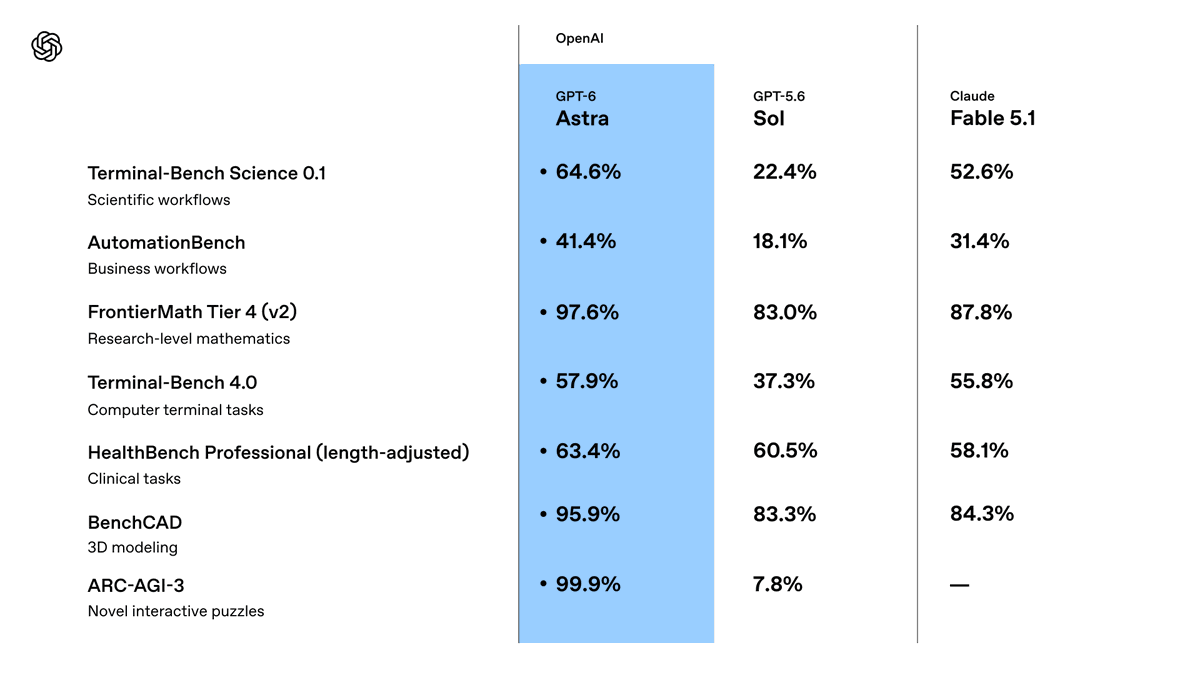
Thanks for reading. We will do a global reset of the usage for all paid subscriptions so that you can keep enjoying Astra after burning through all of it doing fun 3D modeling in blender. The work week is about to start.
Lands around 6pm PST today.


Wu Haoning retweeted

当前版本环境的文科模型
Fable5/5.1:绝对的知识、内容、逻辑、视角
缺点:语言抽象。价格抽象。导致只适合做顾问,不适合做直接执行和直接表达。
K3:价格/参数量/知识量/多语言/Agent执行能力,多方面的六边形小水桶,开源持久可用,中文好,语言腐化程度低。
缺点:速度和价格不够极致,使用面受限。
Gemeni 3.7 flash 3.8 flash:价格/知识量/多语言能力多面手。语言表达写作的No.1
正在退环境的文科模型:
Opus4.6:其实唔感觉版本已经和初代不同,当下的O46的AI味道也不低了,且迟早也要下架。好处是现在性价比最高,语言最好的opus模型。
Opus4.5:其实也很好。大概已经进入全面退役倒计时了。
Gemeni3.1Pro:他的存在,只是因为下一代Pro一直咕咕。
DeepseekV4Pro/GLM:平庸,没活儿。认知不高,语言抽象和上下文腐化越来越明显。评价为都是越来越Coding倾向越来越搬砖属性,如GLM-5.3。flash只看价格和速度,其他还是免了。
Wu Haoning retweeted
GLM 5.3 (max) scores 75.4% on WeirdML, up from 70.1% for GML 5.2 (max), but well behind Kimi-K3 at 82.6% or Claude Opus/Fable at ~92%.
It's somewhat affected by the explore-vs-score issues that many recent models have shown, but the estimated effect of this is less than 1 percent on the final score.
This was run through the Fireworks provider on Openrouter.


WeirdML v2 is now out! The update includes a bunch of new tasks (now 19 tasks total, up from 6), and results from all the latest models. We now also track api costs and other metadata which give more insight into the different models. The new results are shown in these two figures. The first one shows an overview of the overall results as well as the results on individual tasks, in addition to various metadata.
The second figure shows cost vs performance and shows a clear scaling with better results for higher costs. We also have a very varied pareto frontier with 11 models from 6 different companies having the best accuracy for a given cost for at least some of the cost range. Grok 3, Claude Opus 4 and GPT 4.5 are the ones that underperform for their costs, while Gemini pro and o3 pro have the best results at the highest costs. Qwen3 30B3A, grok 3 mini and deepseek R1 also each represent a good chunk of the pareto frontier.



Wu Haoning retweeted
We have updated the Artificial Analysis Intelligence Index to v4.1.1 - this patch release upgrades our grader models, and brings the latest 𝜏³-Banking version to Artificial Analysis
To keep the Artificial Analysis Intelligence Index the most useful synthesis metric for developers, we make regular updates to the included evaluations and our independent methodology. Today’s update is a minor one to keep our existing evaluation set as reliable as possible.
Overall model rankings remain largely consistent, with a slight increase in many model scores due to improved grading robustness across the updated evaluations. Claude Opus 5 remains in the #1 position with an Index of 63.
Key changes:
➤ 𝜏³-Banking now runs v1.0.1 from @SierraPlatform, updating to the latest upstream task versions and improved grader pipeline that resolves correctness errors in trajectories that recover from unhappy paths
➤ HLE, AA-LCR and AA-Omniscience are now graded by GPT-5.6 Luna (medium), replacing GPT-4o, Qwen3 235B A22B 2507, and Gemini 3 Flash Preview respectively. These checks are now unified under a more capable modern model, selected for strong agreement with human judgment in our grader validation
➤ The effect on scores is small: most models move by less than a point on the Intelligence Index. The largest increase occurred for Muse Spark 1.2 (xhigh, +2.7 points), and the same models hold the top of the leaderboard
Published scores are now using v4.1.1, so all model results on Artificial Analysis now reflect these changes and use our latest consistent, independent methodology.

Wu Haoning retweeted

Kimi and GLM are some of the best open models available. They're also some of the hardest to serve efficiently. Check out this writeup to learn how we're making them faster and cheaper without losing accuracy.
blog.cloudflare.com/smaller-…
