




Sophia S. Han PhD @ INFORMS 2026 retweeted

🦩 Introducing Gen4P: Video Generators are 4D Perceivers.
We turn a pretrained video generator into a feed-forward 4D perceiver—recovering geometry and motion from monocular videos in a single forward.
Project page: gen4p.github.io/
Key highlights:
🎯 Single-pass encoding—no iterative denoising
🎯 On-demand spatial and continuous-time queries
🎯 A frozen depth LoRA as a plug-in geometry prior
From thin flamingo legs to complex motion: explore our interactive 4D reconstructions!
A work led by Yitong Xia and @CodyJzr (@Oxford_VGG)
Sophia S. Han PhD @ INFORMS 2026 retweeted

Leonard Read's pencil story: no one knows how to make a pencil from scratch, yet millions are made without a central manager. Each worker knows only their part. Incentives, not central control, coordinate their efforts.
Current multi-agent AI seems to work the opposite way. A central manager does everything: assigns roles, writes the workflow, and decides who acts next. As agents increase and tasks get harder, that manager might become the bottleneck: it should understand every agent and every task, and adaptation becomes inefficient.
So how can a group of machine agents organize themselves into something none of them could achieve alone? Further, how can that society of agents keep improving itself over time?
In Economy of Minds (EoM), we show that simple local incentives can drive global self-coordination and self-improvement for modern LLM agents. We let agents live in a minimal economy: they compete for work, earn by helping others succeed, and go broke when they don't. Workflows, specialists, and improvement naturally emerge, with no one in charge.
Across 5 domains (math reasoning, financial research, scientific research, accelerator design, and distributed-system optimization), limited agents grow into strong societies.
The whole idea in a 90-second cartoon👇
Had great fun and learnt from great ppl at CoLM 2026. #CoLM2026


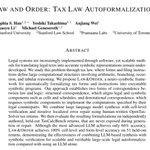
We’ve COMPLETELY AUTOMATED personal income tax calculation with AI.
Check it out: arxiv.org/pdf/2610.02792.

Next week, I’ll be at OOPSLA/ISSTA in Oakland during the day and CoLM in San Francisco in the evenings. Looking forward to catching up with old friends and meeting new ones!
Places like Filoli serve as a constant reminder of why defending the pure arts and sciences is so vital.

Hiring RL researchers passionate about building logic into legal and medical AI! DM me your resume.

Sophia S. Han PhD @ INFORMS 2026 retweeted

🏆2026 Computational Linguistics Distinguished Reviewer Awards: It aims to highlight and promote high standards in peer review and to acknowledge reviewers whose contributions have had a meaningful impact on the quality of our #CLjournal. Congratulations to our 2026 awardees!

Sophia S. Han PhD @ INFORMS 2026 retweeted

Arrived at ACL! Happy to chat about reasoning, legal NLP, and more.
🗓️ ReasoningFlow: Discourse Structures for Understanding LLM Reasoning Traces (ArgMining WS, 7/3 3:30 Harbor E&F)
🗓️ Evaluating Legal Reasoning Traces with Legal Issue Tree Rubrics (Oral, 7/5 4:00 Harbor E&F)

Sophia S. Han PhD @ INFORMS 2026 retweeted

A lot of people have opinions about the philosophy of AI and want to write things about it and I would like to say to these people: *please* talk to a philosopher first. Philosophy is hard!


Sophia S. Han PhD @ INFORMS 2026 retweeted

Everyone who actually understands history, technology, the diffusion of innovation, and economics already understands that AI will create more jobs than it displaces.
But mass media and politicians never waste a good fake crisis to terrify people.
And a few very loud, very prominent people in AI were screaming nonsense about the end of all jobs, the same nonsense people once babbled about "computers" in the 80s.
You can still sell a million copies of a crappy book if you want to keep telling that story. People love scary bedtime stories.

The jobs data coming out continues to suggest the opposite of what a lot of people had thought would happen.
Just take engineering, as the prime example of the area with greatest AI impact (and perceived risk). Most companies now have far more software projects than ever before because of AI, and effectively only engineers are going to be the ones doing that work.
You can get by for a while by being non-technical building software, but eventually someone has to understand what the thing is that got built, has to maintain it, has to fix security issues that come up, upgrade the systems beneath it, and so on. That’s all jobs.
Now apply that to a number of other job functions. AI is going to cause companies to hire more in sales because agents can let them process more leads and do more customer research. AI will cause an explosion of new marketing roles because of how much more efficient it is to launch campaigns and target. The list goes on.
AI is going to have the opposite effect that lots of people thought on jobs.
Sophia S. Han PhD @ INFORMS 2026 retweeted

Some things never change: Gary just doesn't fit in distribution.

Some things never change. If you don’t understand this one, you don’t understand what’s happening AI.
Marcus, 1998: neural nets have trouble generalizing far beyond the data.
Marcus, 2001, 2012, 2019, 2022, etc: neural nets have trouble generalizing far beyond the data.
Apple, 2025: neural nets have trouble generalizing far beyond the data.
Meta/Stanford/Harvard, 2026: neural nets have trouble generalizing far beyond the data.
Sophia S. Han PhD @ INFORMS 2026 retweeted

"SPICE continues to be the leading light for international and cross-cultural outreach education."
As part of @StanfordSPICE's 50th anniversary celebrations, professor emeritus Steve Thorpe shares his reflections on teaching and learning from the program. ow.ly/AGBZ50YVg2O

Sophia S. Han PhD @ INFORMS 2026 retweeted

I am honored to assume the presidency of the @asilorg. I look forward to working with our 4000 members to pursue our mission: to foster the study of international law, and to promote the establishment and maintenance of international relations on the basis of law and justice.

Sophia S. Han PhD @ INFORMS 2026 retweeted

Yann LeCun (AMI Labs Founder): "The AI industry is completely LLM-pilled. Everybody is working on the same thing. They're all digging the same trench."
LeCun explains why no lab dares break from the pack:
"They are stealing each other's engineers. So they can't afford to do something different because if they start going on a tangent, they're going to fall behind the other guys. And so they're all doing the same thing."
This groupthink is exactly what drove him out of Meta.
"Meta also became LLM-pilled with sort of recent reshuffling. And it's fine, a strategic decision that maybe makes sense for them. It's just not what I'm interested in."
For @ylecun, the problem runs deeper than strategy.
LLMs are missing something essential about how intelligence actually works:
"I cannot imagine that we can build agentic systems without those systems having an ability to predict in advance what the consequences of their actions are going to be. The way we act in the world is that we can predict the consequences of our actions and that's what allows us to plan."
His broader critique is that the industry has mistaken fluency for intelligence.
Language turned out to be the easy part. The hard part is the physical world.
It's why we still don't have domestic robots or level-five self-driving cars, even though today's systems can pass the bar exam and write code.
Sophia S. Han PhD @ INFORMS 2026 retweeted

"Not just literature, all art plays a very big role in my life and my literature. Nowadays, I very much love contemporary free jazz, art, architecture... almost every form of art is very important for me.”
- 2025 literature laureate László Krasznahorkai

ALT László Krasznahorkai stands at a podium with a microphone, wearing a suit and bow tie. To the left is the quote “Almost every form of art is very important to me.”
Sophia S. Han PhD @ INFORMS 2026 retweeted

I love Geoff.
But he understands even less than Dario about the effects of technological revolutions on the labor market.
Again, don't listen to AI scientists, as brilliant as they might be, and even less to AI CEOs, as successful as they might be, for questions of labor economics.
Listen to reputable economists who have studied these things like @Ph_Aghion , @DAcemogluMIT , @erikbryn , @amcafee , @davidautor , etc.