





Pinned Tweet
A very special paper beautifully integrating ~25 years of research on eye movements, visual attention, peri-saccadic visual perception, behavioral control, and neurophysiology!
hafedlab.org/2026/08/22/fove…
Another amazing tour-de-force study led by Tatiana Malevich:
biorxiv.org/content/10.64898…
Congratulations to @MatthiasPhilip6 for deservedly winning the 2026 Doctoral Thesis Prize at our university:
hafedlab.org/2026/07/22/2026…
The third in our trilogy of "much higher/much stronger" papers this year:
biorxiv.org/content/10.64898…

Further evidence of much higher covariation with saccadic reaction time of superior colliculus than primary visual cortex visual responses:
biorxiv.org/content/10.64898…
New paper about a topic close to our hearts: the temporal structure of saccadic eye movements. Work led by Tim Näher, Pascal Fries, and colleagues:
biorxiv.org/content/10.1101/…
New paper from the lab describing transient burst signals in the foveal region of the superior colliculus, which we think aid in the transition between gaze fixation and saccade generation:
biorxiv.org/content/10.64898…
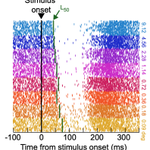
New results showing that an inevitable, unadaptable, and extremely short-latency behavioral reflex is an exclusively cortical phenomenon.
biorxiv.org/content/10.64898…
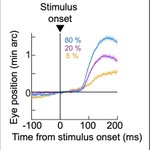
New results aiding our continued investigations of the multiple sensory pathways influencing the oculomotor system...
biorxiv.org/content/10.1101/…
New article with our Tübingen neuroscience colleagues, identifying common principles across vastly different species and sensory-motor modalities.
hafedlab.org/2025/07/23/stat…
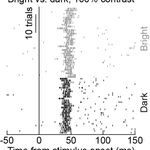
The superior colliculus exhibits qualitatively similar visual responses to those in the primary visual cortex. We show that this similarity masks a large fundamental difference between the two areas when it comes to active vision:
biorxiv.org/content/10.1101/…
New paper about foveal visual representations in the superior colliculus, and how they may help integrate visual scene information across rapid eye movements.
hafedlab.org/2025/06/24/fove…
Saccadic suppression was demonstrated in many species. In a new paper, using modeling and matched experimental paradigms in fish and primates, we explored the reasons for why saccadic suppression strength might be different in different organisms.
biorxiv.org/content/10.1101/…

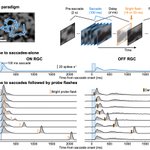
New paper establishing a novel paradigm for exploring the neurophysiological mechanisms underlying a well-known active vision phenomenon.
hafedlab.org/2025/05/26/new-…
New paper: "prediction error" signaling by foveal superior colliculus neurons across eye movements. Could be one building block for maintaining perceptual stability despite disruptions of retinal image streams caused by eye movements.
biorxiv.org/content/10.1101/…
New paper demonstrating saccadic suppression in zebrafish, as well as an intriguing selectivity for specific stimuli. In upcoming work, we'll also quantitatively compare the zebrafish suppression strength to that in primates.
biorxiv.org/content/10.1101/…