
This account is no longer used. Please see our current media on our website at: https://xitter.cf/t.co/9qg5ZVvdPn.
- Tweets575
- Following80
- Followers341
- Likes60






ALT Picture of the speaker, accompanied by the text in the tweet, and: Talk Description: We've all been there, whether it's an app on our phone suddenly closing or a full on "blue screen of death". Computer systems crash. Crashes are mostly harmless, if very annoying, but that's not always the case. What do we do when a computer system crashing might result in a physical car crash as well? Or when a more subtle error might cause a car to slowly veer off course? In this talk I will give an overview of the kinds of safety issues which can arise with computer systems, with a particular focus on automotive systems but also in safety critical systems in general. I will then discuss how we can approach the avoidance and mitigation of such safety issues in computer systems. Finally, I will outline how the automotive industry tackles said issues, and the standards and processes involved. Please note: this talk will not include any real life examples beyond abstract hypothetical scenarios.

ALT A picture of the talk's speaker, accompanied by the text: An Introduction to Reservoir Computing, or Why I’m Doing a PhD in Magic, by C Wringe 19:00–20:00 Thursday 24 February 2022 CSE/082&083 Unconventional Computing is a field in Computer Science that attempts to look at new ways of performing computation, and on a larger level, what “performing computation” even means. It can be approached from two directions: unconventional models, which looks at using models other than Turing Machines and Grammars, and unconventional materials, which looks at performing computation on any material that isn’t silicon. Reservoir computing is sort of both. It takes the dynamics of any given substance, and uses that to perform computations. In this talk, I’ll introduce the models behind Reservoir Computing, some physical instantiations of it, and then I’ll elaborate on the different ways it gets used in the literature.

ALT A picture of the talk's speaker, accompanied by the text: Talk: The History of Calculators by Aaron Christiansen 19:00–20:00 Thursday 3 February 2022 Online - HackSoc YouTube, Q&A in Discord Ever since picking up my first scientific Casio for GCSEs, I've had a strange fascination with calculators. Even in today's smartphone-dominated world, these single-purpose devices still hold an important place, especially in education. As one of the earliest forms of a crude pocket computer, they also have a rich history - which I'll cover in this talk! From the earliest mechanical models, to early vacuum-florescent display pocket calculators, and up to the present day, we'll explore notable models and advances made along the way to modern readily-available devices stuffed with extra features.

ALT A background collage of previous talks, with the text "Talks" overlayed.

ALT A picture of the speaker in the corner, followed by this text: What actually is an Operating System? By Jacob Allen Thursday 3rd December - 19:00-20:00 BST on YouTube Operating Systems are everywhere. At the core of most computers, be they desktops or embedded systems, an Operating System is running. However, there are a wide gamut of different things we call an Operating System. What, then, makes an Operating System what it is? Why do we even need Operating Systems in the first place? In this talk I will explain the origins of Operating Systems and what the roles of Operating Systems are in modern computing. I will also cover what the different forms of Operating System commonly in use are, some of why they are designed the way they are, and give my thoughts on what an Operating System actually needs to be an Operating System.

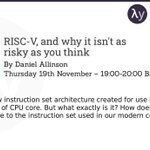
ALT A picture of the talk's speaker, accompanied by the text: RISC-V, and why it isn't as risky as you think By Daniel Allinson Thursday 19th November - 19:00-20:00 BST on YouTube RISC-V is a new instruction set architecture created for use in many different types of CPU core. But what exactly is it? How does it work? How does it compare to the instruction set used in our modern computers?

ALT [Talk] Talk In Which Matt Talks For 30 Minutes About Speedrunning 19:00–20:00 Thursday 11 November 2021 CSE 082&083 ("The Pod") Talk by: Matt Windsor Abstract: I'm Matt, and this year I started learning how to speedrun - a way of playing video games that emphasises trying to do tasks in the game as quickly as possible. I'll try to convince you that anyone can speedrun, any game can be spedran, and possibly some other things too. A sort-of sequel to the talk in which Matt talked for 30 minutes about Sonic. Please ensure that you have proof of a negative lateral flow test done up to 48 hours before. Face coverings are required for indoor HackSoc events, unless you are exempt. A British Sign Language interpreter will be present for this talk.

ALT You can win the enterprise but lose the world: a recent history of DevOps, k8s and Cloud Foundry by Miki Mokrysz Thursday 28th October - 19:00-20:00 in CSE/082&083 ("The Pod") Miki Mokrysz has spent years working on large-scale cloud platforms for the UK government, large enterprise, and small startups. In this talk they'll tell us about the DevOps side of the tech industry, how Kubernetes has gotten so big, and the huge projects like Cloud Foundry that couldn't beat Kubernetes. Please ensure that you have proof of a negative lateral flow test done up to 48 hours before. Face coverings are required for indoor HackSoc events, unless you are exempt. Unfortunately, a British Sign Language interpreter will not be present for this talk.

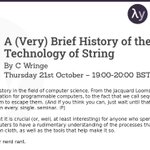
ALT A (Very) Brief History of the Technology of String By C Wringe Thursday 21st October - 19:00-20:00 BST on Youtube Textiles have their history in the field of computer science. From the Jacquard Looms that every first year learns was the inspiration for programmable computers, to the fact that we call sequences of characters strings, we can't seem to escape them. (And if you think you can, just wait until that one student brings it up as an example in every. single. seminar. :P) Given this, I posit that it is crucial (or, well, at least interesting) for anyone who spends a lot of time thinking about computers to have a rudimentary understanding of the processes that take fluff and turn it into string, and then cloth, as well as the tools that help make it so. So have my half-hour nerd rant.

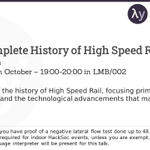
ALT An Incomplete History of High Speed Rail By Iris Scoffin Thursday 14th October - 19:00-20:00 in LMB/002 An overview of the history of High Speed Rail, focusing primarily on new developments and the technological advancements that made them possible. Please ensure that you have proof of a negative lateral flow test done up to 48 hours before. Face coverings are required for indoor HackSoc events, unless you are exempt. A British Sign Language interpreter will be present for this talk.


ALT A grid of stills from our past talks, with the title "Talks" overlayed on top.