

Economist (https://xitter.cf/t.co/8S407DW9vk)
Joined March 2019
- Tweets10.9K
- Following1K
- Followers8.8K
- Likes52.3K





Pinned Tweet
A short essay related and describing the research of my paper with David Rahman:
"The Social Role of Competition Policy"
rafaelrguthmann.substack.com…

Eu vejo o Lula como representante de uma mentalidade pré-moderna no Brasil: uma mentalidade de relação rei-súdito, onde o Lula é o "painho", com sua corte (os "cumpanhero"), e o povo é súdito, não é cidadão.
O próprio marxismo, ideologia comum entre os intelectuais do PT, pode ser entendido como demonização ideológica da modernidade ("o capital malvadao"). Por isso seus policy makers não entendem que explodir a economia com gastos descontrolados é um problema: se a bolsa cai com os juros na lua, para eles, "o capital malvado perde" o que é bom: a modernidade (ou seja, "o capitalismo") é ruim.
O vejo, portanto, ideologicamente, como pre-moderno ou pre-iluminista e portanto nao é liberal. Nem liberal "didireita" como o Milton Friedman, nem "liberal esquerda" como o John Rawls.
É um rei absolutista wannabe que tem sua corte e seus súditos, se considera acima da lei ("o estado sou eu", por isso esquemas de corrupção mil), e se considera generoso porque distribui umas migalhas aos súditos (assistencialismo).

Lembrem-se, amiguinhos, ninguém tem ideologia liberal-capitalista só por morar em uma sociedade liberal-capitalista, e sim por ter a visão de mundo e as ações políticas moldadas pelo liberalismo. Do mesmo modo, ninguém é cristão só por viver em país cristão, ninguém é católico-romano só por viver em país de cultura religiosa católica-romana, ninguém é Flamengo só por vir de família rubro-negra.
Lula é liberal porque quer. Ele é neoliberal por escolha política. Não porque ele foi obrigado a ser por circunstâncias. Lula governa pros banqueiros porque decidiu ser pelego.
Não compactuem com pelegos, neoliberais, e representantes de banqueiros. Deem um sonoro ''não" ao sapo barbudo enterrado no quintal brasileiro e que destrói o país desde os anos 1980.
Não precisa dar um 'sim' a Flávio, algo que tampouco recomendo. Mas libertem-se da escravidão ao lulopetismo.
Its true that, however, mid-20th century sci-fi predictions of greatly increased human control over the material world did not fully materialize over the past 60 years or so.
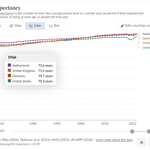
Some people in ca. 1970 were predicting there would be a comparable population living outside of Earth than at Earth by the mid 21st century. Instead, over the past 60 years we got about 8-9 years of increased life expectancy in the developed world*, which is significant but not the radical change people around 1970 expected.
*from 70-75 years in 1965 to 79-84 years in 2025.


In Brazil the situation is even more extreme:
1. There are 39 million formal private sector employees.
2. There are 20 million families on government welfare, with nearly 60 million people, plus 37 million people that are retired and receiving government pensions (however, in Brazil many "retired" people continue working in the informal sector).
Brazil is a country of 210 million where 39 million formal workers produce 85-90% of GDP. The inequality in productivity is even more pronounced if you consider that the 270 major public companies in the Brazilian stock market produce 18% of Brazil's GDP while employing 2.8 million workers (portal.fgv.br/noticias/estud…). That means that 1.3% of the total population and 2.7% of the labor force produce 17.9% of output in the nation.
This shows the enormous but so far unexploided growth potential in Brazil: if we increased the average labor productivity of Brazilian workers to the standard of the 270 major public companies, GDP would be 6.6 times the current figure, higher in per capita terms than in the US or Switzerland.


The biggest, and stupidest, myth in European politics, particularly popular in France, is that Europe suffers the consequences of "austerity" and "neoliberalism". In the biggest 5 countries in Europe, more than half of the population makes its income from the state, less than half from the private sector. This is what makes the problem of reducing the welfare state so impossible: more than half of the voters are net recipients. No surprise that Italy's budget has not been balanced in 100 years, France's in 50 years (ooh la la, l'austérité!!):
-France: 30 million from the state versus 21m private sector workers. State spending is 57% of GDP, taxes more than half the economy. The budget hasn't been balanced in the lifetime of most French (since 1974).
- Germany: 35 million adults from the state, versus 34 million from the private sector. 10% of the population is registered as severely disabled. Public spending is over half of GDP. Germany has had a continuous budget deficit since 2019.
-Italy: 23 million from the state, versus 20.5 million private-sector workers. Public spending is 51% of GDP. Italy has had a budget deficit every year since 1925, for 100 years.
- Spain more people get their income from the state since 2024: 18.21 million from the public sector versus 17.9 million people working in the private sector. Since 2025, Spain also had more government employees than self-employed workers (autónomos) for the first time in history. State spending is at 45%, budget has not been balanced since 2007.
- UK: 54% of households now receive more in state benefits than they pay in taxes. State spending is 44.5% of GDP, taxes (40%) are at their highest since 1950, the budget hasn't been balanced since 2001, and 1 in 5 new cars is paid by the government through a bizarre state disability scheme (Motability).

Bem, o Brasil cresceu mesmo de 1945 até 1980.
Desde a redemocratizacao e a constituicao de 1988 nao existiu um foco serio em crescimento. O que é algo bem absurdo dado o nosso nivel de PIB per capita: nossas elites políticas tentaram impor uma social-democracia escandinava na canetada em uma economia mais pobre do que a da Bielorrusia. Nunca teve a menor chance de dar certo.
Desde 1980 o Brasil teve dois breves periodos de prosperidade: 1992-1998 e 2003-2008. Ambos foram insustentaveis porque os governos nao mantiveram disciplina fiscal e nao reduziram a burocracia: FHC quase dobrou a carga tributaria em um pais que ja tinha altísima carga tributaria para seu nivel de renda. O caso do outro nem preciso comentar, parece que a funcao objetivo deles colocou um sinal negativo na produtividade total dos fatores do pais.

Menander's play from around 300 BCE shows an interesting piece of information: the Greeks at the time understood the world to be a world of cities, and conjectured it had about 1000 of them, with an average size of 30,000. Their notion of city and its population included both the urban center and the suburbs/agrarian hinterlands.
While modern estimates puts the number of ancient Greek city-states existing at Menander's time to be about 1000, the average size appears to be substantially smaller: archeological surveys can be aggregated to reach an estimate 50 hectares in the average area of the ancient Greek walled city center, which suggest an average population about 7,500 to 10,000 for these thousand Greek city-states around Menander's time.
However, since the average ancient Greek was more likely to live in the larger cities than the average (because you are a thousand times more likely to live in New York than a town a thousand times smaller), and I had estimated that ordering cities from larger to smaller implied that the median Greek lived in a city-state of 28,000.
In addition, Menander also likely considered non-Greek cities in his guess, as Aristotle talked about places like Babylon and Carthage as well. But it is true that the vast majority of cities existing in the Mediterranean world were culturally Greek at that time (300 BCE).

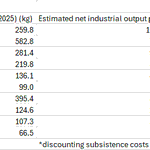
These pictures show very clearly how the world changed in the last 100 years. While large income gaps still persist across countries, industrialization went global over this period: we now live in a completely different world from the world of ca. 1920-1940 when the industrialized world was just Europe+US.


I saw it recently too. I read the book a few weeks before then watched the movie to check if it was too different. Actually it was a closer adaptation than most movie adaptations of books.

Nobody really understands the *full mechanism* of anything since any form of understanding is a theoretical construct which is based on assumptions that are taken as a given.

I don't think so.
Given that an Indian farmer already has access to (near) cutting edge free Chinese AI in their cell phones, AI is part of equalization in access to technology: the Indian farmer today has the equivalent of a Harvard professor's research assistants to provide information for them.
Its true the big companies have better AI than the Indian farmer, but having faster/more powerful AI will mean less and less over the next few years than it does today, thanks to the universal principle of diminishing returns.

AI will be a forceful inequality multiplier. It will make winners reap greater rewards than ever before, with losers lagging way behind, not being capable of harnessing the technology.
This applies to countries and individuals alike. For income, wealth, and most importantly, human capital.
This will be a painful transition.
Brazil has the world's most high stakes presidential elections: because so much power is represented in the executive, the future of 210 million people depends on a vote difference of 2-3%.
For example, if trend of the 1st round continues to the 2nd round, then the change in macroeconomic trajectory might be similar in scale to the change that occurred in Eastern Europe after the fall of the Berlin Wall.


I think it can be illustrated like this:
Country X consumes 100: 75 of services and 25 of manufactured goods. If it has trade balance and pay for imports with exports, X's economy becomes 75% services and 25% manufacturing in the allocation of factors and in output.
If country X increases consumption above output using government debt, to lets say 110, it will have net imports of manufactured goods of 10.
It will consume 82.5 in services, 27.5 in m. goods, net imports 10 of m. goods and produce only 17.5 in m. goods and 82.5 in services.
Thus, manufacturing output will be down 30% thanks to this fiscal policy.

It is pretty obvious to me that the US government choice to build up massive debt after 2000 has been driving it's de-industrialization: if the government consumes more than it collects in tax revenues that increases domestic absortion which increases net imports and supresses domestic production of manufactured goods.
One might say it was dollar's role as global reserve and trade currency that made it easier to accumulate debt, but still they could have had some discipline to avoid increasing the national debt from 4 trillion to 40 trillion over 25 years.

In my opinion, blaming China has been a means for American elites to avoid reflecting on their own role in their country's issues.
Back in 2005, even Brad Setser acknowledged dysfunction in the US political economy as a cause of global imbalances. Twenty years later, he gives the impression that it is just China.
And that's also why any attempt to econometrically determine China's causal role in deindustrialization post-2000 is going to have a problem with confounders.


O PT literalmente comprou o congresso ja no seu primeiro mandato, como o mensalao revelou em 2005.
Em uma democracia representativa, como deveria ser o caso do Brasil, o congreso consiste nos representantes do povo que sao eleitos para representar os interesses de seus eleitores.
Quando vc compra os votos dos congressistas com uma transferencia bancaria direta na conta pessoal deles para implementar seu projeto politico, vc esta literalmente destruindo a democracia.
Entao, quem votou no PT em qualquer eleicao desde 2005 pode se dizer que realmente se importa com a democracia?
