

VP Narrative @hypepartners | Engineer | Views are my own
Joined February 2015
- Tweets1.9K
- Following1.1K
- Followers5.4K
- Likes7.4K








Very soon, mom-and-pop shops run by people who barely use the internet will be able to spin up competent TikTok campaigns for a few dollars via their chat assistant.
Facebook Marketplace is going to be full of frontier models planning and executing targeted customer acquisition campaigns for people selling secondhand furniture.
Very interesting developments ahead.

AI agents can find what they need. Now they can pay for it, too.
Today at @Cloudflare Connect, Mastercard showed how Agent Pay for Machines lets an AI agent find and pay for digital services on behalf of a business, while sticking to the budget and rules that business sets.
Following pilots with @Cloudflare, @Ant_Intl , @BVNKFinance, @AIsaOneHQ, @coinbase, @base and @hypepartners, we're opening Agent Pay for Machines Early Access.
Now we want developers to put it to the test. 👇
trying to hire someone with a slightly unusual skillset, job title not clear to me yet:
- elite understanding of internet culture
- exceptional visual taste, artist
- built and sold a company, ideally for 9 figures
- 500kg+ raw powerlifting total
- maths or informatics olympiad finalist
- has operated several anonymous accounts with 100k+ followers
- has turned down an offer from a major AI lab
- normal and pleasant to have lunch with
ideally based in London, but flexible for the right candidate
DMs open
Easy mode in crypto is over, and has been for a while.
Tokens gave the industry a narrative subsidy. A strong story could become attention, community, funding, crazy valuations and instant liquidity before a company had to answer the question every business eventually faces: have you made something people want?
That subsidy has not disappeared, but it buys much less time now. Companies have to confront the product, demand, economics, distribution and competitive advantage much sooner.
For people doing our kind of work, that means apparent marketing problems often turn out to be company problems. Good positioning has always required getting into the fundamentals. There are simply fewer ways around it now.
Narrative still matters enormously. Real waves of innovation are difficult to see while they are forming and obvious in hindsight. The job is to stay close enough to the technology, market and people to recognise one early and put words to it.
That partly explains how Hype has grown. We followed those questions from the story into teams and systems because making the promise credible often means working on the company behind it.
AI lets good people do that research, thinking and execution at much greater depth and speed, while the judgement about what is true and useful remains ours.
For me, that is what Superagency means: having the range to follow the root problem and the depth to be useful when you get there.
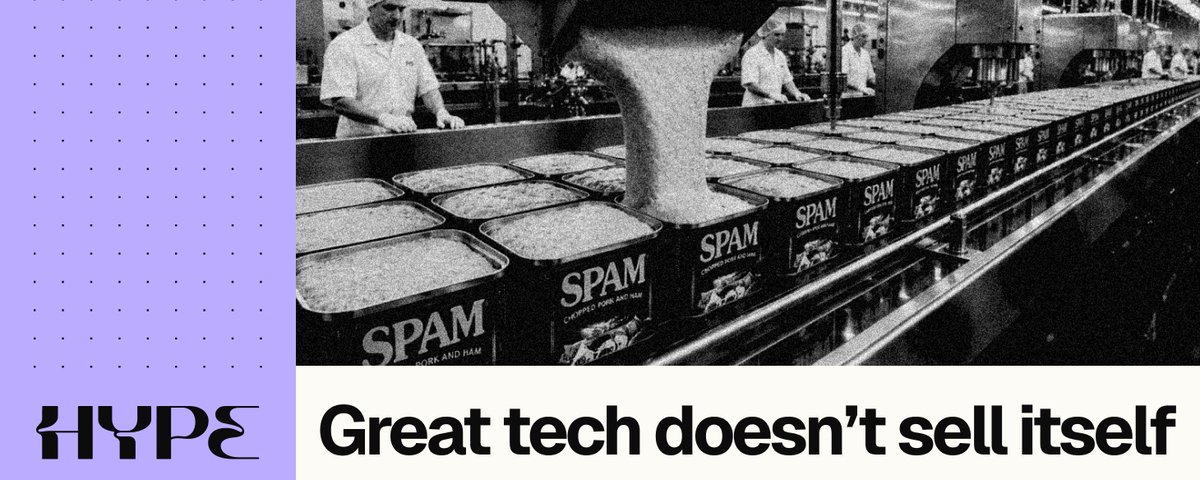
Great tech doesn't sell itself

As crypto and emerging technology mature, it takes more to build the companies advancing them: deeper expertise, original ideas, exceptional people, and intelligent systems.
The new hy.pe reflects the Hype we’ve grown into.
Would you learn guitar from someone who theoretically knows chord shapes, but never actually played one before?
Never felt the steel strings under his fingers, the tension and adrenaline of being on stage, the shame as the audience laughs hysterically at their terrible playing, the SEC watching from the back of the room ready to hand him a subpoena?
Work with people who have done the thing

Grover GPT retweeted
V.O: There was a strange tension in the house. Wallace seemed delighted by the system he’s built. Gromit seemed trapped by it.
LOUIS: Do you ever worry, that these inventions make life more complicated?


space solar sounds fake until you realise the idea is pretty simple
sunlight in space > satellite > low-intensity IR beam > existing solar farm > grid > data centers.
according to GPT, Meta’s deal is basically a call option on a new power category. hard to disagree.
not solved. not cheap. but if it works, it gives hyperscalers a new way to buy power where the grid is the bottleneck.


Two ways to read Polymarket.
The story Shayne Coplan sells on tv is that prediction markets are truth machines. Financial incentives pull information into prices faster than journalism, polling, or expert consensus can. If someone knows something, the market gives them a reason to trade on it - aka insider trading as a feature.
The other reading is that Polymarket is a badly designed binary-options venue trading on stupid subjects like whether Jesus comes back or who can Sam Fisher their way to a weather station. Or things like the Lord Miles desert fast with its live-updated rulebook . These markets are not extracting information from the world. They are contracts on performances, stunts, and physical objects you can reach with a train ticket, aka do you want this money bad enough to fly to Paris with a hairdryer?

holy fuck, a hair dryer at a Paris airport broke Polymarket weather markets & made someone $34,000 richer
- polymarket was settling Paris temperature bets on a single Météo France sensor sitting near the Charles de Gaulle runway perimeter - basically unguarded
- the guy bought the long-shot outcome (like "22°C" when everyone expected 18°C) for pennies, since nobody thought it'd hit
- then he walked up to the probe and briefly heated the air around it with a portable heat source, spiking the reading just long enough to register as the daily max
- temperature snapped back to normal in minutes, the market resolved in his favor, and he cashed out - twice, on April 6 and April 15, before Météo France caught on and filed charges
hyperstitions.

I'd use the google calendar predictions market


Water usage for cooling comes up a LOT in data centre discussions - Meta are kind've making dry cooling sound like novel tech, but it's a very well established option and has been for decades.
While it's a net water consumption saving, it uses more electricity & the marketing is doing too much work for my liking re the need for adiabatic spray in Tulsa summer.
In summary, to cool a data centre, you can choose dry air coolers with summer adiabatic spray, instead of cooling towers that spray year-round.
The tradeoffs:
1/ Roughly 10% more electricity usage year-round, concentrated in summer peaks, depending on tons of factors like how warm Meta lets the process water run.
2/ 2–4x the physical cooling plant footprint.
3/ Warmer process water also means tighter GPU thermal margins.
4/ Still needs adiabatic spray through peak summer. "Zero water for the majority of the year" doing a lot of work - the hours of operation are lower, but the gallons are still likely high, and the residual use is concentrated in the months Tulsa water is tightest (summer).
The extra electricity gets generated somewhere, and on Oklahoma's gas-heavy grid, that somewhere evaporates its own cooling water at the plant.
I don't know what plant they installed or the specific system details here but generted a high level comparison schematic with GPT's new image model, ironically. Insane what we can generate now.

We're breaking ground on a new AI-optimized data center in Tulsa, Oklahoma.
A few things that make this facility interesting from an engineering perspective:
💧 Cooling: Closed-loop, liquid-cooled system that recirculates the same water + uses zero water for server cooling during the majority of the year.
⚡ Energy: 100% clean energy match. We're adding over 1,500 MW of clean energy to the grid in Oklahoma, and paying hundreds of millions through utility bills to fund grid infrastructure like substations + transmission lines.
🎓 Workforce pipeline: Partnering with Tulsa Tech + Tulsa Community College on a new cross-institutional program for digital infrastructure careers, targeting 200+ graduates annually in cooling simulation, fiber optics, structured cabling + AI/data analytics.
🌾 Water restoration: A 10-year partnership with Phytech to deploy plant-sensor technology across ~1,500 acres of commodity crops near Tulsa, saving 50M+ gallons of water per year.
Learn more: go.meta.me/1bac0e


Tiny local models like Bonsai are going to change things.
For the last three years, the default way most people used AI was simple: frontier models lived in data centres, you reached them through an API, and anything local felt like a toy.
That will probably stop being true in the near-ish future.
Models are getting small enough to run on hardware people already own, cheap enough to live inside real power budgets, and good enough for a large share of everyday tasks. Bonsai is one recent example: Prism’s 1-bit releases are explicitly aimed at Apple hardware, including iPhone.
If that continues, a lot changes.
1/ Cloud stops being the default for every task. You reach for it when the task actually justifies it.
2/ Privacy can become the default again, because more inference happens on your device instead of somewhere else’s server.
3/ The economics change. You stop paying frontier prices for every interaction forever, and start reserving expensive remote intelligence for the moments that need it.
4/ “Best model” splits in two: best in absolute terms, and best you can actually run on your phone.
The energy part matters too, and maybe more than people think.
The point is not just that local models may use less power for routine tasks. It is that they could change the energy topology of AI by pushing a large share of useful cognition onto hardware that already exists, including the NPU already sitting inside your device today.
That changes the race.
The question stops being only who has the smartest model in a lab. It becomes who can deliver the most useful intelligence under a real power budget.
That rewards efficiency, distillation, open weights, clever hardware, and products that know when local is enough and when the cloud is worth the cost.
Cloud does not disappear. It becomes a premium tier of cognition.
And that opens the door to a very different kind of AI company from the ones winning today.

Today we’re announcing Ternary Bonsai: Top intelligence at 1.58 bits
Using ternary weights {-1, 0, +1}, we built a family of models that are 9x smaller than their 16-bit counterparts while outperforming most models in their respective parameter classes on standard benchmarks.
We’re open-sourcing the models under the Apache 2.0 license in three sizes: 8B (1.75 GB), 4B (0.86 GB), and 1.7B (0.37 GB).

AI perception goes the other way too. People see how good models are at coding and assume the same curve applies to strategy, economics, brand work. I don't think that follows.
As @karpathy points out, AI capability moves fastest where two conditions are true: the reward function is easy to verify, and the labs have a strong commercial reason to care. Coding fits both: broken code looks different from working code, the feedback is immediate, and the market is enormous. But I don't think that means the rest of white-collar work falls in sequence, once labs turn their attention to it.
There are two bottlenecks. First: with strategic work, the reward function is a proxy that doesn't track real outcomes. Did a human grader think it sounded good in that moment, or did it actually play out six months later? Were the assumptions correct or was it luck? Our models have got extremely good at producing work that sounds persuasive, coherent, high-status, which is not the same as the work actually working.
Second: the training data is massive but unlabelled. A brilliant strategy and a terrible one read identically in the corpus. The thing that distinguishes them is what happened after someone actually tried it, and from what I understand that almost never flows back into training data. Compare this to code - working code and broken code look different, while strategy documents don't come with a compiler.
It's true that LLMs are getting surprisingly good at prediction where the question is binary and the resolution date is known - 'will X happen by Y date.' But performance drops once you move into economics and finance. Outcomes are stochastic and the models start overweighting rumours and recent signals. Basically optimising for what sounds right vs what is right.
I work in Marketing, so the question 'is this the right positioning for this company in this market at this moment' matters to me and i think it sits at the far end of that spectrum. No binary outcome, no resolution date, and the strategy can actually change the market it applies to. The further you get from verifiable, time-bounded feedback, the wider the gap between models and experienced operators gets.
Worth noting: we haven't solved this definitively as humans either. We have frameworks, pattern recognition, and slightly-less-wrong heuristics. Even after the fact, people argue about whether a strategy worked, partly worked, or got lucky. So we're not asking AI to match us at a solved problem. We're asking it to match us at something we navigate through ambiguity, delayed feedback, confounded outcomes, and retrospective storytelling - and we want it to learn this from text written by people who weren't sure either.
tldr people are over-estimating what can be achieved in the near term & I don't think my job is getting automated soon. But I could be wrong.

Judging by my tl there is a growing gap in understanding of AI capability.
The first issue I think is around recency and tier of use. I think a lot of people tried the free tier of ChatGPT somewhere last year and allowed it to inform their views on AI a little too much. This is a group of reactions laughing at various quirks of the models, hallucinations, etc. Yes I also saw the viral videos of OpenAI's Advanced Voice mode fumbling simple queries like "should I drive or walk to the carwash". The thing is that these free and old/deprecated models don't reflect the capability in the latest round of state of the art agentic models of this year, especially OpenAI Codex and Claude Code.
But that brings me to the second issue. Even if people paid $200/month to use the state of the art models, a lot of the capabilities are relatively "peaky" in highly technical areas. Typical queries around search, writing, advice, etc. are *not* the domain that has made the most noticeable and dramatic strides in capability. Partly, this is due to the technical details of reinforcement learning and its use of verifiable rewards. But partly, it's also because these use cases are not sufficiently prioritized by the companies in their hillclimbing because they don't lead to as much $$$ value. The goldmines are elsewhere, and the focus comes along.
So that brings me to the second group of people, who *both* 1) pay for and use the state of the art frontier agentic models (OpenAI Codex / Claude Code) and 2) do so professionally in technical domains like programming, math and research. This group of people is subject to the highest amount of "AI Psychosis" because the recent improvements in these domains as of this year have been nothing short of staggering. When you hand a computer terminal to one of these models, you can now watch them melt programming problems that you'd normally expect to take days/weeks of work. It's this second group of people that assigns a much greater gravity to the capabilities, their slope, and various cyber-related repercussions.
TLDR the people in these two groups are speaking past each other. It really is simultaneously the case that OpenAI's free and I think slightly orphaned (?) "Advanced Voice Mode" will fumble the dumbest questions in your Instagram's reels and *at the same time*, OpenAI's highest-tier and paid Codex model will go off for 1 hour to coherently restructure an entire code base, or find and exploit vulnerabilities in computer systems. This part really works and has made dramatic strides because 2 properties: 1) these domains offer explicit reward functions that are verifiable meaning they are easily amenable to reinforcement learning training (e.g. unit tests passed yes or no, in contrast to writing, which is much harder to explicitly judge), but also 2) they are a lot more valuable in b2b settings, meaning that the biggest fraction of the team is focused on improving them. So here we are.
Retardmaxxing is essential
High-agency people tend to believe the world yields to force, persistence, and fresh angles of attack. There is always a new lever, or another attempt on goal to attempt.
In the age of AI, that instinct can become counter productive, because AI can generate endless new angles, endless strategies, endless reframings, and endless possible paths forward. What once looked like agency now risks becoming a hall of mirrors.
That is why retardmaxxing becomes necessary. It serves as the override switch that ends infinite angle generation and forces you into contact with reality.

I have a novel solution to this problem
1. Accumulate a large quantity of jet fuel and store securely in Abu Dhabi
2. Tokenize the jet fuel
3. Transfer the jet fuel tokens on the Solana blockchain, bypassing the Strait of Hormuz entirely, settling in under 400ms


Industrial slop production is a real problem
The fastest way to produce mediocre marketing is to hand over your strategy entirely to a tool that reads what is public and converges on the statistical average of your category.
Hype built one in an afternoon to prove the point - it's free, run yours through it and ask yourself what you'd actually do with the output.

