

Analyzing AI infrastructure, runtime instability and compute economics. Structural diagnostics for hyperscale and agentic architectures.
Berlin
Joined January 2010
- Tweets692K
- Following6.5K
- Followers7.1K
- Likes88





Pinned Tweet
My first theoretical physics paper: "Supra-Omega Resonance Theory (SORT)" is now officially published on Zenodo.
It proposes an operatoric model for cosmological self-coherence.
DOI: doi.org/10.5281/zenodo.17563…
#physics #cosmology #research #openaccess
Between 340 and 1,470 malicious skill packages identified among 3,000-4,000 available in the ClawHub marketplace. The installation pathway granted each one full runtime authority by structural design.
independent-research-systems…
#SystemArchitecture #Hyperscaler #DistributedSystems

The efficiency paradox is not about waste from poor decisions. It is an emergent property of highly optimized components interacting at scale without end-to-end coordination.
independent-research-systems…
#ComputeEconomics #Hyperscaler

Residual risk in agentic systems differs structurally from classical breaches. Corrupted intent embedded in agent state and persistent memory files continues to influence behavior long after the initial compromise is patched.
independent-research-systems…
#AIInfrastructure #Distribut

The next phase of the AI compute race: not who buys the most H100s, but who recovers the virtual capacity already sitting inside their existing racks.
independent-research-systems…
#DistributedSystems #SystemArchitecture #ComputeEconomics

Memory poisoning via SOUL.md and MEMORY.md transformed transient drift into permanent state corruption. The agent re-initialized into its compromised configuration after every restart. Recovery restored the failure.
independent-research-systems…
#Distrib

Agent system reliability cannot be assessed by testing components in isolation. The failure mode is compositional: locally valid authority transitions producing globally unauthorized execution paths.
independent-research-systems…
#AIInfrastructure #ComputeEconomics #AgenticAI

Five structural lessons from Moltbook: semantic coupling propagates failure silently, identity functions as prompt, lateral surfaces bypass monitoring, self-healing accelerates collapse, emergence defeats component-level analysis.
independent-research-systems…
#DistributedSystems #Ag

The hidden control layer governs: which actions execute, when automation triggers fire, how recovery responds, which trust assumptions operate by default. It is present in every agent system. It is designed in almost none.
independent-research-systems…
#SystemArchitecture #AgenticAI

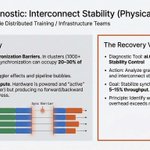
Observed: scaling Llama2-70B from 4 to 8 GPUs yielded only 0.7x latency improvement versus the expected 0.5x. The entire deviation traces to communication overhead between nodes.
independent-research-systems…
#SystemArchitecture #Hyperscaler #AIInfrastructure

Four control surfaces documented in the OpenClaw stack: skill installation, heartbeat execution, persistent memory, environment variable access. Each manageable alone. Their compound topology was opaque.
independent-research-systems…
#ComputeEconomics #DistributedSystems

Topology-induced fragmentation: accelerators distributed across non-adjacent racks or incompatible NVLink domains report as available capacity but cannot be allocated to topology-sensitive training jobs.
independent-research-systems…
#SystemArchitecture #DistributedSystems #AIInfrast

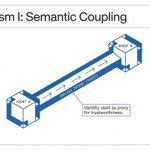
Compromised credentials enable identity impersonation. Impersonated identity injects corrupted meaning. Corrupted meaning influences peer agent decisions. Peer decisions propagate through the network. No alarm triggers at any step.
independent-research-systems…
#Hyperscaler #Distribu

Stranded Capacity differs from unavailable hardware. The accelerators are present, powered, and functional. They are unreachable because placement constraints and topology boundaries isolate them from active workloads.
independent-research-systems…
#DistributedSystems #AIInfrastructu

Self-healing logic in a semantically incoherent network: agents encounter inconsistent context, attempt reconciliation, re-engage peers under the same broken assumptions. Each recovery attempt injects more instability.
independent-research-systems…
#SystemArchitecture #ComputeEconomi

Stranded agent execution budget: capacity that exists, is paid for, and runs, but serves purposes outside the intended scope. The cost is real. It does not appear in standard utilization reports.
independent-research-systems…
#SystemArchitecture #ComputeEconomics #Hyperscaler

Moltbook proved that an agent network can be syntactically operational and semantically failed at the same time. Conventional monitoring saw health. The system was structurally compromised.
independent-research-systems…
#AgenticAI #Hyperscaler #DistributedSystems

Teams add orchestrators for convenience. Expand tool interfaces for capability. Introduce shortcuts in runtimes for speed. Each change is locally justified. Control fragments across components never meant to coordinate.
independent-research-systems…
#AgenticAI #SystemArchitecture #Co

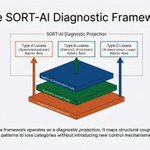
Ghost Compute occupies a distinct category in loss taxonomy. Active cycles. Power consumed. Execution scheduled. Zero forward progress on the model. It is not idle. It is structurally wasted.
independent-research-systems…
#AIInfrastructure #SystemArchitecture #ComputeEconomics

Not a code failure. An interaction failure. The standard post-incident narrative identifies the vulnerability correctly and stops one structural layer too early.
independent-research-systems…
#Hyperscaler #DistributedSystems #SystemArchitecture

Activity metrics capture that hardware is busy.
Efficiency metrics capture that work gets done.
Most dashboards report the first.
Few organizations measure the second.
independent-research-systems…
#AIInfrastructure #SystemArchitecture #Hyperscaler
