

Making Scripture, doctrine and church history clear for Nigerian Christians | Sunday school teacher | Husband | Chess player
Nigeria
Joined October 2023
- Tweets1.7K
- Following254
- Followers130
- Likes721





Pinned Tweet
I write about Church history, the Reformation, and Reformed theology.
To understand how the Church developed, what the Reformers actually taught, and why it still matters today, follow along.
First thread dropping soon.
Bible Nerd | Theology & Church History retweeted

Happy Anniversary My Joy,
It has been 40 beautiful years of love, friendship and God’s faithfulness.
I’m grateful everyday for the blessing of having you by my side.
May God continue to watch over us, protect us, and give us many more happy years.
I love you.

Bible Nerd | Theology & Church History retweeted
I think there is a deeper theological problem with the framework.
While family background, poverty, upbringing, and exposure can influence a person’s opportunities and outlook on life, Scripture does not measure the success of a Christian by economic advancement, social capital, influence, or the ability to rise above one’s parents.
When did living an ordinary, quiet, responsible life become mediocrity? Paul actually instructs believers to aspire to live quietly, mind their own affairs, and work with their hands (1 Thess. 4:11–12).
There is a difference between contentment and complacency. A Christian who has learned to be content in little is not necessarily suffering from a defeated mindset (Phil. 4:11–13).
And why should overcoming generational poverty be dismissed as merely doing better than one’s parents? By whose standard is that achievement insignificant?
More troubling is the suggestion that God cannot find someone to accomplish His purposes because their background has left them too disadvantaged. Have we forgotten Gideon? Or that God deliberately chooses the weak and despised things of this world (1 Cor. 1:26–29)?
Even the suggestion that people who cannot secure conventional employment should not enter ministry requires qualification. The qualifications for ministry are established in 1 Timothy 3 and Titus 1, not by corporate employability.
Yes, Christians should be diligent. Yes, poverty should not be romanticized. Yes, religion must never become an excuse for irresponsibility. But neither should ambition be baptized as kingdom purpose, nor should personal development be confused with the gospel.
A poor Christian can be spiritually mature. A wealthy Christian can be spiritually bankrupt. Social influence is not evidence of divine approval, and obscurity is not evidence of failed destiny.
The gospel is not a motivational programme for turning disadvantaged people into high achievers. It is the proclamation of Christ crucified and risen, through whom sinners are reconciled to God.
So here is my question:
If a man is born poor, works diligently, raises his family, serves his neighbours, remains faithful to Christ, and dies without ever becoming wealthy or influential, has he lived a mediocre life?
Because if your theology answers yes, then perhaps it is not the man’s life that needs re-examination, but your definition of success.
God has not called every Christian to be extraordinary in the eyes of the world. He has called every Christian to be faithful.
And faithfulness is never mediocrity.
Bible Nerd | Theology & Church History retweeted

We need to reconsider the frequent appeal to David's dancing as a justification for contemporary practices in corporate worship.
David's dancing in 2 Samuel 6 occurred during a public procession celebrating the transportation of the Ark of the Covenant. It was not an account of the prescribed worship conducted within the Tabernacle.


Bible Nerd | Theology & Church History retweeted

Hot take.
Your chess rating is actually not so important.

GOD is not looking for someone to take over the world. He never did! Just by simply reading the Bible will save us from all these theatrics and beside how wealthy is AFL?! With all these his valuable knowledge what has he produced? He is not listed among the top 20 wealthiest ministers in Nigeria oh!
Make Una no put me for talk.

Pastor, with all due respect, the Church is not Plan B because the family failed.
The family is God’s primary place for training children (Deut 6:6-7, Eph 6:4), and older women are indeed to teach younger women (Titus 2:3-5). Basic home training, including modesty should start at home. That part is true.
But the Church is not a backup plan that only became necessary because families dropped the ball. The Church is the body of Christ, the household of God, and the pillar and foundation of the truth (1 Tim 3:15, Eph 2:19-22, 1 Cor 12). Christ Himself builds His Church (Matt 16:18). It is Plan A in God’s redemptive purpose, not a substitute for failed parenting.
When parents fail in their responsibility, the Church can help, correct, and disciple, that is biblical (Gal 6:1, Eph 4:11-16). But framing the Church as “Plan B that exists because Plan A failed” is neither accurate nor helpful. It reduces the Church to a social repair shop instead of the living body of Christ.
Also, when we address these issues from the pulpit, it helps to open the Bible and show the people the actual scriptures rather than just ranting. People need the Word, not just the pastor’s frustration.
God’s design is clear, strong families and a strong Church. One is not the backup for the other.

1
1
218
Many assume David escaped the consequences of adultery and murder because he repented. Scripture teaches otherwise.
GOD pardoned David’s guilt, yet He did not remove the temporal consequences of his sin (2 Samuel 12:13–14).
Divine mercy does not nullify divine justice. Forgiveness reconciles the sinner to GOD, but it does not necessarily exempt him from the consequences of his transgression.
David was pardoned, but he was not left undisciplined.
Jesus said, “The poor you will always have with you.”
Yet we have created a version of Christianity in which nobody wants to be poor, and every believer is supposedly empowered to become wealthy.
So who exactly are the poor Jesus was talking about?
We quote Deuteronomy 8:18 about God giving power to get wealth, but conveniently forget James 2:5, where God speaks of the poor who are rich in faith.
We cannot all be billionaires. We cannot all be entrepreneurs. And we certainly cannot all measure God’s faithfulness by the size of our bank accounts.
There is nothing inherently sinful about wealth, just as there is nothing inherently righteous about poverty. But neither is wealth evidence of faith, nor poverty evidence of unbelief.
My concern is what we have made of the Gospel.
When our pulpits become platforms for wealth creation, financial empowerment and capacity building, while the doctrines of sin, repentance, justification, sanctification and the cross are relegated to the background, we ought to ask ourselves what exactly we are preaching.
Christ did not die to make every believer a millionaire. He died to save sinners.
The Gospel is not a ladder out of poverty into wealth. It is the proclamation of reconciliation between sinful men and a holy God through Jesus Christ.
And any gospel that makes financial prosperity its central promise has already shifted its attention from the riches of Christ to the riches of this world.
The problem with this statement is that it reduces Adam’s sin to a matter of nakedness, when Scripture presents it as the fall of humanity.
Adam was not merely a man who made a mistake; he was our federal head. Through his disobedience, sin and death entered the world (Romans 5:12–19).
David, like every other man, was already fallen in Adam. Only Christ, the last Adam, could undo what the first Adam did (1 Corinthians 15:45).
This is why theology matters. The Fall was not a wardrobe malfunction. It was a covenantal catastrophe.

Praying for mercy is an act of faith. Confessing your sin is an act of faith.
Jesus said the man who prayed, “God, be merciful to me, a sinner,” went home justified (Luke 18:13–14). And Hebrews tells believers to come boldly to the throne of grace to receive mercy (Heb. 4:16).
Christ’s blood is the very reason we can ask for mercy with confidence. And when we confess our sins, we’re trusting GOD to do what He promised: forgive us and cleanse us (1 John 1:9).
Don’t be deceived by men who twist the Word of GOD and call fear what Scripture calls confidence.

Asking for mercy is not a New Testament concept but a bias toward the Old. Mercy is not received through mere utterance; it comes through the payment of blood.
“Father, have mercy on me” is not a prayer of faith but of fear. What many wanted to ask for was grace, not mercy.
Understanding mercy reveals that it is a kind of judgment in itself.
76
The Church is the Body of Christ, and Christ alone is its Head (Ephesians 1:22–23; Colossians 1:18). It is neither a family inheritance nor a private estate to be passed from one generation to another.
The argument for hereditary succession in ministry, often drawn from the Levitical priesthood, fails to recognise the distinction between the Old and New Covenants. The priesthood of Aaron was established under the Mosaic Law and finds its fulfilment in Christ, our eternal High Priest (Hebrews 7–10).
Under the New Covenant, the qualifications for church leadership are not biological but spiritual. Paul instructs Timothy and Titus to appoint men on the basis of character, doctrinal soundness, and the ability to teach (1 Timothy 3:1–7; Titus 1:5–9). Nowhere do the apostles establish biological succession as the pattern for governing Christ’s Church.
This is why the controversy surrounding The Fountain of Life Church raises questions far beyond the personalities involved. It forces us to examine a troubling feature of contemporary Nigerian Christianity: the gradual transformation of churches from communities of believers into institutions built around the personalities, ambitions, and legacies of their founders.
When a ministry becomes inseparable from the identity of its founder, succession easily becomes a question of inheritance rather than spiritual stewardship.
And where faithful co-labourers are displaced merely to preserve a family legacy, we are no longer dealing with the biblical qualifications for leadership but with the preservation of an institution.
We must be careful not to confuse the continuity of a family name with the continuity of Christ’s work.
The Church does not belong to the man who founded the congregation, the family that bears his name, or the generation that succeeds him.
Christ is the Head. The Church is His Body. Ministers are stewards, not proprietors.
And no steward has the authority to turn his Master’s household into his family’s inheritance.

I wrote against Bishop David Oyedepo for retiring Bishop David Abioye, Bishop Aremu and my own pastor
Now I understand better
I FINALLY AGREE, CHURCH IS FAMILY BUSINESS
For a long time, I used to argue. I used to say church is not family business. Church belongs to God. Church belongs to everybody.
But after what Bishop David Oyedepo did, I finally agreed.
When he retired Bishop David Abioye, Dr. Aremu and others, many people were angry. Many people said, why retire men who have served faithfully for 40 years? Why send them home at the peak of their service?
Today, I understand.
Bishop Oyedepo is a wise man. He saw the future. He saw what is happening now at Fountain of Life Church.
He saw that if those powerful men remained in the system after his demise, they would become a problem for his son. They would have said, we are the elders. We know the church more than you. We were here before you were born. You cannot lead us.
And that is exactly what is happening to Pastor Jimmy Odukoya right now.
Pastor Taiwo Odukoya is gone. Now the board, the elders, the trustees, the people his father trusted, are the ones troubling his son. They are bringing out old videos. They are bringing court papers. They are bringing police to seal the church his father built.
Is this not what Bishop Oyedepo saw and prevented?
A founder can build a church, but if he does not secure it for his family, strangers will take it over after he dies and fight his children for it.
That is why I say, church is family business.
And let me prove it from the Bible, because some people think this is a new idea. It is not. God Himself made priesthood a family inheritance.
First, look at the house of Eli.
In 1 Samuel 2:27-36, God told Eli that He had chosen his father's house, the house of Aaron, to be priests before Him forever, to go up to His altar, to burn incense, and to wear the ephod. The priesthood was given to Eli's family by covenant.
Eli failed because he did not correct his sons, Hophni and Phinehas, so God judged that house. But the principle did not change. God still gave the priesthood to a family.
Then look at the Levites.
In Numbers 3:5-10, God said, bring the tribe of Levi near and present them before Aaron the priest, that they may minister to him. And in Deuteronomy 18:1-2, God said the Levitical priests, the whole tribe of Levi, shall have no portion or inheritance with Israel. The Lord is their inheritance.
In Exodus 28:1, God said, take Aaron your brother, and his sons with him, from among the children of Israel, that he may minister to Me as priest. Aaron, Nadab, Abihu, Eleazar, and Ithamar.
So from the beginning, God did not give the priesthood to the highest bidder. He did not give it to the board of trustees. He gave it to a family. From father to son. From Aaron to his sons. From Levi to his descendants.
That is why when Pastor Taiwo Odukoya handed over to his son Jimmy, he was not doing business. He was following Bible pattern. He was following the order of Aaron. He was following the order of Levi.
It is not about greed. It is about protection. A father must protect his legacy. A father must protect his children from those who will smile with him while he is alive, and fight his children when he is gone.
Oyedepo understood it. That is why he cleared the table while he was still alive. He retired them with honour, with houses, with cars, with respect, so that tomorrow, nobody will say his son is sitting on their sweat.
Pastor Taiwo Odukoya was too gentle. He trusted too much. He left his son to fight men who should have been retired with honour long ago.
And now Jimmy is paying the price for his father's gentleness.
Let this be a lesson to every founder. Retire your Abioyes and Aremus with honour while you are alive. Secure your family. Secure your legacy. Do not leave your children to fight for what you built with your blood.

70
The recent controversy surrounding Pastor Jimmy Odukoya and Fountain of Life Church has not particularly surprised me.
His earrings, tattoos and dreadlocks have always struck me as expressions of his personality and his understanding of personal liberty.
And while none of these things, in themselves, establishes moral failure, I have always wondered how far the modern Christian understanding of self-expression can go before it begins to conflict with the biblical call to modesty and holiness.
There is a reason Scripture calls believers to modesty, sobriety and self-control. We are not merely individuals expressing ourselves; we are people called to present our bodies as living sacrifices, holy and acceptable to God (Romans 12:1).
Even the early Christians, living within cultures that celebrated outward adornment and social status, were repeatedly exhorted to distinguish themselves through simplicity, restraint and godly conduct.
Of course, cultural respectability must never be confused with biblical holiness. But neither should Christian liberty become an excuse to dismiss every concern about outward conduct.
I do not believe a man’s hairstyle or jewellery can establish his character. Yet I believe the philosophy governing his personal expression is worth examining, especially when he occupies the office of a pastor.
For the Christian, and particularly for the minister, the question is not merely, “Am I free to do this?”
It is also, “Does this reflect the sobriety, self-control and example Scripture requires of me?”
Christian liberty is not freedom from the demands of holiness.
I’ve noticed that Guinness Foreign Extra Stout in a can tastes different from the bottled version. Personally, I prefer the canned version.
I wanted to ask if anyone else has noticed this, but I remembered that some of you will be more concerned about who’s drinking it than what it tastes like. 😂
🤖 Made with AI

36
Many believers cannot distinguish between a spiritual experience and an emotional experience, especially during worship.
We have become so accustomed to measuring spiritual encounters by how deeply we feel that we sometimes forget that emotions, however genuine, are not necessarily evidence of the Spirit’s work.
A man may weep without repentance, tremble without reverence, and rejoice without understanding.
This is why we must begin teaching discernment at the most basic level of Christian discipleship.
Not every feeling is spiritual, and not every spiritual experience is accompanied by extraordinary feelings.
The Christian must learn to distinguish between being emotionally moved and being spiritually transformed.
1
39
“No man that warreth entangleth himself with the affairs of this life; that he may please him who hath chosen him to be a soldier.”
— 2 Timothy 2:4 (KJV)
1
18
We have become accustomed to measuring churches by their buildings, crowds, influence and the gifts of their leaders.
But the New Testament gives us more demanding questions.
Is Christ preached faithfully? Are the sheep cared for? Is sin confronted? Are the weak protected?
18
Someone should ask him how many souls he has won to the kingdom this year?
Ride on Papa 😂

Be fruitful and multiply is about winning souls to his Kingdom, it has never been about carrying belle 🤦🏿♂️🤦🏿♂️
"Godly offspring", not offspring, there's a reason it's written that way, if you're a child of God who decides to have children, raise them the "godly" way.
1
78
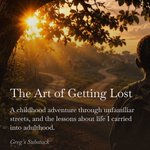
As a child, I used to wander through unfamiliar streets just to see if I could find my way back home. Some roads were shorter, others longer, and some led absolutely nowhere.
I never imagined those little adventures would teach me something profound about life.
Today, I wrote about those childhood memories, the wrong turns we make as adults, and the landmarks that help us find our way back.
Perhaps getting lost isn’t always the problem. Sometimes, it’s forgetting the way home.
My latest essay is now on Substack. I’d love you to read it, share your thoughts, and pass it along.
📖 The Boy Who Always Found His Way Home
🔗 Read here:
gregtafri.substack.com/p/the…

22