

Maxi Analysts ‖ Data ‖ Controversial Tweets ‖ Web3 Research
Joined January 2010
- Tweets18.8K
- Following504
- Followers4.4K
- Likes17.6K





Pinned Tweet
Top 10 Token Unlocks in November
Token unlocks worth $2.1 billion are expected in November
= $SUI - $146.55 million
= $ASTER - $84.99 million
= $PUMP - $51.18 million
= $ENA - $47.21 million
= $ZRO - $42.10 million
= $EIGEN - $40.13 million
= $APT - $39.19 million
= $COAI - $34.81 million
= $XPL - $33.08 million
= $ARB - $30.53 million

The moment scaling feels “solved” is when users stop noticing the chain
Cheap fees + fast finality quietly remove friction
Most people won’t know they’re using L2
Does invisibility become the real UX win?
ZK used to be a research topic
Now it’s production infra with real apps and liquidity
The interesting part isn’t the tech anymore, it’s the adoption curve
Are we underestimating how fast ZK becomes default?




GreatWeb retweeted
something something january


#PolygonProject #Polygon
* DeFi TVL: $1.169B
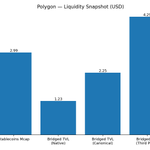
* Stablecoins mcap: $2.992B
* Bridged TVL: $7.774B (Native $1.229B, Canonical $2.255B, Third Party $4.291B, Own Tokens $615.87M)
* 24h: Transactions 6.08M, Active addresses 509,589, New addresses 55,169
* 24h: DEX volume $259.99M, Chain fees $98,077, App fees $423,600, App revenue $250,357

#Polygon is quietly turning into an internet of ZK chains
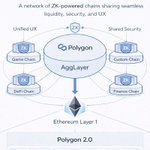
With @0xPolygon CDK any team can launch its own rollup while inheriting Ethereum security and shared liquidity via AggLayer – a coordination layer for cross-chain liquidity and fast messaging.
Key real network metrics today:
• ~546 K daily active addresses and ~3.4 M transactions/day on PoS alone.
• TVL ~$744 M in DeFi on Polygon PoS.
• Stablecoin supply ~$2 B+ and NFT activity picking up.
Apps don’t fight for users on one crowded chain — they scale horizontally but stay economically connected.
The real moat isn’t just TPS — it’s unified liquidity + developer choice across multiple specialized L2s backed by shared infrastructure.
That’s why builders and users keep coming back — scale without fragmentation.
Polygon’s Explosive Network Growth in 2025
Unique Addresses Hit a Record High
Polygon’s Proof-of-Stake network surpassed 500 million unique addresses in total – a massive adoption milestone reached by mid-2025. This means over half a billion wallet addresses have interacted with Polygon. The surge reflects real user growth: by the end of 2025, monthly active users on Polygon climbed past 14 million (more than double the year before).
Surging On-Chain Activity and Usage
Transactions: Polygon handled about 1.4 billion stablecoin transfers in 2025, a 227% year-over-year increase. This highlights booming on-chain payment activity, as users take advantage of Polygon’s low fees for everything from micropayments to remittances. In December 2025 alone, over 79 million transactions were processed in a single month – showcasing the network’s high throughput capacity.
Enterprise Adoption: Major fintech and Web2 companies have embraced Polygon. For example, Stripe processed over $50 million in stablecoin payments on Polygon, and digital bank Revolut saw about $690 million in volume after integrating Polygon for crypto transfers. These integrations indicate growing confidence in Polygon’s infrastructure for real-world applications.
Ecosystem Expansion and Partnerships
Polygon’s ecosystem growth underpins these metrics. The network’s scalability (including the launch of Polygon zkEVM for zero-knowledge smart contracts) and low-cost transactions attracted a wide range of projects. Big brands like Starbucks (for NFT-based loyalty programs) and Disney (for digital collectibles) have built on Polygon, as have numerous gaming and DePIN (decentralized physical infrastructure) projects. This broad adoption – from everyday payments to enterprise and gaming use cases – underscores Polygon’s emergence as a leading hub for Web3 innovation.
Polygon has quietly become the backbone for real crypto payments
It’s not just Stripe — Binance, Revolut, OKX, and other major platforms route stablecoin flows through Polygon
Over 1B+ stablecoin transactions per year, powered by low fees and fast finality
This is where exchanges actually move money, not just trade it
Polygon isn’t hype-driven adoption — it’s infrastructure adoption
Polygon quietly leads in real-world crypto adoption
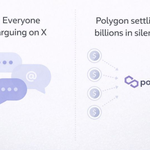
Everyone’s talking DePIN, but few chains actually settle real-world valuePolygon powers projects like Helium Mobile, Worldcoin onboarding, and on-chain identity for millionsAdd zero-knowledge infra + dev-friendly stack = ideal launchpad for utility-scale appsNot theory. It’s already happening.

$POL is not just a token upgrade
Most people still think $POL is just a rebrand of MATICBut it’s actually a new class of token — hyperproductive, protocol-native, built for multichain stakingIt secures multiple chains at once, with ZK-enabled governance at the base layerIn 12 months this will be the blueprint for modular token economies$POL is what MATIC always wanted to become

GreatWeb retweeted

Bringing money onchain isn’t about asking financial leaders to change how they operate, it’s about meeting them where they are.
We are going to meet the leaders, where they are!


#PolygonProject ≠ just a chain, it’s an ecosystem layer
Everyone’s focused on L2s competing with each otherMeanwhile, @0xPolygon is building something different — a network of ZK-powered chains united by shared liquidity and securityCDK + AggLayer = modular stack + seamless UX + #Ethereum alignmentIt’s not another alt-L2 playIt’s what Ethereum scaling actually looks like in 2026
