

Web3 infrastructure specialists. Partnering with protocols through continuous collaboration
Switzerland
Joined May 2024
- Tweets32
- Following115
- Followers27
- Likes22
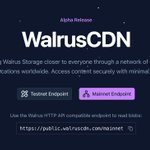


To improve latency on subsequent requests and decrease load on aggregators, extensive caching strategies are implemented on the edge.
This ensures high availability and low latency access to blockchain data by maintaining multiple aggregator endpoints across different geographical regions.
It implements a fallback mechanism where if a primary aggregator fails, it attempts to route through backup aggregators in the same region, and finally falls back to default global aggregators.
WalrusCDN is a geo-distributed Walrus blob aggregating service. It uses edge computing to intelligently route requests to the nearest aggregator node based on the user's location. The system supports multiple regions (EU West, EU East, US East, US West, APAC, and LATAM)
Big announcement from our friends at @Covalent_HQ - powering next-gen AI agents with their robust data infrastructure. Exciting times ahead! $CXT


We're excited for the anticipated launch of Swisstronik Mainnet, powered by SWTR. This is a big step for user privacy & decentralization and compliance in Web3.
5. Strategic Investments
$5 Million Investment (November 2024): Swisstronik secured a $5 million investment from Hong Kong-based Syndicate Capital Web3 Venture Fund as part of its ongoing Private SWTR Token Offering. This investment underscores the demand for blockchain compliance solutions and brings Swisstronik's total funding to $11.5 million.
4. Testnet Developments
Testnet 1.0 (July 2024): Swisstronik launched its first testnet, providing dApp developers with robust encryption and enterprise-grade transaction security through Intel SGX technology. The testnet is fully compatible with the Ethereum Virtual Machine (EVM), facilitating seamless migration of Ethereum-based dApps and smart contracts.
Testnet 2.0 (September 2024) : Building upon the initial testnet, Testnet 2.0 introduced features such as enhanced customizable privacy, a revamped Swisstronik JS SDK, and user-friendly block explorers. This version aims to mirror the core functionalities planned for the mainnet, inviting developers to interact with the ecosystem and provide feedback.
3. Developer and Community Initiatives
Grant Program Launch (May 2024): Swisstronik introduced a grant program offering over $1,000,000 in rewards for developers building on its platform or utilizing partner technologies.
Hyperlane Challenge (June 2024): In collaboration with Hyperlane, Swisstronik hosted a developer challenge encouraging the creation of cross-chain applications.
Secret Network Collaboration: Plans were announced to launch joint developer grants with Secret Network, aiming to foster collaborative development efforts.
2. Application Enhancements
Staking and Governance Support (May 2024): Swisstronik expanded its application functionalities across iOS, Android, and browser extensions, enabling users to:
- Stake assets and participate in governance activities across Cosmos-based networks, including Swisstronik, Cosmos, Osmosis, and Secret.
- Delegate tokens to validators to earn rewards and contribute to network security and decentralization.
- Engage in on-chain governance by voting on proposals, influencing the future of the ecosystem.
1. Major Blockchain Upgrades
Chain Upgrade (May 2024): Swisstronik implemented a comprehensive chain upgrade that introduced several key features:
- Updated Encryption Schema: Enabled random nonce usage and prepared cryptographic primitives for key rotation, enhancing data security.
- Key Rotation Mechanism: Introduced a mechanism to change encryption keys in response to potential vulnerabilities in Intel SGX, ensuring continuous block production and transaction security.
Excited for STRK staking to go live on Mainnet!
Graphyte Labs is proud to be a validator from day 1 of @Starknet Staking Testnet and Mainnet

STRK Staking phase 1 is officially live on Mainnet!
If you want to take part in this initial phase (or in futures phases) and contribute to the decentralization of Starknet, you can now:
💠 Become a Validator: Open to everyone, this requires running a full node and staking a minimum of 20,000 STRK tokens. Learn more here: docs.starknet.io/staking/ent…
💠 Become a Delegator: No technical requirements; simply choose a validator to delegate your tokens to.
For delegators, many professional validators and projects have already announced their support for STRK staking, including: @StakingRewards, @bitwise, @Luganodes, @ValidationCloud, @0xvoyageronline, @avnu_fi, @Nimbora_, @karnotxyz, @zkLend and many more.
Voyager, Stake Rewards and Endur have created dashboards to make it easy for you to delegate:
>xitter.cf/0xvoyageronline/status…
>xitter.cf/endurfi/status/1858887…
>xitter.cf/luganodes/status/18595…
You’ll also be able to stake (delegate) directly from your @argentHQ and @myBraavos wallets.
The initial staking figures are available below.
As a network built from first principles and prioritizing security above all, we are proud to be the first to introduce a staking framework directly on L2.

Graphyte Labs retweeted

$STRK staking on @Starknet mainnet is just a week away going live on Nov 26th! 🚀
We are proud to reveal our UI of Voyager where you can easily delegate to the staking operator of your choice!
🔗Bookmark voyager.online/staking-dashb… and be the first to explore it live next week!
Proud to be a Validator from the first day of Phase 1!
While the first phase of staking is already live on Starknet Sepolia, it’s important to emphasize that this is just the beginning of a broader plan to transform Starknet into a fully decentralized PoS network.
Here’s how we envision this transition:
💠 Phase 1: Introduction of staking with a permissionless staking protocol and stake delegation. Validators are expected to run a full node in preparation for the next phases.
💠 Phase 2: Validators will begin attesting to blocks, i.e., signing blocks when their turn is randomly selected.
💠 Phase 3: Validators will validate and vote on blocks sequenced by the sequencer, and their consensus will be proved to L1.
💠 Phase 4: Validators will be fully responsible for maintaining and securing the network by producing, attesting, and proving blocks.
We’ve chosen a gradual implementation for several reasons. This phased approach allows us to carefully roll out staking and make adjustments over time to meet the evolving needs of the community. The first phase in particular will provide valuable insights, enabling us to test, learn, and adapt based on community activity, feedback, and usage patterns. Additionally, this gradual rollout ensures a smooth experience for stakers, giving them time to prepare for their new responsibilities.
Please note that this is not a rigid or static plan; it may evolve based on what we observe along the way.
