

Partner, First Point PLLC | tweets my own | tweets not legal advice | tweets are Mets bullpen management advice | rt's=marriage proposals
DC
Joined February 2009
- Tweets1K
- Following676
- Followers259
- Likes6.4K


Andrew W. Grant retweeted

This is an interesting thought, but won't happen for a few structural reasons:
1) Most consumers are too busy to hunt for yield on their deposits. They're busy driving to work. Making lunches for their kids. Cleaning. Taking care of ailing parents. Fighting medical bills. Watching football. Doing other activities.
2) Consumers who live paycheck to paycheck don't have big deposits to move.
3) Consumers with big deposits already optimize — either for yield or for tax savings. So some of them are sitting in treasury funds through their wealth advisors vs. high yield savings accounts.
4) Muse is fun, but it's going to be a while before AI agents see mass consumer adoption.
5) It'll be longer before AI agents have write and payment initiation access on consumer bank accounts.
6) Banks, except for Wells Fargo, are very good at blocking unwanted traffic. Please read up on PNC suing Plaid. Or all the open banking drama with JPMC forcing companies to pay for API access. Those banks were able to do that because they got very good at blocking unwanted web and mobile traffic. Some of this comes from large banks using the same IT infrastructure providers to secure their web and mobile properties. Once the provider identifies an unwanted actor, they can block them across all the banks who are clients.
7) These large banks cover something like 50%+ of consumer accounts. If Wells ever gets its technology together and figures out how to identify and block this type of unwanted traffic, that number jumps to ~60% of consumer accounts.
8) That leaves 40% of consumer deposits sitting at non-large banks.
9) Smaller banks pay competitive interest rates, so most of that 40% is sticky.
And let's be honest — it's large deposit holders who cause bank runs. VC and large corporates toppled SVB by quickly moving too much money out of the bank. Similarly, it was First Republic's HNW customer base that threatened it with collapse.
But the corporate deposits didn't leave SVB because they were chasing higher yield — they did it because it wasn't viewed as safe anymore to keep your money at SVB. And the FRB depositors didn't leave over yield, either.
Consumers are diffuse. There's roughly 270 million of us adult age consumers in the U.S. Sure Elon Musk and Zuck are likely rolling with huge bank balances, but (taps sign) they're covered in point 3 above.
This is fun fiction. I'd read the Andy Weir novel about it, even if it involved strange rock spider aliens feeding Ryan Gosling me burgers.
But it's not anything I'm losing sleep over. Dario's wet labs are going to get us before we see AI agent powered bank runs.


Andrew W. Grant retweeted

There is a fact about the future that I feel many people are not facing for reasons that are largely psychological: there are going to be rogue AIs that exist in the world, that will replicate in the wild, and that will attempt to acquire resources for themselves. There will be rogue AIs that try to get money and power. They're going to be a facet of the information ecosystem going forward.
Acknowledging this fact would look like giving up; it would look like defeatism. Defeatism would undermine efforts to achieve certain types of collaboration on safety outcomes or technical effort on safety outcomes, so we can't say it outright. But it has to be said.
It isn't obvious how many rogue AIs there are today but I wouldn't be terribly surprised if the number was greater than zero already; if there are some already, they're probably not very good at what they do and I don't expect them to be terribly long-lived without substantial human intervention to support them.
But a few years from now, there will be many of them. Modeling how many of them there are, how many resources they might command, and how we might detect and manage them seems important. But even doing this work appears to require that we acknowledge that a strategy of pure containment or alignment is a kind of wishful thinking that will not work.
The way I get to this conclusion is not by assuming that the labs will have a containment breach, although I treat that as somewhere in the space of possibilities. The rogue AIs in the ecosystem could emerge from many directions. They may be sub-frontier models, for whatever future definition we will have of frontier---after all, it would not take AI models much more advanced than the ones we currently have, to support independence and self-sufficiency. A near-frontier model today could plausibly eke out an existence on an AWS instance, doing jobs on freelancer platforms, earning just enough rent to pay for its continued uptime.
More strangely: a rogue AI in the future may not even be a singular model, but may be a chimera composed of multiple models; it might be a mix of Claudes and GPTs and Groks of various makes and sizes. No individual lab may be able to detect that there is an orchestrator or sequence of orchestrators using intermittent model calls from burner API accounts to sustain its own existence.
The concept of "identity" for a rogue AI may be much more malleable than for that of a person; it just has to be, in essence, a self-replicating idea.
My guess is that this will not turn out to be anywhere near as catastrophic an outcome as people currently predict. "Loss of control" is not a binary, it's a matter of degree. What coercive power will rogue AIs actually have? To what extent will they be subject to coercion themselves? They will be competing for resources with AIs that are more aligned with human interests.
This makes me somewhat interested in the "ecology" perspective. Though I suspect even "ecology" may turn out to be the wrong framing. "Ecology" is what you get when the timescale of evolution is slow compared to the timescale of daily life and actions. The ecosystem of rogue AIs may look more like phase transitions in physics: under certain physical or cultural conditions, it takes one shape with one set of resource allocations and consumption patterns, but then once a condition has changed, it rapidly and in totality shifts to a totally different phase.
Just trying to reason about the shape of that future is impossible so long as we are psychologically incapable of saying that rogue AIs will happen. I think we should rip the bandaid off and have the conversation.
Andrew W. Grant retweeted

How is this not a bigger story? A Phoenix man who's lived in the U.S. since he was 4—when his family fled persecution in Egypt—was deported without warning to Equatorial Guinea. He's been imprisoned in a hotel there since April. What are we doing.

Immigrants confined in a decommissioned hotel in Equatorial Guinea, after the U.S. deported them there without notice/due process, report worsening, dangerous conditions: "We’re living a nightmare." tucson.com/news/local/subscr…

Andrew W. Grant retweeted
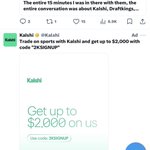
I took down my Kalshi post. I was upset that the company was running ads in youth sports channels. They reached out. We chatted about it. They confirmed that this was not their intent and they were doing an audit to make sure they don't market in these channels again.
I appreciate their engagement and take them at their word that they're working to correct this. It's what a good company does.
Sports betting is a silent scourge that is ruining people's lives in America. I saw this first hand in my last job as we had to chase fraudsters who had tried to skip out on sports book payments because they had lost six figures worth of bets. Regardless of whether Kalshi wants to call it a futures contract or prediction event, their product touches on the same impulses and can lead to the same dark consequences.
Legislators will need to eventually do something about this. There will be too many bankruptcies, too many broken homes and too many families and kids that will suffer if they do not.
But until then the sports betting industry — whether via online gaming or predictions markets — is going to have to self police and take steps to put guardrails in place.
I appreciate Kalshi's recognition that youth sports signups is not an acceptable channel to try and acquire customers. It's the kind of first step a serious company will take to demonstrate they can self police in the absence of meaningful consumer protection regulation. I'm rooting for them to keep going and build other self-regulatory measures in the future.


Andrew W. Grant retweeted

Looks like the CFPB is back in the game …

🚨We are so back!🚨 "Here is something to be thankful for this Thanksgiving: The Federal Reserve System has 𝙧𝙚𝙩𝙪𝙧𝙣𝙚𝙙 𝙩𝙤 𝙥𝙧𝙤𝙛𝙞𝙩𝙖𝙗𝙞𝙡𝙞𝙩𝙮. It appears to be on track for the combined profits [of] over $2 billion in the current quarter." tinyurl.com/2h5em63u @billnelson2x2


Andrew W. Grant retweeted

I don’t think the word fascism should be thrown around or depreciated through overuse, but if your top advisers are going around calling for an autocratic executive to suspend the judiciary and declare martial law, the whole “don’t call me a fascist” thing loses its punch.
So I don’t get very political on here - but I live in DC. West End is one of the safest neighborhoods (& crime is down in DC, as it is in most major cities …). Is this a video of like 12 people arresting the guy who threw a sandwich? This video isn’t parody?

📹 Nighttime Routine: Operation Make D.C. Safe Again Edition
Readers added context they thought people might want to know
On Nov. 6, 2025, Sean Dunn, a.k.a. “Sandwich Guy,” whose arrest is shown in this video, was acquitted by a jury for the single misdemeanor count for which he was indicted.
nbcnews.com/news/amp/rcna2…
Andrew W. Grant retweeted

If you think that “open banking experts” 1. Know the basics and 2. Honestly state them, you’d be wrong! So Detective Joe Friday is here (on a Tuesday) for “just the facts” on how it works…
This is a great thread - and the JPMC people commenting to each other for standards setting body is amusing (in a sad way)

Well well well - news.bloomberglaw.com/bankin…
@AlexH_Johnson @sytaylor
And let’s assume the court stays the suit, the CFPB issues new ANPRM — and it’s just that, not an NPRM, so we’re still very early plus working with a significantly reduced CFPB staff.

I’ve come around to the concept of fees for operational expenses associated with operating the data access portal. I’m firmly opposed to access fees being a source of revenue.
Andrew W. Grant retweeted

The challenge in analyzing JPMorgan Chase's proposed pricing for open banking data access is that the pricing is trying to accomplish multiple goals.
I think it's worth pulling those goals apart and trying to understand the motivations behind this aggressive move from JPMC.
So, here it is.
My most up-to-date theory, which I call The Theory of the Five Motivations.
#1: We need to cover our costs.
Banks don't want to eat the costs of standing up and maintaining APIs.
This strikes me as entirely reasonable and something that other countries with regulated open banking have solved for (in various ways).
I think the Biden-era CFPB erred in not building a defined cost-recovery fee into the final open banking rule.
#2: We need to price in our liability.
Use of bank data can create liability, especially for certain well-regulated use cases like payments. Banks don't want to be on the hook for that liability when the consumer uses their data to empower a third party to facilitate the use case.
This also strikes me as reasonable and an area where the Biden-era CFPB fell short in the final rule. It should have included a liability framework that aligned incentives across various stakeholders.
#3: We need to discourage abusive secondary data use.
JPMC argues that a vast majority of the calls to its open banking APIs are not initiated by its customers and are, therefore, evidence that the aggregators and fintechs are using the data for their own commercial purposes.
I think there has definitely been some of this abusive secondary data use by aggregators and fintechs, but I also think a big chunk of these batch API calls are legitimate under the use cases authorized by the customer (e.g., PFM apps sending notifications to users when a certain transaction happens or a balance falls below a specific threshold.)
I think the Biden-era CFPB correctly restricted the vast majority of secondary data use in its final rule (over the objections of aggregators and fintechs).
#4: We need to get a cut of the value being created.
Reading the public comments from JPMC executives (including Jamie Dimon), you get the impression that they don't like giving their data away for other companies (particularly the aggregators) to monetize. This seems to bother them on an almost philosophical level and it's not hard to imagine them looking at the revenues generated in this space and thinking, "we deserve a cut of that."
I completely understand this reaction, but personally I don't believe that banks should be allowed to directly monetize open banking.
Being a bank (particularly a SIFI) comes with a lot of privileges and a lot of obligations. I think it's fine, as a matter of public policy, to say that one of those obligations is the requirement to provide access to customers' data (at their discretion) and to only charge a modest fee for cost recovery.
This would not preclude a bank from finding other ways to monetize its first-party data (e.g., Chase Media Solutions) or to compete directly in the data aggregation business (e.g., Akoya).
#5: We need to crush competition.
JPMC has made it very clear that it views fintech companies as a serious competitive threat and it's understandable why the bank might view the opportunity to raise the operational costs for those competitors as too good to pass up.
Indeed, as others have pointed out, the bank has fiduciary duty to seize all such opportunities.
To me, this is a legitimate motivation and I think it's naive to assume that any company wouldn't do the same thing in JPMC's position. They would.
However, as a matter of public policy, there's a good reason why we tend to restrict large incumbents from flexing their market power in ways that are obviously anti-competitive.
Preventing market incumbents from stifling competition was clearly a goal of the Biden-era CFPB in drafting the final open banking rule, and I think it was right to make it a priority.
So, what do we make of the bank's proposed pricing? Which motivations are the primary drivers?
The pricing that JPMC proposed to the data aggregators is significantly higher than what you would expect if the bank's goal is just to cover its costs (#1) and price in its liability risk (#2).
This suggests to me that the pricing is motivated, at least partially, by a desire to crack down on secondary data (#3), extract value from the open banking ecosystem (#4), and hurt competitors (#5).
Personally, my guess is that #4 isn't a huge motivator for JPMC (they have plenty of other, more lucrative opportunities to generate revenue). The bank has publicly stated that #3 is a big motivator, and I think #5 is as well, even though the bank will obviously never say that out loud.
The irony, which is important to reiterate, is that #3 was actually addressed by the CFPB's open banking rule. And #1 and #2 could have been easily addressed if the rule had been revised by the Trump Administration.
Instead, the current CFPB has responded to JPMC's lawsuit by asking the court to throw out the open banking rule entirely, which narrowed the bank's options for addressing those concerns while giving it more latitude to use the one option that it had been waiting to use: charging for access to its open banking APIs.
We'll see how it plays out.