

Tweets on all things #NASA. At 12:06 into the #Apollo11 launch CAPCOM Bruce #McCandless relays: Apollo11, this is Houston. You are confirmed GO For Orbit.
- Tweets3K
- Following495
- Followers228
- Likes179












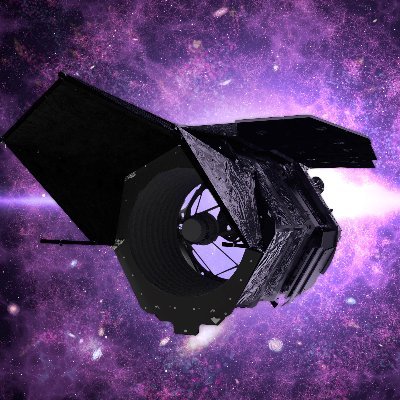





ALT NASA’s Nancy Grace Roman Space Telescope, encapsulated in a protective payload fairing atop a SpaceX Falcon Heavy rocket, is seen at sunrise, Saturday, Aug. 29, 2026, at Launch Complex 39A at NASA’s Kennedy Space Center in Florida. Photo Credit (NASA/Joel Kowsky)


ALT NASA’s Nancy Grace Roman Space Telescope, encapsulated in a protective payload fairing atop a SpaceX Falcon Heavy rocket, is seen at sunrise, Saturday, Aug. 29, 2026, at Launch Complex 39A at NASA’s Kennedy Space Center in Florida. Roman will investigate dark energy and dark matter, conduct a statistical census of planetary systems, and enable a broad range of additional astrophysics research. Liftoff from NASA Kennedy is targeted for Sunday, Aug. 30, 2026. Photo Credit (NASA/Joel Kowsky)


ALT Black and white graphic with purple accents and white drawn stars, lightning bolts and circles, along with animations of Roman, Hubble and Webb. Text: “Discover your space telescope personality match. Explore outward with telescopes and inward to find your match.”


ALT NASA photographer Jim Ross takes a selfie from the rear seat of a NASA F/A‑18 during a cross‑country flight from Spokane, Washington, to Washington, D.C., on Thursday, July 2, 2026. Credit: NASA/Jim Ross

ALT A NASA F‑15 aircraft is shown during a cross‑country flight from Spokane, Washington, to Washington, D.C., on Thursday, July 2, 2026. Credit: NASA/Jim Ross

ALT A NASA F‑15 aircraft is shown during a cross‑country flight from Spokane, Washington, to Washington, D.C., on Thursday, July 2, 2026. Credit: NASA/Jim Ross

ALT A NASA F‑15 aircraft is shown flying next to a NASA F/A‑18 during a cross‑country flight from Spokane, Washington, to Washington, D.C., on Thursday, July 2, 2026. The full F‑15 is visible, along with a partial view of the F/A‑18’s wing, as both aircraft display new red, white, and blue paint to celebrate America’s 250th birthday. Credit: NASA/Jim Ross

ALT NASA's Nancy Grace Roman Space Telescope, large spacecraft, wrapped in silver thermal covering is tilted upright on a massive white rotation stand inside a clean room at NASA's Kennedy Space Center in Florida on Thursday, June 25, 2026. Several technicians in blue clean-room suits and protective gear stand around the base, observing the operation. The spacecraft’s solar arrays are partially deployed overhead. Mission logos, an American flag, and clean-room equipment line the white walls in the background. Photo credit: NASA/Sydney Rohde (Rocz)


ALT This photo of the Moon was captured by the Artemis II crew aboard the Orion spacecraft a few hours before the lunar flyby on April 6, 2026. During the flyby, the crew captured critical science observations as they traveled around the far side of the Moon, traveling farther than any humans ever before. The Moon resembles a gray cratered orb in the distance, standing out against the blackness of space. Credit: NASA

ALT The Moon appears half-illuminated in this photo captured by the Artemis II crew on April 6, 2026. The terminator — the difference between light and darkness — provides a stark contrast and even greater perspective of the Moon's rocky, uneven, and otherworldly surface features. The near side of the Moon, which is what we can see from Earth, appears in the dark gray regions at the top of this image. The Moon stands out against the blackness of space around it. Credit: NASA

ALT The Artemis II crew was tasked with capturing many key features visible in this image of the Moon, captured on April 6, 2026. The terminator, or the difference in light and darkness, is visible on the top left. The large dark gray area toward center-left is Orientale Basin, while the characteristic dark patches of ancient lava flow we see on the near side are visible on the right half of this image. The Moon stands out against the blackness of space around it. Credit: NASA

ALT This photo of a crescent Moon and crescent Earth was taken by an Artemis II astronaut during their lunar flyby on April 6, 2026. This image captures one of the final moments before their loss of signal with Earth as the Orion spacecraft flew around the far side of the Moon, reemerging and regaining contact approximately 40 minutes later. Earth can be seen peeking behind the Moon in the distance. The illuminated regions of the Moon and Earth stand out against the blackness of space, while the rest are swallowed in shadow. Credit: NASA


ALT Artemis III Crew Announcement Ceremony Date: June 9, 2026 Location: Bldg. 2south, Teague Auditorium Photo Credit: NASA/Robert Markowitz
