
Powering dealerships and OEMs with best-in-class mobile service solutions.
Apex, NC
Joined October 2013
- Tweets4.3K
- Following947
- Followers1.1K
- Likes3.6K



Pinned Tweet
We’re excited to announce Spiffy’s strategic partnership with Blink AI Automotive to advance mobile service for automotive dealers.
This partnership integrates Blink AI Automotive’s intelligent customer engagement and scheduling capabilities with Spiffy’s proven mobile operating system to help dealers and OEMs more efficiently deploy and scale mobile programs.
Together, we’re helping dealers enable an end-to-end mobile service experience that is simple for customers to schedule and efficient for dealers to operate.
Read the full announcement: hubs.ly/Q041vv0Q0
#MobileService #AI #Partnership #Integration #FixedOps #Spiffy #BlinkAI

The service takes 30 minutes. So why should the customer have to set aside four hours?
That’s the downside of block scheduling. The actual service may be quick, but a broad arrival window can turn a short appointment into a much bigger commitment for the customer.
Real-time availability changes that equation.
When customers can choose an actual available time, they know when service will happen and how much of their day they need to set aside.
Same service. Same amount of work. A very different customer experience.

We break down block scheduling vs. real-time availability in our latest blog: getspiffy.com/blog/block-sch…

A mobile service van is more than a toolbox on wheels. It's a fully equipped service bay built to operate beyond the dealership.
But not all mobile service vans are built the same.
The right upfit determines what services technicians can complete, how efficiently they work, and how much revenue each van can generate.
With 12 years of operational experience and over 4 million mobile services completed, Spiffy has firsthand knowledge of what technicians need in the field. We've gone through 10+ iterations of our van designs, using real feedback from technicians and lessons learned in the field to improve how each van operates.
From integrated fluid systems and onboard power to tire service equipment, diagnostic tools, and organized storage, every component serves a purpose.
When technicians have the equipment organized and within reach, they spend less time searching for tools and more time completing repair orders.
The right van upfit does more than expand your service capabilities. It creates the foundation for a more productive and profitable mobile service operation.
Take a closer look at how Spiffy builds mobile service vans designed for the demands of daily service: getspiffy.com/mobile-vehicle…
What happens when service demand keeps rising, but your shop capacity can’t keep up?
For Cavender Grande Ford, the answer wasn’t adding more service bays. It was creating capacity outside the shop.
With three mobile service vans running on Spiffy Mobile 360™, the dealership scaled from 50 mobile ROs per month to 236 in just two months running on Spiffy Mobile 360™.
That’s 4.7x the mobile service volume with the same fleet and no new bays.
And the financial impact followed. Within two months, Cavender Grande Ford’s mobile service program was generating an annualized $509K in gross profit.
More capacity doesn’t always require more square footage. Sometimes, it comes from optimizing your existing operation.

Mobile service is supposed to give customers their time back.
So why are we still asking them to set aside multi-hour windows?
Block scheduling gives the operation flexibility. Real-time availability gives the customer certainty.
That distinction may seem small, but it changes the experience. Instead of waiting for service to happen sometime that morning, customers know when to expect you and can plan the rest of their day accordingly.
And when convenience is one of the biggest reasons customers choose mobile service in the first place, the way you schedule matters.
Our latest blog takes a closer look at block scheduling vs. real-time availability and what dealerships should consider when deciding which experience they want to deliver.
Read the full blog: hubs.ly/Q04zT8K00

Mobile service can create capacity beyond the service drive. But that’s only part of the value.
For some dealerships, it solves a capacity constraint. For Cavender Grande Ford, they see the bigger opportunity in retention and growth.
As Fixed Ops Director Grant Miles explains, the goal is to grow market share and expand the dealership’s customer base.
Mobile service gives Cavender another way to do that while also creating service capacity outside the shop.
More capacity for the dealership. More convenience for their customers. More opportunities to build the relationship.
That’s the value of building mobile service into the fixed ops department.
Hear more from Grant Miles on Cavender Grande Ford’s approach to mobile service: youtu.be/JEJ5eY6b2hI?si=m8yY…
Spiffy CEO Karl Murphy recently joined Ted Ings on the Fixed Ops Roundtable to discuss the growing opportunity in mobile service.
One of the biggest questions dealers have when getting started is whether the demand is there. But as Karl shares in this clip, dealers with established mobile programs are often finding the opposite. The demand is there. The challenge is building an operation that can keep up with it.
The full conversation covers what it takes to launch and grow a successful mobile service program, from increasing service capacity and driving demand to improving operational efficiency and customer retention.
Full segment below. It's worth the watch if mobile is anywhere in your 2027 plan.
Thanks to Ted and the Fixed Ops Roundtable team for having us!
Recalls can be a great place to start with mobile service. But the strategy shouldn't stop there.
Recall work can quickly generate demand and revenue. For OEM-incentivized programs, that can be enough to make mobile service profitable. But building a mobile operation strictly around recalls makes it difficult to create a sustainable business once those incentives are inevitably reduced or removed.
The bigger opportunity is using recalls as the entry point, then building from there.
The leading mobile service dealers maximize each van's utilization through proactive outreach to customers due for service, identify additional work via mobile MPI, create new opportunities for the shop, improve the customer experience, and ultimately strengthen long-term retention.
That's why the impact of mobile service extends well beyond the initial mobile RO. Early data from our program with Hyundai found that 31% of mobile services converted into shop work within 60 days. Meanwhile, Cox Automotive research found customers serviced within 12 months of purchasing a vehicle were 86x more likely to purchase their next vehicle from the same dealer.
Recalls can get the wheels turning. A profitable mobile operation is built on what comes next.
Spiffy Mobile 360™ and Capture™ help dealers build and manage mobile service for the full opportunity, not just the entry point.

Three vans in San Antonio are delivering the added service capacity you might expect from a multi-bay expansion.
In just two months using Spiffy Mobile 360™, Cavender Grande Ford grew mobile service volume 4.7x.
That growth is impressive on its own. It's even more exciting when you consider they achieved that volume without adding to their fleet.
When a mobile service operation moves from pilot to program, the instinct for many dealers is to add more vans. That is often the right move. But sometimes, you can unlock more capacity from the fleet you already have.
Cavender's three vans are now absorbing nearly five times their early volume because the underlying operation improved in three ways. Converting open recalls already in the dealership’s database. Booking without an advisor on the phone. Sequencing routes to maximize what each van can accomplish daily.
No new bays. No fourth van. The same fleet.
Cavender Grande Ford is proof that scaling mobile service does not always mean adding more vans.
Download the full case study to see how they grew volume 4.7x in two months: hubs.ly/Q04yyfMj0

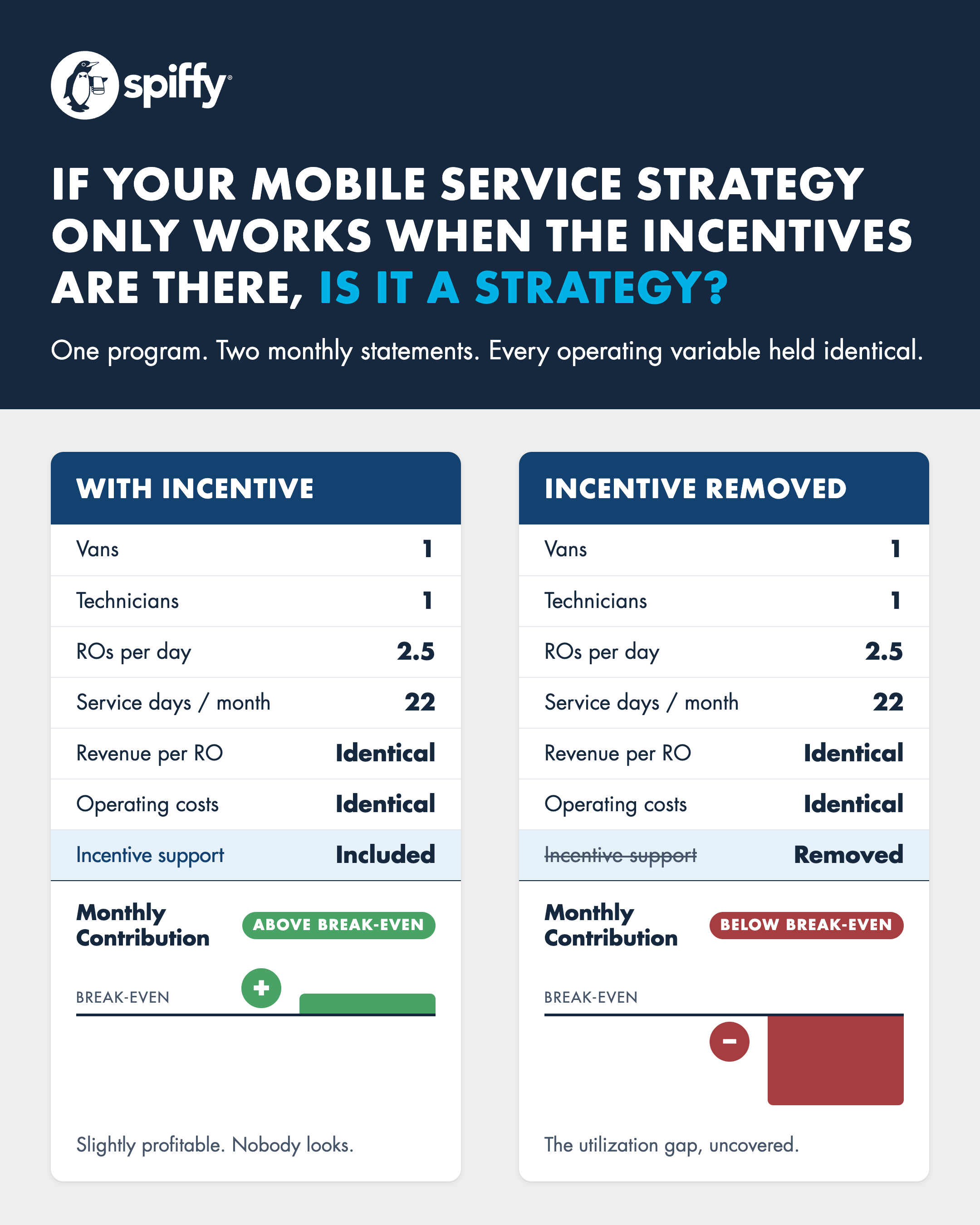
If your mobile service strategy only works when the incentives are there, is it a strategy?
That question is not a criticism of incentives. Incentive support, OEM training, and OEM marketing are real resources, and the programs that use them well scale faster than the ones that do not.
The problem is what they can hide.
An incentive lowers the daily repair order count at which a van breaks even. That sounds like help, and in the first year it is. It also removes the pressure that would otherwise force a store to go fix the thing actually holding the program back, which is an empty schedule.
So the program runs at two or three ROs a day, the P&L shows a small profit, and nobody goes looking. The incentive is carrying a utilization problem that never gets named.
Here is the diagnostic worth running on your own store this quarter. Take your mobile program's contribution for the month. Remove the incentive line. Look at what is left.
If the answer is a healthy number, you have a program, and the incentive is making a good thing better.
If the answer is a number you do not like, you do not have an incentive problem. You have a utilization problem wearing an incentive as a coat.
Same van. Same technician. Same everything. One variable, and it was never the incentive.
Cavender Grande Ford increased mobile services from 50 a month to 236 in just 60 days.
Two months. Same three vans they started with. No new bays.
The volume number is the headline, but it is not the interesting part. This is:
At that pace, the program is projected to return its full startup investment in under eight months.
A new line of business that pays back its capital that fast is not a side project. It is a profit center, and it should be evaluated as one.
What made it work was not the vans. Three vans in a lot do nothing. It worked because they built the demand mechanism before adding to their fleet. Recall outreach against lists the store already owned. Self-scheduling that let customers book without calling in. Routing that let each van absorb volume as it arrived.
Cavender added 186 services a month without even adding a van.


Service departments running over capacity usually conclude they need more bays.
Look at what is actually occupying your lifts this week. Oil changes. Tire rotations. Light maintenance. Software updates. Recall work that takes twenty minutes.
Most of it does not need a bay. It needs a technician, a set of tools, and a parking spot.
Which reframes the whole question. You may not have a capacity problem. You may have an allocation problem, where low-margin work that could happen in a customer's driveway is sitting on a lift that should be reserved for high-margin work.
A bay expansion takes months, costs six or seven figures, and adds fixed costs you carry forever. Moving the wrong work off your lifts takes a van and an operating model.
One of those two options is on the table before next quarter.
If bay capacity is in your 2027 fixed ops plan, run the other version of the math first.

Exciting news out of Goshen, Indiana! Eby Ford is officially up and running with Mobile 360™.
The Eby Ford team was all in from the start. A big thank you to Owner Eric Eby, General Manager Dan Tack, Service Manager Sean Lacey, and Mobile Service Manager Kevin Lamb for their hands-on involvement and commitment throughout the launch.
With Mobile 360, their team now has the tools to help manage and grow their mobile service operation while bringing a more convenient service experience directly to their customers.
Our Training Manager, Adam Major, was on-site for the launch, making sure the Eby Ford team had the training and support they needed for a strong start.
Congratulations to the entire Eby Ford team!

There is a line item missing from almost every mobile service cost model we have read.
Not the technician. Everyone remembers the technician.
Coordination.
Someone writes and closes the repair order. Someone fills tomorrow's schedule. Someone rebuilds the route at 9am when two customers move their appointment and a third cancels. Someone answers the call about where the van is.
In a published one-van model, that work costs zero. In your service department, it is advisor hours, BDC hours, and dispatch time, and it scales with volume in ways the spreadsheet never shows.
Leaving it off the sheet does not make it free. It just moves the cost from a line you can manage to a person you are quietly overloading.
Two things happen when you put coordination on the model honestly.
The margin comes down to something a fixed ops director recognizes from his own operating statement.
And the real question surfaces: not "does mobile pencil," but "how much of this coordination should a human be doing at all?"
That second question is the one worth building around.

Ingersoll Chevrolet is officially up and running with Spiffy Mobile 360™!
Our team was on-site helping Ingersoll Chevrolet launch their program and get ready to bring a more convenient mobile service experience to their customers.
This launch is part of some exciting momentum we’ve been seeing lately, as more dealerships implement Mobile 360 to launch, manage, and grow their mobile service operations.
A big shoutout to our Training Manager, Adam Major, for being on-site and working side by side with the Ingersoll Chevrolet team to get them off and running.
Congratulations to the entire Ingersoll Chevrolet team! We’re excited to keep building the future of mobile service together!

Customer satisfaction, customer retention, and capacity all go hand in hand.
That's one of the topics Jim Sabino of All American Ford touched on during the Fixed Ops Roundtable mobile service panel hosted at Paragon Honda.
Mobile service creates a more convenient experience for customers, which leads to higher satisfaction and stronger retention. At the same time, it gives dealers a way to add capacity without the cost of expanding brick and mortar.
For many stores, the next opportunity for growth isn't building more bays. It's bringing those bays to the customer.
#MobileService #FixedOps #CustomerExperience