

Entering a new chapter 💪 Building "Fomo Sapiens" | Telegram: https://xitter.cf/t.co/gIkZRFYJZC | X: @realFomoSapiens
Joined March 2021
- Tweets1.6K
- Following772
- Followers208
- Likes4.5K
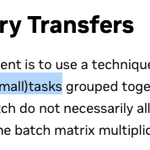




What does @NVIDIAAIDev use to cook this CUDA's doc? Multiple syntax and typing errors in a row? If it's AI, then seems like AI is trying to fake the error and pretend to be human (which is both scary and impressive at the same time) 😂😂😂


anw, CUDA is super fun to learn. People should check out how they manage threads and mem, super smooth and intelligent
docs.nvidia.com/cuda/cuda-pr…


Ironically, we can get into "503" more often than 429 😅

5 ways to reduce 429 errors on Vertex AI:
1. Implement smart retries
2. Leverage global model routing
3. Reduce payload via context caching
4. Optimize prompts
5. Shape traffic
More on how to build resilient LLM apps on Vertex AI and reduce 429 errors → goo.gle/4tN4z28

Split the G!!!

Mati Staniszewski and his team at @ElevenLabs have built amazing text-to-speech and speech-to-text models, and are now expanding into voice agents. In this episode of Cheeky Pint, I asked why one of the longest-promised UIs in computing ("Open the pod bay doors, HAL" was 1968!) has been so slow in arriving. Along with lots of details on how voice AI actually works at a technical level.
00:00:27 How audio models work
00:08:52 ElevenLabs business model
00:17:50 The conversational Turing Test
00:21:01 Link by Stripe
00:26:02 Cascaded vs speech-to-speech
00:31:53 Universal translation
00:51:41 Designing an AI-native org
TLDR: API Barrier - If you work above the API Barrier, you're in the money. If you work below the API, keep pushing to move above!

George Nguyen retweeted

Meet Gemma 4: our new family of open models you can run on your own hardware.
Built for advanced reasoning and agentic workflows, we’re releasing them under an Apache 2.0 license. Here’s what’s new 🧵
George Nguyen retweeted

LLM Knowledge Bases
Something I'm finding very useful recently: using LLMs to build personal knowledge bases for various topics of research interest. In this way, a large fraction of my recent token throughput is going less into manipulating code, and more into manipulating knowledge (stored as markdown and images). The latest LLMs are quite good at it. So:
Data ingest:
I index source documents (articles, papers, repos, datasets, images, etc.) into a raw/ directory, then I use an LLM to incrementally "compile" a wiki, which is just a collection of .md files in a directory structure. The wiki includes summaries of all the data in raw/, backlinks, and then it categorizes data into concepts, writes articles for them, and links them all. To convert web articles into .md files I like to use the Obsidian Web Clipper extension, and then I also use a hotkey to download all the related images to local so that my LLM can easily reference them.
IDE:
I use Obsidian as the IDE "frontend" where I can view the raw data, the the compiled wiki, and the derived visualizations. Important to note that the LLM writes and maintains all of the data of the wiki, I rarely touch it directly. I've played with a few Obsidian plugins to render and view data in other ways (e.g. Marp for slides).
Q&A:
Where things get interesting is that once your wiki is big enough (e.g. mine on some recent research is ~100 articles and ~400K words), you can ask your LLM agent all kinds of complex questions against the wiki, and it will go off, research the answers, etc. I thought I had to reach for fancy RAG, but the LLM has been pretty good about auto-maintaining index files and brief summaries of all the documents and it reads all the important related data fairly easily at this ~small scale.
Output:
Instead of getting answers in text/terminal, I like to have it render markdown files for me, or slide shows (Marp format), or matplotlib images, all of which I then view again in Obsidian. You can imagine many other visual output formats depending on the query. Often, I end up "filing" the outputs back into the wiki to enhance it for further queries. So my own explorations and queries always "add up" in the knowledge base.
Linting:
I've run some LLM "health checks" over the wiki to e.g. find inconsistent data, impute missing data (with web searchers), find interesting connections for new article candidates, etc., to incrementally clean up the wiki and enhance its overall data integrity. The LLMs are quite good at suggesting further questions to ask and look into.
Extra tools:
I find myself developing additional tools to process the data, e.g. I vibe coded a small and naive search engine over the wiki, which I both use directly (in a web ui), but more often I want to hand it off to an LLM via CLI as a tool for larger queries.
Further explorations:
As the repo grows, the natural desire is to also think about synthetic data generation + finetuning to have your LLM "know" the data in its weights instead of just context windows.
TLDR: raw data from a given number of sources is collected, then compiled by an LLM into a .md wiki, then operated on by various CLIs by the LLM to do Q&A and to incrementally enhance the wiki, and all of it viewable in Obsidian. You rarely ever write or edit the wiki manually, it's the domain of the LLM. I think there is room here for an incredible new product instead of a hacky collection of scripts.
LangSmith and MCP Inspector are must-have for debugging. But speaking of connecting and kickstart, LangSmith is way easier. I remember wasting a day to solve the logger and stderr to connect to MCP Inspector 😢

Build deep agents for enterprise search with the NVIDIA AI‑Q blueprint and LangChain 🔍
Our new technical tutorial walks you through:
✅ Connecting agents to your enterprise data sources
✅ Configuring the agents with Nemotron models
✅ Monitoring and debugging performance in LangSmith
📝 nvda.ws/47ezM5j

George Nguyen retweeted

Karpathy just open-sourced autoresearch.
One GPU. 100 ML experiments. Overnight. You never touch the code — just write a Markdown file.
The bottleneck isn't compute. It's your program.md.
gli.st/z3iakp3f
then...we should fine-tune and use it locally real quick before Qwen becomes closed 🧐🧐🧐

Based on the latest rumor mill, looks like two things happened:
1. CEO of Alibaba Cloud (who is btw the CEO of all of Alibaba) is exerting a more direct line of sight on Qwen
2. A new person, possibly someone who was ex Gemini team, is brought in and layered on top of current Qwen leaders, thus the mass exodus
If true, it looks like future advanced Qwen models might become closed soon, as Alibaba tries to replicate the GCP/Gemini playbook.
As a *pure business decision*, this actually makes sense...(this is not at all to diminish all the hard work, goodwill, and open source community building that current Qwen team did to get Qwen to where it is today in the first place.)
Alibaba and Google are the *only* tech companies that have *both* in-house frontier AI models *and* a sizable and global 3rd party cloud business that needs to grow even bigger with AI adoption. (Azure/AWS, great cloud, no in-house models, OAI is playing both sides. All other AI labs have no standalone cloud business.)
GCP grew by a whopping 48% last year. AliCloud is no where near that and starting from a smaller base
On paper, bringing in a Gemini person and being more commercialization focused, which always means closing not opening more models, appears logical as a short to mid-term business decision...
But just because you signed someone who was on a Superbowl team doesn't mean you'll win the Super Bowl too
Meanwhile, this resignation exodus is a bad look and losing lots of goodwill...
George Nguyen retweeted

Now, the quantum resistance roadmap.
Today, four things in Ethereum are quantum-vulnerable:
* consensus-layer BLS signatures
* data availability (KZG commitments+proofs)
* EOA signatures (ECDSA)
* Application-layer ZK proofs (KZG or groth16)
We can tackle these step by step:
## Consensus-layer signatures
Lean consensus includes fully replacing BLS signatures with hash-based signatures (some variant of Winternitz), and using STARKs to do aggregation.
Before lean finality, we stand a good chance of getting the Lean available chain. This also involves hash-based signatures, but there are much fewer signatures (eg. 256-1024 per slot), so we do not need STARKs for aggregation.
One important thing upstream of this is choosing the hash function. This may be "Ethereum's last hash function", so it's important to choose wisely. Conventional hashes are too slow, and the most aggressive forms of Poseidon have taken hits on their security analysis recently. Likely options are:
* Poseidon2 plus extra rounds, potentially non-arithmetic layers (eg. Monolith) mixed in
* Poseidon1 (the older version of Poseidon, not vulnerable to any of the recent attacks on Poseidon2, but 2x slower)
* BLAKE3 or similar (take the most efficient conventional hash we know)
## Data availability
Today, we rely pretty heavily on KZG for erasure coding. We could move to STARKs, but this has two problems:
1. If we want to do 2D DAS, then our current setup for this relies on the "linearity" property of KZG commitments; with STARKs we don't have that. However, our current thinking is that it should be sufficient given our scale targets to just max out 1D DAS (ie. PeerDAS). Ethereum is taking a more conservative posture, it's not trying to be a high-scale data layer for the world.
2. We need proofs that erasure coded blobs are correctly constructed. KZG does this "for free". STARKs can substitute, but a STARK is ... bigger than a blob. So you need recursive starks (though there's also alternative techniques, that have their own tradeoffs). This is okay, but the logistics of this get harder if you want to support distributed blob selection.
Summary: it's manageable, but there's a lot of engineering work to do.
## EOA signatures
Here, the answer is clear: we add native AA (see eips.ethereum.org/EIPS/eip-8… ), so that we get first-class accounts that can use any signature algorithm.
However, to make this work, we also need quantum-resistant signature algorithms to actually be viable. ECDSA signature verification costs 3000 gas. Quantum-resistant signatures are ... much much larger and heavier to verify.
We know of quantum-resistant hash-based signatures that are in the ~200k gas range to verify.
We also know of lattice-based quantum-resistant signatures. Today, these are extremely inefficient to verify. However, there is work on vectorized math precompiles, that let you perform operations (+, *, %, dot product, also NTT / butterfly permutations) that are at the core of lattice math, and also STARKs. This could greatly reduce the gas cost of lattice-based signatures to a similar range, and potentially go even lower.
The long-term fix is protocol-layer recursive signature and proof aggregation, which could reduce these gas overheads to near-zero.
## Proofs
Today, a ZK-SNARK costs ~300-500k gas. A quantum-resistant STARK is more like 10m gas. The latter is unacceptable for privacy protocols, L2s, and other users of proofs.
The solution again is protocol-layer recursive signature and proof aggregation. So let's talk about what this is.
In EIP-8141, transactions have the ability to include a "validation frame", during which signature verifications and similar operations are supposed to happen. Validation frames cannot access the outside world, they can only look at their calldata and return a value, and nothing else can look at their calldata. This is designed so that it's possible to replace any validation frame (and its calldata) with a STARK that verifies it (potentially a single STARK for all the validation frames in a block).
This way, a block could "contain" a thousand validation frames, each of which contains either a 3 kB signature or even a 256 kB proof, but that 3-256 MB (and the computation needed to verify it) would never come onchain. Instead, it would all get replaced by a proof verifying that the computation is correct.
Potentially, this proving does not even need to be done by the block builder. Instead, I envision that it happens at mempool layer: every 500ms, each node could pass along the new valid transactions that it has seen, along with a proof verifying that they are all valid (including having validation frames that match their stated effects). The overhead is static: only one proof per 500ms. Here's a post where I talk about this:
ethresear.ch/t/recursive-sta…
firefly.social/post/farcaste…


Wow woow, privacy AI 🧐🧐🧐

People choosing Mac Mini for their @openclaw agent because they want privacy and ensure that it runs in secure environment.
@near_ai offers hosting your agent and more without buying new hardware for only few $ a month.
near.ai/openclaw
George Nguyen retweeted

For the next 3 days, there will be daily live commentary and analysis covering the new benchmarks - from chess & poker legends @GMHikaru, @Liv_Boeree, @NickSchulman, @DougPolkVids. Tune in at 9:30am PT starting today, should be a lot of fun: kaggle.com/game-arena




V3 handles the summary task more precisely than V2. It provides concrete heading points now.


Introducing Jan v3, with updates to Jan Desktop v0.7.6 💛
Jan v3 is our first v3 model, a 4B base built for fine-tuning and fast local use, with stronger math and coding.
This release also includes a small Jan Desktop update, starting with a UI refresh as we move toward a more unified Jan experience.
Try it:
- Jan v3 is available in Jan Desktop and at chat.jan.ai/
- Get the latest desktop app at jan.ai/
Model:
- Jan-v3-4B: huggingface.co/Menlo/Jan-v3-…
- Jan-v3-4B-GGUF: huggingface.co/Menlo/Jan-v3-…
Thanks @Alibaba_Qwen for the base model and @ggerganov for llama.cpp 💛