

Marketing | Systems | Growth | Books | some Digital #Marketing Nerd | All about 🍔🍟 Views my own! ✌#Ifollowback #politicallyincorrect
Riyadh
Joined May 2011
- Tweets18.7K
- Following1.5K
- Followers512
- Likes11K





Don retweeted

This is the most useful prompt I've found in months. I've been using it with Opus 5.5 as a skill called /better to great effect. Grab it here: gist.github.com/joshp123/a14…
Here's how it's really stretches the model's performance vs usual prompts:
1. The "what a top professional in the field would do" somehow reminds the model to think of a lot of stuff it wouldn't otherwise do, and (unless this is your core area of expertise), you wouldn't know either.
Obviously Claude/Codex always knows the best practices already, but often it needs reminding to use them (despite it being in the training data), so this helps.
2. Rawest material - models love using proxies for stuff (e.g. Claude sampling logs instead of reading them); so telling them to use rawest materials helps them go back to primary sources/think from first principles, avoiding a lot of problems that come from lazy models and the resulting indirection.
4. Designing independent success criteria: important for the model to know how to actually work; and forcing it to define them means you get better and stronger results vs just letting it vibe stuff. The risk here is that you end up with "proof porn" - think endless hashing or comparisons without testing the real result - all frontier models as of Oct 2026 (Astra 6/Sol 6.1/Opus 5.5/Fable 5.1) all love doing this, so keep an eye on them.


Don retweeted

Here's a free City Generator that can export to GLB, OBJ, or FBX for your MCP Blender projects.
Even if you're NOT going to use it for 3d scenes, it's just fun to play around with for 5 minutes!
Don retweeted

THIS IS MADNESS
Sunra just launched Sunra MCP and you get Seedance 2.5 from $0.039/sec 🤯
Every leading image, video and audio model is now inside Claude and ChatGPT, at each maker's own API price.
save this if you’re working with AI video generation, it’ll help you
🤝 Paid partnership


Today we're launching Sunra MCP, with the most accessible pricing in the industry.
Every leading image, video and audio model, right inside Claude, ChatGPT and the AI assistant you already use. Each one at its maker's own API price, with no markup added.
Now is the time to build. Go create something no one has seen before.
Don retweeted

Kromoss, a new finetune of MOSS Image for even better quality and consistency
huggingface.co/lodestones/Kr…


Don retweeted

How do you become a model PM?
My roadmap (better than a $2.5K course).
I went back through every long interview I could find with PMs who ship models, at OpenAI, Anthropic, Google and on Meta's Llama team. They describe the same skills in the same order, so I mapped them into six levels:
Level 1: How models get made
Start with my AI Foundations for PMs.
Then Andrej Karpathy's "Deep Dive into LLMs like ChatGPT," and Stanford's CS336 if you want to build a language model from scratch.
Build: explain pretraining and post-training to an engineer without notes.
Level 2: How behavior gets shaped
Nathan Lambert's RLHF Book, then OpenAI's Model Spec next to Claude's constitution. My context engineering guide covers the instructions side.
Build: a one-page behavior spec for a product you use.
Level 3: Evals
My AI evals guide.
Then Hamel Husain's evals FAQ, and my episode with him and Shreya Shankar.
Build: one eval card. Start with 30 to 40 cases where a model fails your task.
This is the core skill. OpenAI's Core Models posting asks for someone who can "distinguish a useful metric from a convenient one."
Level 4: Follow the frontier
Simon Willison's notes on new models, and the system card at every launch. I cover each big release in AI by Aakash.
Build: pick the three numbers you'd watch for that model.
Level 5: Ship to developers
Google's Release Notes podcast on launching Gemini 2.5, and Cat Wu's essay on product management at Anthropic. My harness engineering guide shows your model from the developer's side.
Build: release notes and a migration guide for one model change.
Level 6: Land the job
Run the Model PM Lab on your own docs, and publish the eval and the spec as one portfolio piece. Then ask for a single referral.
Why does every level end with a build?
Because that's what the labs hire on. None of the 46 model PM roles open today lists hands-on ML research as a must-have. They ask for evals and judgment. And of the 316 PMs I found at companies that train models, only 7 have a PhD.
If you're already a PM, I'd start at level 3. Evals show up in every one of those postings.
Madhu Guru, who led product for Gemini, Veo and Nano Banana at Google, put it this way: "It is a rare, but learnable skillset. Only way is to build, build, build."
Save this for later.

Don retweeted

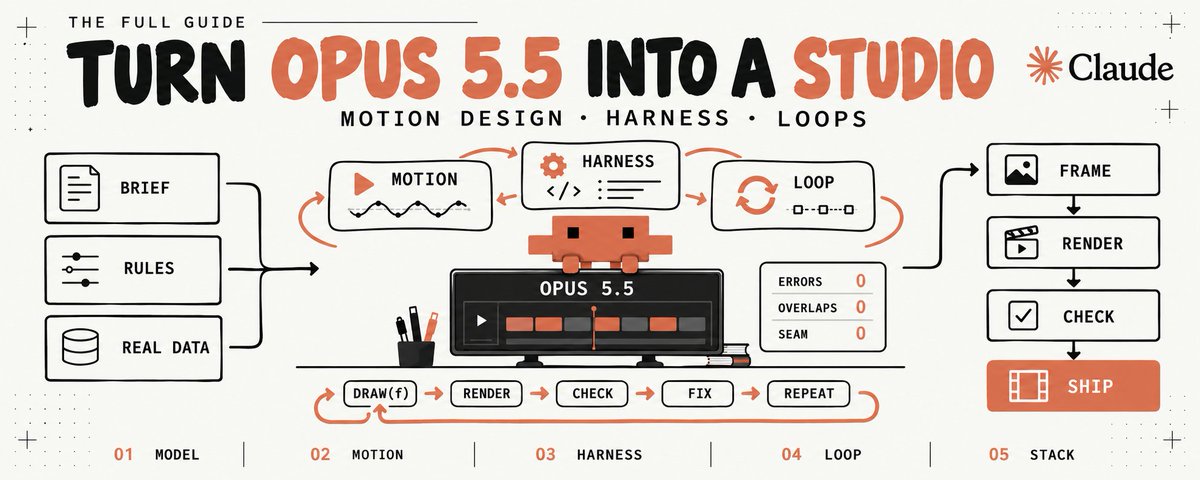
this is pure f*cking treasure
ex.Antrophic engineer put together 20 GitHub repos to build a f*cking motion empire, with 1m+ combined stars:
taste:
> LottieFiles/motion-design-skill: timing, easing, choreography + Disney principles
github.com/LottieFiles/motio…
> iart-ai/motion-design-skills: timing, type, color, composition, logos
github.com/iart-ai/motion-de…
> frankxai/awesome-motion-design-agent-skills: curated GSAP, Motion, Remotion, Lottie, Rive
github.com/frankxai/awesome-…
> ismoshushi/awesome-opus-video-skills: index of open video skills for Opus 5.5
github.com/ismoshushi/awesom…
web motion:
> whaleyxbt/claude-motion: a motion design toolkit for coding agents
github.com/whaleyxbt/claude-…
06 freshtechbro/claudedesignskills: 3D, animation and interactive web
github.com/freshtechbro/clau…
> 199-biotechnologies/motion-dev-animations-skill: Motion.dev, 120fps, springs, scroll
github.com/199-biotechnologi…
> greensock/gsap-skills: official GSAP skills, 16.6K stars
github.com/greensock/gsap-sk…
video in code:
> remotion-dev/skills: Remotion's own agent skills
github.com/remotion-dev/skil…
> haidrrrry/claude-remotion-skill: B-roll, captions, sound design from one prompt
github.com/haidrrrry/claude-…
> Liamrjohnston/remotion-motion-graphics-skill: production-ready Remotion graphics
github.com/Liamrjohnston/rem…
> wilwaldon/Claude-Code-Video-Toolkit: Remotion, Manim, screen capture, FFmpeg
github.com/wilwaldon/Claude-…
reels & launch:
> iart-ai/motion-skills: 50 skills, 14 packs, from kinetic type to WebGL
github.com/iart-ai/motion-sk…
> kaventro/motion-designer: your real UI, cut to music, rendered locally
github.com/kaventro/motion-d…
> Sunwood-ai-labs/hyperframes-motion-reel-skill: beat-synced reels, 120 BPM, 60 FPS
github.com/Sunwood-ai-labs/h…
> charlie947/motion-graphics-skills: 13 skills, launch-grade, no After Effects
github.com/charlie947/motion…
opus 5.5 pipeline:
> howseen-ai/claude-motion-design: pure-code video, HTML + Playwright + ffmpeg
github.com/howseen-ai/claude…
> tuzhechen2005/opus-video-skills: hand-painted animation, kinetic type
github.com/tuzhechen2005/opu…
> siyuanfeng636-cpu/agentic-motion-graphics: code-to-video with Whisper + TTS
github.com/siyuanfeng636-cpu…
> Lob0Garou/opus-visual-motion-engine: deterministic seek(t), render QA, MP4 export
github.com/Lob0Garou/opus-vi…
start at floor 01. then climb.

Don retweeted

UI/UX Designers, this might be the coolest icon library you’ll find.
Koboyo gives you access to 133,000+ unique, hand-drawn SVG icons covering everything from UI elements and technology to people, objects, business, and more.
Bookmark it for later 💜
Don retweeted

Google has another banger 🤯
It’s called PaperBanana.
It turns your methodology text into academic illustrations, helping you explain your research visually.
100% free.

Don retweeted

I just made a 908-page comic book.
19 chapters, dozens of consistent characters, all adapted from a 95,000-word novel.
Here's "The Hobbit" by J.R.R. Tolkien, turned into images.
How I built it: reference images, agents and a tight harness 👇
Don retweeted

I truly don't understand why nobody is using this setup
graphify, a tool that turns any folder into a knowledge graph your agent can query, just passed 126k stars on github and got into Y Combinator. people stopped asking ai questions. they're giving it a desk, a memory and a job.
you give Claude Code one folder, plug in your email, calendar and a browser, and it turns into an agent. it reads, remembers, acts, and checks itself before it does anything stupid.
doesn't matter if you're a founder, a marketer or a student, you need this
the full setup:
> create a folder called AGENT, open Claude Code inside it and add a CLAUDE.md with one rule: "save every decision, person and project to memory/"
> run npm install -g @googleworkspace/cli, then gws auth setup. now it reads your Gmail, Calendar and Drive
> run claude mcp add playwright npx @playwright/mcp@latest. it gets its own browser to open sites, fill forms and pull data for you
> run uv tool install graphifyy, then graphify install, then type /graphify .. everything in the folder becomes a knowledge graph it queries in seconds instead of digging file by file
> run npm i -g jev-guard, jev-guard key "...", jev-guard install claude. a tiny model called Jev scores every action before it runs. rm -rf gets blocked, a poisoned email gets flagged, for about 4 cents per 1,000 checks
> type /schedule and tell it "every morning at 7:30, send me what came in, what you drafted and what waits for my yes". from now on it works on a routine
15 minutes to set up, and you never start from a blank chat again.
every repo is below:
-> github.com/googleworkspace/c…
-> github.com/microsoft/playwri…
-> github.com/Graphify-Labs/gra…
-> github.com/leepokai/jev-guar…
bookmark this


Don retweeted
McDonald’s actually does have best-tasting Coke in the world and here a few reasons:
▫️Coca-Cola ships Coke/Diet Coke syrup to McDonald’s in specially-designed 75 gallon stainless steel containers and pumped directly into store machines.
▫️ Metal preserves taste better than plastic bags, which is how every other customers gets their syrup (Coca-Cola reps are also forbidden from selling syrup at a lower cost than what McDonald’s pays).
▫️Syrup machines frequently tweaked and calibrated to ensure taste is consistently strong since McDonald’s pours drinks with certain amount of ice which dilutes when melts.
▫️McDonald’s has specialized water filtration system at every location (tastes better) and cooling system (drink always consistently same cold temperature and cooler water holds more carbonation aka fizz)
Coca-Cola sends employees to do frequent quality checks at McDonald’s locations.
The McDonald’s and Coca-Cola partnership dates back to 1955 and goes deep.
McDonald’s is the largest restaurant partner ($1B+ a year) and only company within Coca-Cola that has its own division. When Coca-Cola reps are asked about the largest markets, they often say “US, Japan, Germany and McDonald’s.”
***
Screenshot from WSJ: wsj.com/business/hospitality…
Good NYT article from 2014: nytimes.com/2014/05/16/busin…


Major L for Pepsi, which owned KFC from 1986 to 1997.
Meanwhile, Coca-Cola with another huge fast food account. Its biggest customer is McDonald's, which buys $1B+ of product a year (mostly syrup). Coca-Cola literally has an exec position of President, The McDonald's Division.


Don retweeted

One of the coolest prompts to try on a video model!
Prompt : The camera begins very low near the surging ocean waves, close to the water’s surface, as the sea crashes violently against the jagged rocks. It then shoots upward very fast in a smooth, continuous cinematic motion, rapidly climbing along the rugged cliffside and rising higher and higher at speed. The ascent should feel powerful, direct, and dramatic, with a strong sense of rapid vertical movement and increasing scale. The camera keeps rising fast until it reaches a very high position directly above the lone man standing at the cliff’s edge. From this extreme top-down view, the camera looks straight down at him, clearly showing the top of his head, while keeping both the cliff and the crashing sea waves visible in the frame. Bright sunlight illuminates the entire scene with crisp, clear visibility, vivid natural colors, sparkling water, and sharply defined rock textures under a clear blue sky. The overall visual feels cinematic, expansive, and powerful, with dramatic speed, great height, and a striking sense of scale.
🤖 Made with AI
Don retweeted

how to get into marketing engineering (crash course)
you can start by having agents handle the research, production and execution behind your paid ads, outreach and SEO
Cody's walkthrough is a good introduction, here's what you need to get started:
1. choose your agent and give it context
use Claude Code, Cursor, Hermes or Grok Bot
give it your company knowledge: summary what you do, offers, target customers, brand guidelines and previous work
keep this in a shared folder or GitHub repo so your agents can find the context for each task
2. connect your performance data
set up a data warehouse and sync your ad performance, website analytics and Search Console data into it
your agent reads the warehouse to understand what is working, then uses the platform APIs to make approved changes
this reduces repeated requests to ad platforms and lets your agent compare performance across channels (so you don´t get rate limited)
3. give it tools to complete the work
the tools depend on which workflow you're building:
> paid ads: copy writing skill, customer research, image generation and access to your ad platform and data warehouse
> outreach: company research, contact providers, email verification and your sending platform
> SEO: Search Console, DataForSEO API access for keyword research and access to your CMS
give the agent instructions for each tool, including what it can do independently and what needs your approval
4. build your first workflow
choose a task you already understand so you can judge whether the agent does it well
here are three examples from the walkthrough you can build on:
paid ads
research customer problems → create ad angles and visuals → review the creatives → upload approved ads → check performance
outreach
find relevant prospects → check their fit → find and verify business emails (enrich) → prepare outreach for review
SEO
find relevant queries where you already get impressions → review existing pages and search results → update or write content → review and publish
work through the steps with your agent and give it feedback on the results
5. save the workflow and put it on a schedule
once the workflow works well, save the instructions, examples and checks as a skill
use a cloud server if you want it to run when your laptop is closed
you could have it review ads each morning, research prospects each week or prepare content updates from Search Console data


just made a Marketing Engineering Crash Course for you
you're going to learn
1. what marketing engineering is and why it pays $150k - $300K
2. data pipeline + warehouse and why your agent shouldn’t hit the ads APIs directly
3. the whole tech stack you need including server, s3, postgres, cron, auth, git, api gateway
4. how to give your whole stack to claude code in one install
5. static ads creation with unified api to make 1080x1080 ads with chatgpt image 2.5
6. meta api token creation system user, never expires facebook ads, so you can upload ads, turn ads off one prompt across meta
7. data analytics of ga4, search console straight into a dashboard
8. linkedin engagers to emails: scrape, waterfall enrich, million verifier
9. seo strategy for saas: x vs y keywords + page 2 keywords from search console
10 . then blog posts on autopilot: research to published with to your CMS with an SEO plugin
11. making AI avatar ugc ad scripts: reddit pain points via the exa api
Don retweeted

框架半年一换,但底层的数学与架构十年不变。在这个每天都在追新工具、套壳 Prompt 的浮躁时代,静下心把这 30 份代码跑通一遍,胜过看 1000 篇快讯。
作者还贴心地配了一个极简的在线阅读站点,通勤路上就能刷完:
🔗 GitHub 仓库:
github.com/Ojhaharsh/30u30
📖 在线阅读版:
ojhaharsh.github.io/30u30
建议随手 Bookmark(收藏) 慢慢啃,也欢迎 Repost 给身边真正在学 AI 的朋友 ⚡️

Don retweeted
Now THIS is a good image model. MOSS Image, 5B Apache 2.0.
Already very uncensored!
huggingface.co/OpenMOSS-Team…
huggingface.co/OpenMOSS-Team…

Don retweeted

It is becoming f*cking dangerous: I don't understand why everyone still isn't doing this, thanks to this I reached an income of $12,000 as early as 3 months ago
Andrej Karpathy, co-founder of OpenAI, shared a straightforward concept that blew up with over 23 million views: stop relying on AI strictly for coding and start using it to construct your own personal knowledge engine
Point Claude Code to a folder, toss in raw materials (whether it's an article, a video transcript, or a PDF) and Claude processes everything, links relevant topics together, and organizes it into a self-updating wiki of your personal knowledge. It acts like compound interest: the more information you add, the more capable it becomes
Here is the exact breakdown:
Set up Obsidian, create a fresh vault, and open it using Claude Code
Supply Karpathy's wiki layout prompt and instruct Claude to build the architecture
Claude automatically sets up three components: a raw directory for source files, a wiki directory for processed pages, and a CLAUDE.md control file to run the system
Dump any document into the raw folder and run "ingest this"
Query your entire knowledge repository at any time, indefinitely
It takes just five minutes to configure, eliminating the need to ever start a conversation with a completely blank context window again
Check the link below for the complete step-by-step walkthrough on setting up Claude with Obsidian
Bookmark this post for later


Don retweeted

What if you could see what Da Vinci NEVER painted?
I went INSIDE The Last Supper using Seedance 2.5 in @FishCreativeHQ
Prompt👇
upload the painting image as first frame and use this video prompt
[First-Frame.png] Create a 20-second vertical 9:16 image-to-video film, using the supplied image as the exact first frame and matching final frame. One continuous camera journey through the room, with macro detail, a gradual emotional reveal, an orbit behind the central figure and a seamless return.
Build the supplied scene as complete 3D geometry while preserving its Renaissance oil-painted appearance. The table stands in real space, the tablecloth drapes over its edges, the food and vessels sit on its surface, and every figure has a fully dimensional body beneath their robes. As the camera passes around them, reveal the sides and rear surfaces hidden from the opening viewpoint. Retain the original brushwork, warm earthy colours, soft daylight and expressive faces.
IDENTIFY AND PRESERVE THE FIGURES
The central figure sits at the middle of the table. He has long wavy brown hair, a full brown beard and downcast, calm eyes. He wears a deep red robe with a rich blue mantle draped across his left shoulder and lap. His right hand rests palm-down on the tablecloth at the left of the frame; his left hand lies open, palm-up, beside a small glass of red wine.
To his right (left of frame) sits a young apostle with long golden-brown hair, a green mantle over a red garment, his sorrowful gaze turned toward the centre. In front of him, a balding older man with a dark beard, wearing red and blue, leans in with a pointing gesture. A partly visible figure with curly hair sits at the far left edge.
To his left (right of frame) a man with thick black curly hair and a dark beard, in a blue robe, turns to speak with a grey-bearded elder in an olive-green robe at the right edge, who raises both hands in an open, questioning gesture.
Keep every pose, gesture, gaze direction and costume exactly as in the reference. No figure moves.
THE ROOM AND TABLE
A dark coffered wooden ceiling. A grey back wall with three tall windows opening onto a sunlit Tuscan landscape of blue hills, cypress trees, terracotta villas and a bell tower. Dark blue and gold damask panels on both side walls.
A long table covered in white linen with a visible grid of fold creases, hanging almost to the floor. On it: scattered bread rolls and crumbs, pewter plates, a central plate of fish, the small glass of red wine, a bowl of green olives, a plate of red and green grapes at the right, a blue-and-white decorated bowl with bread at the left, and a dark glazed ceramic jug at the far left. Wooden trestle legs and the hems of robes are visible below the cloth.
0–3 SECONDS — ENTER OVER THE BREAD
Begin on the exact supplied image for approximately half a second.
The camera then flies forward into the room and descends toward the bread roll resting on the tablecloth just left of centre. Pass macro-close above it.
Reveal the roll's rounded volume, cracked golden crust, flour-dusted ridges and the small crumbs scattered around it, each casting a tiny shadow on the linen. The nearest crust passes softly out of focus beneath the lens as the camera glides on.
The tablecloth has physical relief: woven threads, raised fold creases and shallow dips where objects press into it. The bread falls behind the moving camera while the central figure stays fixed farther into the room. This changing perspective establishes real depth immediately.
3–7 SECONDS — GLIDE ACROSS THE TABLE TO THE WINE
Travel low and smoothly across the linen toward the centre of the table, skimming past the rim of the fish plate. Reveal the plate's worn pewter edge, its curved depth and the painted fish resting inside.
Continue to the small glass of red wine. Curve partly around it at macro distance, revealing the thickness of the glass, the flat surface of the wine, and daylight from the windows refracting through it as a soft red glow on the cloth.
The glass crosses the near foreground, the open palm-up hand appears just beyond it, and the back wall shifts more slowly behind. Maintain forward momentum throughout.
7–10 SECONDS — RISE ALONG THE OPEN HAND AND MANTLE
Rise past the open hand, revealing the gentle curve of the fingers, the creases of the palm and its weight resting on the cloth.
Continue upward along the blue mantle where it falls across his lap and left shoulder. Travel close to the fabric without touching it. Show the painted texture, the deep blue folds as dimensional surfaces: raised crests catch the window light, undersides fall into shadow, and the red robe shows beneath the mantle's edge.
The blue fabric passes beside the lens as his face comes into view above.
10–13 SECONDS — REVEAL THE CENTRAL FACE
Curve inward and slightly upward toward his face.
Approach a close view of his lowered eyes, calm brow, nose and the soft strands of his beard and hair. Preserve the exact face from the reference. Reveal the three-dimensional shape of the cheekbones and brow, and the subtle painted texture of the skin, fully connected to his neck and shoulders.
Ease the camera's speed for approximately one second while continuing a gentle sideways drift. Let the stillness and quiet sorrow register. He does not move; the emotion comes from discovering the expression already present in the painting.
13–17 SECONDS — ORBIT BEHIND HIM TO THE WINDOW
Continue past the outside of his face, over his blue-draped left shoulder, and orbit smoothly behind him into the narrow space between his back and the central window.
Reveal the back of his long wavy hair, the rear folds of the blue mantle and red robe, and the thickness of his shoulders beneath the fabric. His shoulder passes close beside the lens as a soft foreground shape.
Turn gently to look past him through the central window: the sunlit Tuscan hills, cypresses and villas gain real depth, the far hills hazy and the near trees sharper. Then continue the arc so the view swings back over his other shoulder, revealing from behind the backs of the apostles' heads, the young apostle's green mantle, and the whole table spread out before them toward where the viewer began.
17–20 SECONDS — RETURN TO THE ORIGINAL COMPOSITION
Rise and retreat in one smooth arc over the table, passing above the grey-bearded elder's raised open hands at the right, then curving back onto the opening camera axis.
Reveal all figures again in their exact positions. The bread, plates, wine glass, olives, grapes, decorated bowl and ceramic jug settle back onto the table as in the supplied image. The coffered ceiling, three windows and damask walls realign with the frame.
Gently decelerate into the exact opening viewpoint, lens perspective, framing and lighting. End on a frame matching the supplied image so the next repetition flows directly into the opening movement.
CAMERA, STYLE AND CONTINUITY
Use one uninterrupted physical camera path: over the bread, across the table to the wine, up the open hand and blue mantle, to the central face, around behind him to the window, back over his shoulder and out to the original wide composition.
Use natural motion blur and shallow depth of field during macro passes. Transfer focus smoothly to the next detail along the route. Foreground objects pass the lens because the camera moves around them; no figure changes pose, blinks, speaks or moves toward the camera.
Maintain one coherent room with stable geometry and consistent warm daylight from the windows. Hidden surfaces belong to the existing figures, clothing, table and walls and match their visible design. Preserve the oil painting's brushwork, canvas texture and colour at every scale.
No cuts, crash zooms, dissolves, flat canvas flyovers, wall-relief effects, scene morphing, additional people, new props, extra food, text or watermark.
🤝 Paid partnership


Don retweeted

if you're using claude to edit videos, you can give it a library of 5.2M+ audio files for $0
sound effects, ambience, music. openverse has a free api. no key needed.
give it api.openverse.org and ask:
“whenever you need sound effects search Openverse to find the best options and use them for tasteful sound design within my video”
no more using your browser to download random clips or trying to generate the audio itself