

Leading the way in gas analysis solutions for a cleaner, safer planet. We are experts in FTIR technology, emissions monitoring & gas measurements.
Helsinki, Finland
Joined September 2016
- Tweets1.8K
- Following464
- Followers1.1K
- Likes682







Pinned Tweet
- Number of detectable gases 5000
- Number of measurable gases 500
- Simultaneously measured 50
- Seconds to measure 5
- One analyzer
What more do you need? 🟨
#GT5000Terra #KnowWhatsInTheAir

No better way to start the week than with a morning brew and a new free guide!🌱
Soil chamber measurements may seem straightforward, but reliable greenhouse gas flux data is often harder to get than expected. Leakage, pressure disturbances, gas mixing, deployment time, environmental conditions, and data processing choices can all affect the final result.
Our new guide, Getting Soil Chamber Measurements Right, explores the most common sources of uncertainty and shares practical recommendations for improving measurement quality in the field.
📖 Download the free guide here: hubs.li/Q04B61xx0
#EnvironmentalResearch #SoilScience #GreenhouseGases

GC-MS gives the highest sensitivity in the laboratory, but it takes minutes per sample and the results are discontinuous.
What if you also want to see how gas concentrations change in real time, or compare laboratory and field measurements? FTIR fits into that gap. It's flexible, cost-efficient and easy to move between setups.
Our article explains how to choose the right combination for your CBRNE measurement needs: hubs.li/Q04zpm-g0
#CBRNE #FTIR #GasAnalysis

Choosing the right background measurement can make or break the reliability of FTIR gas analysis.
Ambient air is often convenient, but is it always the best option?
Or does nitrogen provide a more controlled and reliable background?
In this article, we break down how to choose the right background measurement based on real measurement conditions, not theory alone.
➡️ You’ll learn how factors like
• gases already present in ambient air
• moisture and temperature conditions
• timing and on-site practicality
affect measurement accuracy and guide the choice between ambient air and nitrogen.
🔗 Read the full article:
hubs.li/Q04zJpRD0
#FTIR #GasAnalysis #KnowWhatsInTheAir

What happens to the carbon left behind when a glacier retreats?
Newly exposed glacier forefields provide a rare opportunity to study the earliest stages of soil formation and to investigate what happens to organic carbon inherited from the underlying rocks.
In our upcoming webinar, Dr Daniel Evans from Cranfield University will share insights from a field campaign in British Columbia, where the team investigated carbon cycling in these newly exposed landscapes.
The session will cover the practical challenges of measuring gas fluxes in remote glacier forefields, including how portable FTIR gas analysis and chamber measurements can be used in demanding mountain environments.
Dr Daniel Evans will be joined by Ola Szymon, Environmental Application Specialist at Gasmet, to discuss the fieldwork, the equipment, and what the team has learned so far.
So mark your calendars:
📅 4 November 2026 ⏰ 2–3 pm GMT / 4–5 pm EET
Register for the webinar: hubs.li/Q04zfryN0

Can healthier soils also lead to better business outcomes?
In our webinar with from the GWCT Allerton Project, researcher Dr Jenny Bussell discusses what they observed when comparing conventional tillage with less intensive soil management practices, including impacts on greenhouse gas emissions, soil carbon and profitability.
Watch the full webinar to learn how multi-gas measurements can help reveal what's really happening below the surface.
Register here: hubs.li/Q04y5S0f0
#SoilHealth #CarbonCapture #GHG #ClimateResearch #Agriculture #Gasmet
Gasmet is now a supporter of the British Occupational Hygiene Society (BOHS).
Our UK team has spent years working with occupational hygienists and H&S managers on workplace air monitoring projects, so @BOHSworld has been a familiar name for a long time. Now we're backing the work it does for worker health protection.
Our Group company Nederman is already a long-term BOHS supporter, so we're in good company.
#OccupationalHygiene #BOHS #WorkplaceAirMonitoring #FTIR #Gasmet

No single technology can measure every gas in every CBRNE scenario.
Concentrations range from ppb to volume percent. Sample volumes range from a few milliliters to whole buildings. And the compounds range from chemical warfare agents to combustion gases.
So with all these options, which technology is right for which task?
Our new article looks at where IMS, FTIR and GC-MS each fit, in the field and in the laboratory.
Read the article: hubs.li/Q04yxTPf0
#CBRNE #GasAnalysis #FTIR #ChemicalDetection

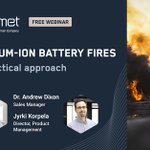
Lithium-ion batteries are increasingly powering our world, but when things go wrong, the consequences can be severe. Understanding the risks and how to manage them is critical for safety and compliance.
In this on-demand webinar, our experts break down:
✅ Why lithium-ion battery fires happen
✅ Practical strategies for detection and prevention
✅ Real-world insights to keep your operations safe
Join the webinar here: hubs.li/Q04wQlgk0
Don’t miss this opportunity to strengthen your safety protocols and stay ahead of emerging risks.
#BatterySafety #LithiumIon #Webinar #Gasmet #FirePrevention #SafetyFirst

When your work takes you to challenging environments; stacks, pilot plants or remote sites, on top of accurate measurements you need a gas analyzer that moves with you, sets up fast, and delivers reliable data on the spot. That’s exactly where the GT6000 Mobilis thrives.
Designed for mobility without compromising analytical performance, the GT6000 Mobilis is used in a wide range of real-world scenarios. From measuring emissions at waste incineration plants and supporting carbon capture trials, to providing quick and accurate data for research, this yellow box adapts to your testing needs like a champ.
#GasAnalysis #EmissionMonitoring #CarbonCapture #StackTesting
Laboratories around the world can be big energy guzzlers. Harvard research team developed a method with Gasmet gas analyzer to measure air quality and humidity. The results prove safety was maintained whilst energy consumption was reduced.
hubs.li/Q04xDB8F0
#AirQuality #OccupationalSafety #IndustrialHygiene

Gasmet UK team is ready at EFD Expo 2026 in Birmingham. This event is part of the wider ESS Expo, the UK's biggest gathering for environmental services and sustainability, expecting 16,000+ professionals across energy, waste, water, air quality, and land remediation.
Gasmet is on-site showcasing our FTIR gas analyzers for emissions monitoring and industrial safety, built to help energy, waste, and decarbonisation operators measure and manage what matters most.
If you're at the NEC this week, come find us on the show floor, stand EN-J64, our team would love to talk emissions monitoring, gas analysis, CEMS, and what's next for the sector's path to net zero.
In photo,: Ola Szymon, Antony Sumner, Matthew Sumner and Geoff Hodgson.
#EFDExpo #ESSExpo #EmissionsMonitoring #Decarbonisation #Gasmet #FTIR

Want better soil gas data without disturbing the ecosystem?
Soil chambers are a proven way to measure greenhouse gas emissions, but the setup matters. Digging, moving soil, or invasive sampling methods can change the very processes you're trying to study.
That’s why portable FTIR gas analysis paired with non-destructive chamber design is so powerful. It allows for real-time, in-situ, multi-gas monitoring, while keeping the soil ecosystem intact.
You get high-resolution, high-integrity data and the soil gets to do what it does naturally.
#Gasmet #EnvironmentalResearch #CarbonCycle #KnowWhatsInTheAir

Next month we're bringing our gas analysis expertise to one of Europe's leading platforms for defence, security, and CBRNE professionals.
At FFF 2026, we’re showcasing how portable FTIR gas analysis supports rapid and reliable identification of hazardous gases in CBRNe scenarios, both in the field and during incident response.
Come find us at FFF 2026 and see what field-ready, lab-grade gas analysis looks like.
#FFF2026 #Gasmet #CBRNE #GasAnalysis #ThreatDetection #FirstResponse
Field work rarely happens in perfect conditions. Waste incinerators, large combustion plants, and battery safety labs all demand robust hardware and clear guidance.
When you’re evaluating a portable FTIR for these environments, there are often many practical questions, in which you want clear answers before the first call. We’ve brought the essentials together in a concise FAQ so you can get oriented quickly and move forward with confidence.
Read the full article: hubs.li/Q04vRVpS0
#MCERTS #QAL1 #EmissionMonitoring #StackTesting #Gasmet #KnowWhatsInTheAir

To celebrate United Nations International Day of Clean Air for Blue Skies 2026 🌍, Gasmet employees worldwide took time to snap photos of what clean air means to them. From a weather station atop a fell to misty northern Wales to rainy orchards in Italy, these photos remind us why we do what we do: protecting our skies and ensuring healthier air for everyone.
This year's theme emphasizes the undeniable economic case for integrated climate and clean air action to support healthier populations and economic prosperity. And Gasmet is right at the heart of that by providing solutions for different industries to #KnowWhatsInTheAir
#CleanAirDay #TheCleanAirCompany


Growing legumes can help reduce the climate impact of arable farming, but proving that requires reliable field data.
This case study from The GWCT Allerton Project shows how greenhouse gas emissions are measured directly in the field to support the Nitrogen Efficient Plants for Climate Smart Arable Cropping Systems (NCS) initiative. By combining climate-smart crop rotations with robust emissions measurements, researchers gain a better understanding of the real impact of agricultural practices.
Read the case study:
hubs.li/Q04wcg3s0
#ClimateAction #AgricultureInnovation #SmartAgriculture @Innovateuk


Are you attending Energy, Fuels & Decarbonisation 2026 in Birmingham?
Join us on Stand EN-J64 on 16-17 September to discuss emissions monitoring, FTIR gas analysis, and the measurement challenges you're facing today.
Whether you're focused on compliance, process optimization, or research, our team will be there to share practical insights and discuss real-world applications.
We look forward to seeing you there!
#EFD26 #EmissionsMonitoring #FTIR #IndustrialEmissions #Decarbonisation
#ESS26 @EFDExpo

Cheaper gas measurement tools can cost more once you factor in the total cost of ownership.
Purchase price is only one line item. The real cost includes time spent on measurements, consumables, repeated manual work, false positives, and delays.
One example from container monitoring: FTIR analysis can cut annual monitoring costs by up to 65% compared with handheld detectors and tubes. Monitoring 50 containers a week runs about €64,725/year with FTIR vs. €163,725/year with detectors and tubes.
The cheapest tool at purchase isn't always the lowest-cost option in practice. We break down the full math here:
hubs.li/Q04s38-q0
#GasAnalyzer #FTIR #KnowWhatsInTheAir

Missed this live session? Now you can watch it on demand!
🎥 Flexible FTIR gas analysis for CBRNE research
In this webinar, Anna Leino, our Product Manager, walks through how FTIR gas analysis fits into the CBRNE research landscape, comparing it to commonly used technologies like GC-MS, and showing how it supports both laboratory and field measurements of hazardous gases, including chemical warfare agents.
Watch it now (on demand): hubs.li/Q04vF4ZH0
#CBRNE #FTIR #GasAnalysis #ChemicalWarfareAgents #HazmatDetection
Happening tomorrow 10am UTC: FTIR gas analysis for CBRNE research webinar
How can FTIR support hazardous gas monitoring, including CWAs, and where does it fit alongside technologies like GC-MS?
Join us to explore real-world applications, technology capabilities, and how FTIR can complement your existing measurement methods.
👉 Register now: hubs.ly/Q04syBnQ0
#CBRNE #HealthAndSafety #KnowWhatsInTheAir
