

Astronomer & Astrophysicist, Galactic Archaeologist & Simulator, Husband & Dad, Director @AIP_Potsdam, backyard astrophotographer
Potsdam, Germany
Joined November 2013
- Tweets5.9K
- Following798
- Followers1.3K
- Likes9.7K



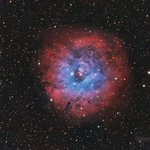


It was not the best night: nearly full moon and heavy rain until midnight, but versus the end of astronomical darkness,
g-rv.eu/lY
🔭 #Astrophotography 🔭📷
1/2

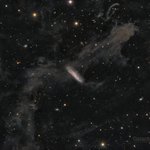
Cosmic contrast: when object of largely different distance conspire to form a particular interesting setting.
g-rv.eu/lV
🔭 #Astrophotography 🔭📷
1/3

Like for NGC 7497 , a barred spiral galaxy of type SBd located about 60 million light-years away in the constellation Pegasus. Seen almost edge-on, the galaxy with its prominent dust lanes shines through a veil of faint Galactic cirrus,
2/3

vdB 152, commonly known as the Dodo Nebula, is a faint reflection nebula located about 1,400 light-years away in the constellation Cepheus. Its bluish glow is produced by starlight scattered by interstellar dust,
g-rv.eu/lO
🔭 #Astrophotography 🔭📷
1/4

There is a red streak in front of Dodo’s beak. Initially I though of a residual from a satellite trail, but indeed the region below Dodo’s head has quite a bit quite structured Halpha emission, and the streak is just a denser part that made it into RGB.
3/4
NGC 7479, also known as the Propeller Galaxy, is a striking barred spiral galaxy located about 105 million light-years away in the constellation Pegasus.
g-rv.eu/lT
🔭 #Astrophotography 🔭📷

Its most prominent feature is a strong central bar surrounded by two asymmetric spiral arms that give the galaxy its distinctive propeller-like appearance.
Messier 1 a.k.a. NGC 1952, commonly known as the Crab Nebula, is a supernova remnant located about 6,500 light-years away in the constellation Taurus. It is the expanding debris of SN1054,
g-rv.eu/lL
🔭 #Astrophotography 🔭📷. 1/3

a massive star that exploded in 1054 AD, an event recorded by Chinese astronomers and visible even during daylight. The nebula's intricate network of filaments consists of gas ejected during the explosion. At its center lies the Crab Pulsar, a rapidly rotating 2/3
NGC 7023, commonly known as the Iris Nebula, is a bright reflection nebula located about 1,300 light-years away in the constellation Cepheus.
g-rv.eu/lQ
🔭 #Astrophotography 🔭📷


A new supernova in NGC7331 (SN2026aaiv), again after SN2025rbs last year. bit.ly/4wyBeu3 🔭#Astrophotography🔭📷