

Founder & Chief Investment Officer - Bristlemoon Capital Global L/S equities Subscribe https://xitter.cf/t.co/qMdR4HXhka Views not investment advice
Sydney / New York
Joined April 2016
- Tweets4.2K
- Following1.8K
- Followers11.9K
- Likes16.6K





Pinned Tweet
Bristlemoon just published a report on $FTAI, a newly initiated position in the Fund. Despite revenues expected to grow 50% in FY26/69% in FY27, and with even faster EPS growth expected, the stock is on a 15x P/E. We try to unpack the nuance in a fairly complex business...
What an incredible account of the Seinfeld story that’s beautifully told. I’m im-pressed.
@gilbert @djrosent
podcasts.apple.com/au/podcas…

Have been watching the GTA VI launch trailer on repeat today. Genuinely think it's going to blow us all away more than we can fathom.
$TTWO

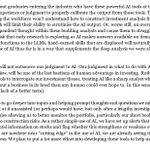
Totally agree with Paul, and I conveyed similar sentiments in our latest quarterly letter. Basically, AI is commoditizing analysis and the job of an investment analyst is likely to drastically change (already is):


Management meetings/field research is more important than ever. Assume 75% of the work you do at your desk for 8-12 hours a day will be done better by agents running 24/7. Being on the road more should be part of the job description for analysts.
Model build tests as a screen to hire analysts will eventually go away and perhaps be replaced with mock management interviews or mock information synthesis.
Being a nob in shared meetings, sabotaging yourself and those you share with will become fatal.
Every possible input into the numbers inside one of the three financial statements – product, sales, distribution, input costs, discretionary opex, balance sheet utilization, capital allocation, etc , etc, etc . . . . seemingly always fall into one of two buckets.
1.) Things within management’s control.
and
2.) Things outside their control.
When given the opportunity to meet with company executives, it’s almost always more productive, when faced with limited time, to ask specifically about things they control. There are certain questions only management can answer. Ask those questions first. Too much time in management meetings is spent asking execs to speculate on short term things outside of their control.


Great to have been included in the Australian Financial Review discussing our REA Group short.
afr.com/markets/equity-marke…

We published our September 2026 quarterly letter, with the Bristlemoon Global Fund returning -8.4% for the September 2026 quarter, with a -5.9% return for the month of September 2026, net of fees. We are not happy with these results and they mark a very disappointing last 12 months for the Fund. While we remain excited and optimistic about the Fund's holdings, many of these stocks have continued to derate to depressed levels, despite robust fundamental performance those businesses. We look forward to a time when we can report better news.
In the letter we discuss the lack of market breadth, how AI is commoditizing analysis, and outline our theses on 4 shorts: $CPB, $REA AU, $MBC and $PII.

Good analysis. We too are short $SBUX

We are short $SBUX with a PT of $70.76 and a 27% projected NTM IRR with 2.8x R/R. The Street believes Brian Niccol’s “Back to Starbucks” turnaround is a success, extrapolating accelerating SSSG into sustained demand and normalized margins. We disagree. Our geospatial imagery analysis, calls to 300 stores, scrape of 1.2M store-week operating-hour posts, permit filing analysis, scrape of 10,082 Glassdoor employee reviews and 80,777 Google reviews, credit card and foot traffic data covering 150M Americans, and survey of 293 customers reveals that 1) store closures are disproportionately concentrated in trade areas where demand can be transferred to nearby Starbucks locations, inflating SSSG by 483 bps, 2) Emerging beverage brands are increasingly locating directly within Starbucks’ trade areas, with competitor openings associated with 8-10% declines in Starbucks traffic, and 3) the Street erroneously models margins reverting to 2022 peak levels despite shops being drastically understaffed, all while employee sentiment declines precipitously.
Our thesis is threefold:
1. Under Brian Niccol’s “Back to Starbucks” plan, Starbucks closed 627 North American company-operated shops in Q4 2025. Since then, SSSG has accelerated from 1.0% to 7.9%, which the Street views as sustained organic growth continuing into FY2027. We believe management has materially understated the customer transfer impact from store closures on transaction growth, with our analysis showing ~483bps of inorganic transaction tailwinds ending after this quarter, most of which management claims is organic.
2. Starbucks has historically dominated the U.S. specialty coffee and drive-thru beverage market. However, its competitive landscape is rapidly changing, as emerging brands ($BROS, 7 Brew) scale into Starbucks’ core markets. Our channel checks indicate 7 Brew will deliver 60%+ unit growth over the next two years, with 500 and 900 openings in FY2027 and FY2028 respectively, while Dutch continues to grow at 17%+. Our analysis of leasing documents shows that 73% of these emerging brand stores are scheduled to open within a mile of a Starbucks, which based on foot traffic alternative data has historically led to 8-10% volume declines at similar locations.
3. In FY2022, Starbucks averaged 26.8 employees/store before cutting North America employees/store to a trough of 19.8 in FY2024, well below competitors’ staffing. Despite Starbucks’ $500M labor investment, which has since increased employees/store to 21.3 in FY2025, we believe Starbucks’ current staffing levels are unsustainable as it adopts a more service-intensive operating model.
Valuation: We model 483 bps of closure-driven SSSG unwinding as Starbucks laps the FY2025 closure cohort, with 181 bps of offset from the FY2026 cohort. This, combined with increasing competition, drives North American SSSG 174 bps below consensus in our base case and 286 bps in our bear case. This steps up by another ~280/420 bps respectively in FY 2028 as the 181 bps tailwind is lapped and competition intensifies. We model labor intensity remaining structurally elevated, forecasting Starbucks increasing employees/store from 21.3 to 24.0 through FY2027, driving FY2027 EBIT margins 263 bps below Street projections. Utilizing a conservative 18.5x/18.5x/20.0x NTM EBITDA multiple on FY2028 EBITDA, our bear/base/bull cases yield price targets of $48.48/$73.39/$113.95, respectively. Weighted at 35%/50%/15%, this yields a weighted average price target of $70.76.
An in-depth breakdown of our primary research and full theses, along with a catalyst path will be published tomorrow.

However, we acknowledge that the supply of serviceable modules may become a constraint on the mix of high margin MRE short builds, which could mean that these share gains come at inferior economics.
$FTAI Power is a valuable call option, with mgt targeting 100 deliveries of its 25 MW Mod-1 turbine in FY27, with guidance for $450-$750m of Power segment adjusted EBITDA (from a base of zero and against a c.$21bn EV for FTAI...). Additional Power contract wins = catalyst.
We think $FTAI can continue to grow even as the CFM56 aftermarket eventually contracts. The company’s market share has increased from under 2% in FY22 to c.14% as of Q2 2026.
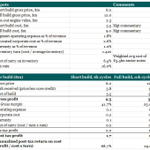
The fall in Aerospace Product GMs from 42.1% in FY22 to 30.5% in 1H26 partly reflects this mix shift towards heavy restoration builds (amongst other factors). Mgt has guided to 30% EBITDA margins over the next 2-3 years.
$FTAI engine exchange economics depend on scope of work, but we model MRE short builds hitting >40% GMs & full builds c.25%, with a debate around the mix of these types of builds going forward affecting what mgns FTAI can achieve. We unpack this debate.

$FTAI has amassed hundreds of CFM56 engines + aircraft shops, enabling it to run an engine exchange program that dramatically improves turnaround time for customers. Modules can be mixed/matched to optimize green time & release usable life from modules.
bristlemoon.substack.com/p/f…
