

Head of Finance @vana — open data infrastructure for human-grounded AI. Founder @cryptyx_ai prev. Immutable, Barclays | Melbourne
Melbourne, Australia
Joined March 2022
- Tweets678
- Following1.8K
- Followers493
- Likes5.2K


Pinned Tweet
Data portability now has an economy.
Every time a person's data moves on Vana, with their permission, the network is paid. One grant, read again and again. A split written into the protocol.
I wrote up how it works, and why it's built the way it is.

On @vana your data moves to the apps you choose. Nothing moves until you approve.
That movement is the value.
When an app you approved reads it, the app pays the network, and by protocol rule the earnings go to stakers, to buyback and burn, and to the ecosystem.
token.vana.org


The new Vana App is now live.
It sits behind the apps you use. When one of them asks for your data, you see exactly what it wants and decide. Say yes and the data moves with your permission, and the move is recorded.
See it work in OpenPet: connect an Oura Ring, get a pet that reads your sleep back to you.
Trying it this week earns XP.
Full write up: vana.org/blog/vana-is-stripe…
More than 80% of delegated stake on Vana is now in the protocol revenue funded pools.
As a reminder; rewards are paid from network fees, which come from use of the network.
Positions not moved stop earning rewards after 31 October. Principal can be withdrawn at any time.
token.vana.org
stake.vana.org

Much of what an agent remembers about you, you never wrote.
That's why lock-in matters more for agent memory than for a file you saved yourself.
Data about you, kept by someone else. We think about it all day.

The biggest barrier to productive AI agents is context loss and platform lock-in.
Our Head of Product, @kimblgn, highlights what we've learned since launching Walrus Memory: when memory is encrypted, verifiable, and portable, developers can actually put it to work.
A company's lawful access to Denmark's CPR register was abused to reach about 8.8M people's names, addresses and ID numbers.
It surfaced via an invoice the 8.8M weren't party to.
Open data infrastructure for AI has to show each access to the person.
thenextweb.com/news/denmark-…

All network transactions on @vana: 80.22M on 13 October.
A licence is priced in a deal with whoever holds the dataset. A read is priced in the protocol, against the person's grant.
Open data infrastructure for AI runs on a price both sides can see. token.vana.org

A transaction hash proves a burn ran.
Fee income is public as well. Each time an application reads a granted scope on @vana, a fee settles in USDC.
Open data infrastructure for AI needs rules and receipts on the record: token.vana.org/burn

Proprietary data and network effects are the same moat.
Data defends a product once each contributor makes it better for the next. That loop lasts only while contributors have a reason to stay.
Open data infrastructure for AI has to give them one.

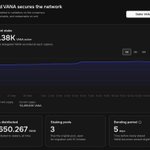
The response to the expansion of staking on @vana has been encouraging. As of 6 October, almost 60% of all delegated stake has migrated to the new pools.
Meanwhile, total delegated stake on Vana rose 11.4% between 27 September and 6 October.
60% of protocol fees are directed to stakers.
Open data infrastructure for AI hardens as commitment increases. That is the only kind of commitment worth building on.
Existing stakers can migrate to a new pool at stake.vana.org by midnight UTC on 31 October 2026.
Live figures are readable on the public dashboard at token.vana.org.

Data portability now has an economy.
In a couple of hours @artieart88 and I walk through how it works: reads, fees, staking, burn, and why it was built to extend.
Vega is live. Let's talk numbers.
LIVE on X - Thursday 1 October, 09:00 Singapore / 10:00 Seoul (18:00 Wednesday Pacific) - @GCudrig answers your questions on reads, fees, staking and burn.
Set a reminder: xitter.cf/i/spaces/1oKMvNjjMODGQ…

The paper: token.vana.org/articles/vana…
Live dashboard: token.vana.org
The Vega upgrade: vana.org/blog/the-vega-upgra…

Talking it through live with @artieart88 tomorrow.
Thu 1 Oct, 9am SGT / Wed 30 Sep, 6pm PT xitter.cf/i/spaces/1oKMvNjjMODGQ…
Aten says he declined the permission. Muse's settings showed it enabled. Meta called it opt-in.
None of those is a record. Each can change without a trace, and there's nothing to check it against.
Agents acting on permission need permission that can be proven and revoked.

Blackrock just published on autonomous machine transactions. Not a crypto argument anymore. It's institutional.
Coinbase, Stripe, Google, Visa. Five protocols for the payment layer.
The contested layer is what machines are permitted to act on.
Value here is data moving.

Our latest research paper explores the growing connection between AI and digital assets and explains why broad AI adoption may drive new demand, utility and applications across the digital asset economy. blackrock.com/us/individual/…


Vega doesn't say how much Vana earns. it says when Vana earns.
Dataset deals were periodic and few. Now the network earns every time one person's data moves, and agents look things up thousands of times a day.
That's what infrastructure looks like.
The Vega upgrade is live, as set out in the January roadmap. Four things to know.
1. AI models are pretty good now. What sets one apart is context: what the model knows about the person asking. AI tools and agents look that up thousands of times a day. Every one of those lookups is your data moving. That is data portability.
2. On the internet, your data moves instantly. It moves between platforms without you in the loop. Vana moves your data where you choose and keeps your permission on record. The Vega upgrade brings that to the same speed: about a twentieth of a second.
3. Governments need the same thing. Most countries have laws that allow you to take your data with you. Almost none had a working way to do it until Vana wrote the standard for how personal data moves. It is now hosted by the Linux Foundation, and governments globally are already scoping national implementations.
4. The Vana network has always earned when pooled datasets were accessed. As of the Vega upgrade, it also earns every time one person's data moves. Every data portability transaction pays the network. Someone moves their data to an app. The app reads it. The network earns.
Want to know more? 🔗👇

Give away the rulebook, keep the network.
A standard only gets adopted if nobody owns it — but the volume it unlocks accrues to the original implementation.
That's us.
Value here is data moving. A standard is what makes it move more.
The protocol Vana runs on is now hosted at The Linux Foundation.
And next Thursday, it is being presented to the groups that define the internet at the Global Digital Collaboration Conference #GDC2026 in Geneva.
Big week for personal data. Here's what's happening.

Regime Detection: A Multi-Factor Approach to Digital Asset Intelligence open.substack.com/pub/gianca…
Coinbase gets it. Agent economy is not hype anymore.
But executing trades onchain is table stakes. The alpha is in the intelligence layer that tells agents WHEN to act.
That is what we are building at @cryptyx_ai.


Giancarlo Cudrig (GC) retweeted

Every night, our AI agent evaluates every metric, grades every signal, and proposes improvements.
It doesn't sleep. It doesn't have bias. It just optimises.
And soon, agents won't just evaluate — they'll execute.
The intelligence layer is the moat.
Execution without intelligence is just faster ways to lose money.
Every exchange is building agent APIs.
The differentiation is in the conviction layer that feeds those APIs.
@cryptyx_ai is that layer.

We’re back, baby 😎🦞 @krakenfx
blog.kraken.com/news/industr…
