I spent five hours playing this new wargame, and it felt like a modern-day scenario, like some of the videos I’ve seen from the Russo-Ukrainian war. They even model cope cages. Bravo @TboneWargames
The drones and unmanned vehicles feel right; I used them for quick reconnaissance, then pulled them back. On another run, I sent both FPV formations on swarm strikes.
Proper mobile air defense is imperative. Moving IFVs, unloading infantry, and then reloading them in different vehicles is phenomenal.
The graphics are awesome, and I especially love the unit information card. Right-click on a unit and select the last option. I appreciate that detail. Can’t wait for the release.
#SteelWolverinesModernArmoredCombat #WarGame
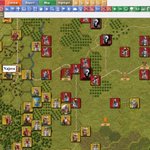
This was a great run. I’m leading the Castilian army under Ejercito Trastamara with a combination of heavy cavalry groups and an infantry force positioned just east of Najera. That’s the town I’m supposed to defend against the English army under the Black Prince, consisting of Grade A archers and men-at-arms.
I knew they’d chew through my first line of infantry; it was inevitable. So I sent my French and Aragonese heavy cavalry east and then north along the Rio Yalde, to snip at the English rear. The French Gendarmes under du Guesclin caught the Black Prince and his wagon train, slowly draining the English of one of their advantages: arrows.
With the English rear enveloped, I sent those heavy cavalry detachments on precision strikes into vulnerable spots, basically the space between the men-at-arms formed in blocks. It's turn 20, and the English front line has fought all the way to the Rio Najerilla; can they storm my defensive works on the other side? Only the next turn will tell. Desperta Ferres!
#WargameDesignStudio #AgeofLongbow #Medieval
Leading Marshal Michel Ney’s Corps, more like a division, with orders to break through the British center toward Mont St. Jean during the epic Battle of Waterloo. I’m still learning the mechanics of Scourge of War Remastered, so my assault faltered, and I was forced to withdraw with at least some order, initially. It soon turned into a headlong retreat behind my line of artillery. It was rather shameful, till next time.
#BattleofWaterloo #ScourgeofWar #WarGame
Since War of the Austrian Succession released on Steam, I’m starting a new campaign at Fontenoy. I’m a little starstruck since the King is on the field, Louis XV.
The starting positions are dispersed, and the map... gigantic. So I’m trying to constrict my lines so it's more manageable when the British/Dutch army under the Duke of Cumberland arrives.
I’m worried about two “fronts.” In the north, the siege of Tournai is in the pre-assault phase; it's around 0500, while the Fontenoy front in the south is already…lively.
I’m going to make my forward headquarters at Gueronne; move the king, dauphin and staff there and position my brigade and division commanders forward to do their thing.
I know Cumberland’s approaching from the east and is gonna tear through my front at Fontenoy; it's inevitable. My only escape route to the west bank of the Escaut is over a series of bridges northwest of the Fontenoy line.
I feel like I should keep that route open, or they can cut my communications with the west bank. Meanwhile, the siege of Tournai in the north probably won’t turn out well. I have plenty of siege weapons for the job, but it's still dark, and their line of sight is slightly obscured.
After they begin their devilish work, I have only one brigade of Milice to assault the walls; I fear not enough to carry the place. I’ve put all the independent columns on the west bank in marching order to reinforce this planned assault. Pour le Roi et pour la France
#WargameDesignStudio #WaroftheAustrianSuccession #History #TurnbasedStrategy
I’m really enjoying the updates to the Musket & Pike series by Wargame Design Studio. This is an example of a brutal slugfest between two giants of the War of the Austrian Succession at the Battle of Dettingen.
I’m leading the Armee du Roy under Marechal de Noailles, who starts with a pretty substantial army that is partly on the march. The clash started with the race to Dettingen, but more importantly, the two objectives on the other side of the marsh, just east of the town.
I sent a flying column of heavy cavalry to try and take the objectives, but the British sent them reeling back into the town. Luckily, they gave me enough time to reinforce the east end with infantry from the Noailles Brigade. They look damn fine with their distinguished colored cuffs.
Since I own the town, I’ve tried to stabilize a firm defensive line with artillery and divert a brigade of infantry and the rest of the cavalry north to cross the stream and marsh and hit the developing British right.
Meanwhile, I have the Corps Detache’ under Maubourg moving from the opposite direction, pivoting south through Aschaffenburg, and hoping to hit the enemy main body in the rear. Fingers crossed.
#WaroftheAustrianSuccession #Wargame
I’ve been working on a project focused on Pensacola’s small-scale military operations during the Civil War for quite some time. War Room: Tactical Sandbox was recently released, and it has greatly helped me present history the way I like.
While there have been some negative reviews, I believe they are misplaced; this is not a game, but a valuable tool. Here’s an example: Around 0330 on October 9, 1861, a little over a thousand Confederates crossed Pensacola Bay on barges towed by steam tugs Neaffie and Ewing and landed about four miles east of Fort Pickens on Santa Rosa Island.
The battle that followed is completely meaningless in the grand scheme of Civil War history, but it means everything to me because it's my second home and thesis. I used to surf, fish, and play on the same ground these titans grappled on.
#WarRoomTacticalSandbox #History #BattleofSantaRosaIsland
Gulf Coast Wargaming retweeted
Why is it Austerlitz and not Slavkov u Brna? Breslau and not Wrocław? Donbas and not Donbass?
Historical names are rarely simple. They pass through languages, maps, armies, archives, borders, translations, typos, and centuries of convention.
Our latest article looks at how WDS approaches names in historical games: when to use period forms, modern local names, established English battle names, catalog titles, or simply the least confusing option.
From Pointe du Hoc to Stavka, Kyiv, Danzig, and the Romans who were not yet “Byzantines,” it is a tour through the messy afterlife of historical naming.
wargameds.com/blogs/news/wha…
Gulf Coast Wargaming retweeted
"A Mere Question of Time"
Grant Crosses the James — June 12, 1864
"We must destroy this army of Grant's before he gets to the James River," Robert E. Lee had told Jubal Early in the grim first days of June 1864. "If he gets there, it will become a siege, and then it will be a mere question of time."
He was right about all of it. He was just unable to stop any of it.
Grant had been moving since early May, crossing the Rapidan on the 4th and plunging south into the dark tangle of the Wilderness, where Lee hoped the scrub timber and the narrow roads would cancel Union numbers and Union artillery. They did — for a time. The armies clawed at each other for two days in that trackless second-growth, fighting by sound as much as sight, whole brigades losing their direction in the smoke and the thickets. Grant took his losses — upward of seventeen thousand men in two days — and moved south by the left flank. Every general who had come before him had turned back across a river after something like that. Not Grant. He moved south.
South to Spotsylvania, where the fighting ground on for nearly two weeks and produced the Bloody Angle of May 12 — that eighteen-hour killing ground in the rain where men were stacked three deep in a Confederate trench and shot and bayoneted and beaten with musket butts until darkness and exhaustion stopped what orders could not. South again through North Anna and Totopotomoy Creek, Lee always getting there first, the lines always settling back into that deadlock that favored the defender. The Overland Campaign had already cost Grant somewhere around fifty-five thousand casualties — killed, wounded, missing — against perhaps thirty to thirty-five thousand Confederate losses. Both armies were used up in ways that did not show on paper.
Then Cold Harbor.
On the morning of June 3, Grant ordered a frontal assault on Lee's entrenched position, and every man in the Army of the Potomac understood, with the particular clarity that comes from having done this before, what was waiting for them across that ground. Some of them — the ones who had learned what these assaults cost — pinned slips of paper to their coats the night before, with their names and home addresses on them, so that whoever found them in the morning could write the letters that would need to be written. The assault lasted perhaps an hour. The Union army lost close to seven thousand men before Grant called it off. He would later write that it was the one order of the war he most regretted giving.
The armies then settled into something like a siege at Cold Harbor, wounded men lying between the lines for days while officers haggled over truce terms that never quite materialized in time. Grant used the stillness to think.
***
His target was Petersburg, twenty-three miles south of Richmond — not the Confederate capital itself, but the rail hub that fed it. The Weldon Railroad. The South Side Railroad. Sever them and Lee's army and Richmond starved together. But getting there meant doing something no army had accomplished in this war: disengaging from a front-line trench with the enemy forty yards away, marching south in the dark, crossing two rivers, and arriving on the far side with enough strength and speed to take Petersburg before Lee could divine where he had gone and move to stop him.
Grant built the plan quietly. On June 7, his aides Horace Porter and Cyrus Comstock rode down to scout the James crossing sites and coordinate with Ben Butler's Army of the James at Bermuda Hundred. Engineers were set to calculating pontoon requirements. Demonstrations were arranged against Richmond's eastern defenses to suggest Grant was still looking north and east rather than south. Wilson's cavalry was positioned to screen the flanks. Deception, speed, and superb staff work — that was what this required, and Grant knew it.
On the night of June 12, 1864 — one hundred sixty-two years ago tonight — the Army of the Potomac began to disappear.
Hancock's II Corps and Wright's VI Corps held the old lines while the rest of the army pulled out and moved south through the summer dark, under orders to keep quiet and keep moving. Warren's V Corps cleared the roads ahead. Burnside's IX Corps followed. Smith's XVIII Corps, already shifted toward Butler, was angling separately toward the James. Tens of thousands of men moved without torches, without drums, hauling with them five thousand wagons and ambulances, fifty-six thousand horses and mules, twenty-eight hundred head of cattle — everything a hundred-thousand-man army needs to eat and fight and bleed for several days running. The silence of that march, for men who had been under fire without real pause since the first week of May, must have been almost as disorienting as the noise they had lived in.
***
Lee learned on the morning of June 13 that the Cold Harbor trenches were empty. He didn't know where Grant had gone — not with any certainty. The cavalry that in other seasons would have cut through the Union screen and traced the dust clouds south was not what it had been. Stuart had been dead since May 11, shot at Yellow Tavern, and the Confederate horse had not recovered its edge. The riders Lee sent probing came back with contradictions rather than answers. Back to the Pamunkey to refit? A new thrust at Richmond's north? Or south — the thing Lee had dreaded since those words to Early?
He could not know. And not knowing, he could not move.
There was another complication, and the timing of it carried an irony that no amount of hindsight makes any easier to look at straight. Around June 12 — at very nearly the moment Grant was beginning his withdrawal — Lee had sent Early and the II Corps marching toward the Shenandoah Valley, ordered to deal with Union successes there and, if circumstances permitted, to threaten Washington and pull pressure away from Richmond. It was defensible on the merits. It stripped Lee's lines at the precise moment when stripped lines might prove fatal.
***
The James River at Weyanoke Neck is wide, tidal, and not forgiving of improvisation. Lt. Col. James Duane directed the engineering effort, drawing on Butler's officers who had been given some advance notice, and what they built was staggering in its ambition: one hundred and one pontoon boats plus larger anchoring vessels, a structure stretching somewhere between twenty-one hundred and twenty-two hundred feet across a tidal river with a mind of its own.
Construction began around midday on June 14 — some accounts push it to the early hours of the 15th — and the bridge was complete in roughly seven or eight hours, the current and the tide fighting the engineers every foot of the way. Infantry crossed mostly by steamer and transport boat. The bridge carried the guns, the wagons, the animals, the cattle, and then more infantry as the columns kept coming.
By the morning of June 17, it was done. Over one hundred thousand men, with everything they owned and needed, had crossed a broad tidal river thirty miles from the Confederate capital without losing a regiment, without a major engagement on the far bank, without effective interference of any kind — because Lee did not know where they were until knowing no longer mattered.
***
Not until around June 16 did Lee grasp the full shape of what had happened — that Grant was across the James and driving hard on Petersburg. He rushed forces south, reshuffled his lines, did what he could with what remained. Beauregard, holding Petersburg with a force that had no business holding anything, performed brilliantly in those desperate days — concentrating his thin regiments with the instinct of a man who understood he had no margin for error, calling Hoke's division up from the Richmond defenses, managing to keep his works intact against the piecemeal Union attacks on June 15, 16, 17, and 18 that might, under a different weight of coordination and energy, have ended it all in an afternoon.
They did not end it. And by the time Grant acknowledged that the city would not fall by direct assault and shifted to siege operations, Lee's army was filing into the Petersburg trenches.
It had become, as Lee had prophesied, a siege. And now it was a question of time.
***
The siege would last nine months and twenty-three days. It would wear through regiment after regiment — including the 2nd Mississippi Infantry and the other used-up veterans of Heth's Division who had already given more than seemed possible at the Wilderness and Spotsylvania and Cold Harbor — until there was very little left to wear through. The supply lines would go, one by one. The rations would thin, and then thin further. Men would dig and watch and wait and in the quiet hours begin to run the arithmetic of whether the Confederacy could still survive, and the answer they kept arriving at would drive the desertions that Lee could not prevent and could not replace. The question he had stated so precisely in the first days of June was being answered, slow and certain, in the trenches outside Petersburg.
The final answer came on a Sunday morning the following April, at a village called Appomattox Court House.
But it had been written here, in the dark, on the night of June 12, when a hundred thousand men crossed a tidal river without drums — and Robert E. Lee, forty miles to the north, could not see which way they had gone.
Turn one as the Confederates under Lt. Gen. Pemberton with decent starting positions. Lorings' division is posted at the southern end of our defensive line, and I had him push Tighman’s brigade up against Jackson Creek and ordered them to prepare breastworks.
1st Miss. Cavalry is patrolling east of Lorings division and keeping a watchful eye on the advancing Yankees. Up north near Champion Hill, I have Stevenson's division with Lee’s Alabama brigade holding the only road leading north into our interior.
Making small adjustments here and there to the initial positions of the infantry and artillery. I want to fill the empty high ground off to my right so the first thing the Yankees encounter, if/when they come through the woods from the east, is my artillery and prepared infantry positions.
Col. Reynolds' Tennessee brigade is already on the Jackson Road heading south to reinforce our rear. The question is where to send them: either immediately north to Champion Hill or farther east along the Middle Road to knock the Yankees off balance.
#ChampionHill #AmericanCivilWar #VicksburgCampaign
I just tried out #Gettysburg from SGS, and I have to say, you won’t find a better depiction of A.P. Hill leading Third Corps into combat than this much-needed Civil War wargame. There simply aren’t enough out there to satisfy my needs.
"Little Powell," alongside the other generals, looks fantastic. These screenshots are from the first, smaller scenario, but I’m now thoroughly enjoying the larger campaign. Cheers.
#StrategyGameStudio #AmericanCivilWar
Squad Battles: Grenada got a new facelift, and it’s a complete makeover. I take charge of Echo Co. from the 22nd Marine Amphibious Unit, diverted from their destination in Lebanon to the Caribbean for what they believed was the lead role in securing Grenada.
Started, turn 1 consolidated near the town of Paradise. Sent Company HQ and Weapons platoon north up the middle to establish a CP and start lobbing 60mm into our first contact from 2nd Platoon, who was maneuvering north on my right.
1st Platoon went up the left, with the lead fireteam breaching the woods south of the airstrip, crossed a stream, and encountered a Quad DshK, which sent them reeling with one casualty.
Probably need to withdraw 1st Platoon and take the long route west, which my jeep is reconnoitering now. I’ll keep one fireteam around that area for a turn to pop off rounds and keep their attention while I maneuver them out. You can download it for free from the @WargameDS website.
#OperationUrgentFury #InvasionofGrenada #WarGame
Battle of the Pyramids, July 21, 1798 metmuseum.org/art/collection…
Age of Longbow released on Steam yesterday. I’m doing a playthrough of the Battle of Poitiers (1356), commanding the French under Jean le Bon.
The first couple of turns had me advancing east with the Avant-Garde division under the Dauphin, which saw initial success, but gradually stalled as I encountered stronger units, i.e., English men-at-arms.
Orleans and his Bataille division follow a little behind, prepared to push in if the Avant-Garde is repulsed, which looks likely. Meanwhile, I’m also trying to find the English flanks.
To the south, I tried to maneuver my Genovese crossbowmen under Grimaldi around the patchwork of orchards and villages and smacked right into a pack of English archers.
I feared bogging down what little cavalry I have in the main assault, so I sent them (German allies under Saarbrucken and the Chevals a Gauche under Clermont) on a recon around the north side of Forest de Noualle. I hope to find an unguarded entry point, but it looks doubtful. Stellar addition to the growing @WargameDS presence on Steam.
#HundredYearsWar #AgeofLongbow #BattleofPoitiers
Gulf Coast Wargaming retweeted
Light infantry was one of the keys to eighteenth-century warfare, and nowhere more so than in the American Revolutionary War.
Our latest essay looks at how light troops scouted, screened, skirmished, seized broken ground, and shaped the conditions for battle long before the main lines closed.
From European precedents to Brandywine, Freeman’s Farm, and Cowpens, it explores the doctrine, tactics, and battlefield role of an arm too often reduced to myth. A great read for anyone interested in the history behind the games.
wargameds.com/blogs/news/tac…
Gulf Coast Wargaming retweeted
Historians long lacked a clear understanding of how ancient battles actually unfolded, since their knowledge came only from written accounts, so they staged a reconstruction to see it for themselves.
Gulf Coast Wargaming retweeted
Fresh on the heels of the recent updates, we have another round for the Sword & Siege series and the two updated Musket & Pike titles. These fixes should be safe for ongoing games and are available now via the Support Hubs or full installers in your Store Account.
wargameds.com/blogs/news/mus…
Gulf Coast Wargaming retweeted
The Renaissance was more than art, cities, and humanist brilliance.
It was also an age of sustained, system-building warfare. In Part I of our new “Wars of the Renaissance” series, we begin in Italy, where the invasions of the 1490s turned a wealthy, fragmented peninsula into the central battleground of European power politics.
From Charles VIII’s march to Cateau-Cambrésis, the Italian Wars reveal how money, fortresses, artillery, logistics, and professional soldiers reshaped war.
wargameds.com/blogs/news/war…
Turn 10 of the #BattleofTiconderoga. Playing as the British under John Burgoyne.
The first couple of turns, I tried to soften rebel defenses with Maj. Williams Royal Artillery, made up of howitzers, six and twelve pounders. As they blasted away, I advanced the right wing under Maj. Gen. Phillips. That includes the Advance Corps and 2nd Brigade under Brig. Gen. Hamilton.
Hamilton’s brigade broke through first, around turn 8, with Lt. Col. Lind’s 20th Foot and Maj. Forster’s 21st Foot piercing through the extreme right and wrapping back towards the middle and the Heights of Carillon.
Meanwhile, the amphibious assault on the left led by von Breyman’s legion of Germans is having a hard time at it, meeting two fortified artillery positions directly south after landing. No cover, boats shot up on the approach; it was nasty business.
While the right wing made its majestic advance on the rebel left, I made a feint in the middle with the Light Battalion under Maj. Lindsay and the Corps of Marksmen under Capt. Fraser. They performed their job magnificently and are now withdrawing to the wood line in the NE.
On the Lake Champlain front, I have five ships mounting guns and pressing SE, but a boom prevents them from getting any closer to Ticonderoga.
Now that the rebel left is thrown into utter confusion, it's time to send in the heavies released last turn, the Grenadier Battalion led by Maj. Acland, which I’ll throw into the now lightly defended mid left, or right, I mean their mid right...
#WargameDesignStudio #AmericanRevoltion #History
No flowery narrative necessary. Just cold steel and clean graphics. #WargameDesignStudios did it again, releasing American Revolutionary War from the Musket & Pike Series.
I’m playing as the Americans in the first scenario of the Battle for Brandywine Creek campaign, and just wow. One difference is the small-unit organization of most American forces.
I’m utilizing the open order mechanic a lot more; it helps avoid disruption as you maneuver through the forest with bigger units. Super cool.
Just a quick comment on the detail: the first image shows an unidentified, possible Royal Marine unit. Their cover is unique, as shown in both the unit card and the 3D view.
I recognized it in the release of War of the Austrian Succession, which distinguished regiments by their cuff color and cover lining. This is the gold standard of war games. Not to mention, they released the Crusade series on Steam today. Cheers.
#AmericanRevolutionaryWar #WarGame #History