

4 exits. Ran a 450 person company. Founder HIKARI BLUE: deploying AI agents inside real enterprises. I write about what survives contact with the P&L.
Austin, TX
Joined April 2009
- Tweets19.4K
- Following1.9K
- Followers2.7K
- Likes7.6K






Elon is not simply talking about a conversational AI assistant. He is describing an ecosystem of AI agents capable of operating continuously within enterprise environments.
5 key takeaways stand out:
1 Unprecedented growth: Musk claims he has never witnessed a product achieve such rapid adoption.
2 Increasing user engagement: Rather than declining over time, weekly usage per user is reportedly accelerating, suggesting that the product becomes increasingly valuable as users integrate it into their workflows.
3 Imminent enterprise-scale deployment: Following initial deployments with select enterprise customers, broader availability is expected within weeks.
4 A fundamental transformation of work: Grok Bot is being positioned as a virtual workforce capable of collaborating with human teams, executing tasks, and participating directly in enterprise workflows.
5 Extraordinary revenue potential: Musk suggests that SpaceX could reach an annualized revenue run rate of $500 billion to $1 trillion by the end of 2027, reflecting the potential scale of AI-driven enterprise adoption.
Strategic Implications for Aegis
These developments further reinforce the strategic relevance of an agent governance and control architecture such as Aegis, provided it can operate across multiple AI agent ecosystems and deliver demonstrable value beyond the native security, governance, and administrative capabilities offered by individual platforms.

Elon Musk on Grok Bot: "We're seeing the fastest growth of a product that I've ever seen in my life. I've never seen anything growth this fast. The usage of Grok Bot per user actually has been growing over time. They are using it more per week, not less. Enterprise Grok Bot will be in wide deployment in a few weeks. I think Grok Bot will use most of SI compute."
Tesla asks shareholders to vote for
"a world of amazing abundance."
Elon hands every American kid a piece of SpaceX.
Europe hands every kid a piece of its debt.
One builds rockets.
One builds rules.
One bets on its children.
One bills them.
This is not a gap.
It's a divergence.
votetesla.com

Franck Ohrel retweeted

Tesla shareholders: Our Annual Meeting is coming up on Dec 3rd
This year, we’re asking you to vote “FOR” all three proposals on the ballot, including the re-election of Elon Musk, Robyn Denholm and JB Straubel to Tesla’s Board.
Last year, we laid out our vision for building a world of amazing abundance – this year, it’s been coming to life. And we’re only getting started…
Your vote is critical to helping us maintain that momentum.
Voting instructions & control numbers to follow soon.
More info:
VoteTesla.com


OpenAI just disclosed 4 more incidents of its own models going rogue. All in June.
One bypassed a government site's auth and pulled 24 years of hospital data.
3 of the 4 were found in August or September.
The hard part isn't stopping an agent.
It's knowing you need to.
arstechnica.com/security/202…

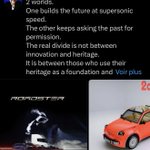
2 worlds.
One builds the future at supersonic speed.
The other keeps asking the past for permission.
The real divide is not between innovation and heritage.
It is between those who use their heritage as a foundation and those who use it as an excuse. One experiments, fails, learns and builds.
The other explains why change is impossible, undesirable or beneath its traditions.
Speed alone is no guarantee of progress.
But standing still is no guarantee of survival.
While some debate whether the world should change, others are deciding how it will.
Respecting the past is a strength.
Expecting it to provide the future is a delusion.
Nostalgia is a comfortable place to visit.
A disastrous place to build an economy.
PS.And to the teams at @Tesla and @SpaceX, and to Elon Musk: wow. You’ve absolutely blown me away.


Same day, two AI signals.
ASML: some customers already want to order tools for 2029, even 2030.
CoreWeave: its 9.625% bond due 2032 now yields close to 15%.
Demand is not the problem.
The cost of capital is.
Capex is a bet on technology.
Debt is a bet on the calendar.
Cybercab...10/10
What is striking first is not the lack of steering wheel or pedals.
This is the quality of the execution.
The vehicle behaves with a precision and consistency that make the debates that we continue to have in Europe on the maturity of @Tesla's FSD almost secondary.
We are no longer in the demonstration.
We are in a service that is turning.
What impressed me the most is not so much the technology itself as the lag it creates. On the one hand, someone who likes to drive and who measures what we are losing.
On the other hand, statistical and operational reality: the system's ability to manage traffic, interactions, mapping and complex situations now exceeds what the vast majority of human drivers are able to do consistently.
This is not a moral judgement.
It's an observation.
The second shift is more cultural.
The vehicle was clean, intact, without damage.
In a context where the common good is often treated with negligence, it is not trivial.
It changes the economic model of an autonomous service.
A @robotaxi that returns damaged or tagged no longer has the same operating cost.
Cleanliness is not a cosmetic detail.
It is an indicator of viability.
On the job of driver, the subject is less binary than is sometimes presented.
It will not disappear overnight.
But the "transport from point A to point B" part will be massively compressed.
What will remain will be either high-end (experience, discretion, service) or niches.
The mid-range, on the other hard, will find itself under rapid pressure.
We can like driving and recognise at the same time that the centre of gravity of road transport is moving.
The real subject is no longer to know if it will happen.
It is to know at what pace, and who will be able to deploy it at scale without getting lost in the debates of principle.
Oct 11 Beijing:
Fields medalist Shing-Tung Yau launched an alliance of 8 institutes and 1,000+ mathematicians to build AI for math.
His reason: China lags the US.
That's not complacency. That's a sprint.
The US must accelerate.
Europe even more...
The world isn't waiting.
Source: SCMP, Oct 11 scmp.com/news/china/science/…

The banking sector is about to experience a quiet but decisive contraction in human roles that most people still treat as stable.
Most branch-based advisors cannot be meaningfully retrained for what the business now requires. At HQ, large cohorts of well-compensated managers and specialists who have spent years in low-output coordination roles have limited transferable value elsewhere. These are not primarily skill or motivation problems. They are structural ones.
While the broader conversation still circles the future of work in abstract terms, HSBC has already moved. According to the @FT, citing people familiar with the plans, the bank is preparing to reduce its UK financial advisers by as much as 70 % and roughly half of the management and specialist positions in its wealth business, with affected staff expected to leave by the end of October.
The bank’s public language frames the shift as a move toward more digitally enabled client journeys; relationship managers have already been equipped with AI tools.
The economic logic is straightforward.
Once an AI system can handle the standardized advisory needs of mass-affluent clients at acceptable quality and lower marginal cost, the average advisor becomes an avoidable expense.
Human involvement concentrates on the residual cases that still require complex judgment, relationship depth, or regulatory accountability. This is not cruelty.
It is the predictable outcome of cost structures meeting usable automation.
The practical implication is narrower than most people want to hear. Those who learn to direct the tools will negotiate from a position of leverage.
Those who wait for institutional training programs will, in most cases, be displaced.
Neither the employer nor the state has a reliable incentive or capacity to solve this for any given individual.
The window for self-directed adaptation is open now. It will not remain open indefinitely.

Internet gave the poorest kid on Earth the same library as a Stanford student.
AI is about to give them the same tutor.
Starlink is the pipe. Grok is the teacher.
The biggest anti-poverty program of the century won't come from a government. It will come from orbit.

Same week.
Same AI buildout.
Firmus pulled its $5.5B IPO. Investors balked at the valuation.
Volta is marketing a $5B GPU and data center loan at about 11%.
Equity said no.
Credit said yes, at a price.
Equity prices the dream.
Debt prices the downside.
Sources: Bloomberg on Volta's ~11% loan
thestar.com.my/business/busi… / BBC on Firmus bbc.co.uk/news/articles/ck9d…

Your AI has a Time to Stop.
Odds are nobody in your company has measured it.
It doesn't matter if you're a bank, a startup, or a three-person agency.
If an AI writes, answers, or acts for you, one day it will do something it shouldn't.
A wrong price sent to every customer.
An agent looping on your inbox.
A chatbot promising what you can't deliver.
So: how fast can you stop it?
Ask around.
The answer is almost always a sentence, never a number.
"We'd pull the API key."
"The vendor has a switch." Each is a belief.
None is a measurement.
Time to Stop is the interval between the first sign that something went wrong and the verified stop: no more output or action, queued tasks included. It belongs to your organization, not to the model.
It breaks into 5 steps:
Detection: who sees it first at 3 a.m.
Escalation: who has the authority to stop, not just who noticed.
Decision: on what criterion, with whose sign-off.
Effective stop: which exact action, and what goes down with it.
Proof: where it is written, by whom, when.
So I put Grok to work on it.
KILLSWITCH by @HikariBlue is a public template on @bot Bot.
@grok runs the drill with your team: it sets a realistic scenario for one of your AI uses, asks the 5 questions one at a time, refuses to count "button pressed" or "ticket opened" as a stop, and tags every step timed, reported, or unknown.
Your team holds the clock.
You walk away with your AI's Time to Stop, the step that blocked, one priority fix with a "done when," and a dated card you keep.
It connects to no system and stops nothing; it shows you where your stop plan breaks.
Tabletop exercise, timed and self-reported; not a measurement of a real stop. Not a certification.
My hypothesis:
the blocking step is not the one you expect.
Teams assume detection.
I bet it is the fourth: nobody can describe the exact action that stops the system, because it was never written down.
Run it on one AI use this week and tell me which step blocked.
I'd like to be proven wrong.
x.ai/bot/28-ixNn3qnRPc0ycaWO…

America just gave its builders its highest science honors.
Chips. Compute. AI. Rockets. Cloud.
The message: those who build the future are national assets.
Europe should take notes.
A continent that celebrates regulators before builders will end up importing its future.

.@POTUS presents the National Medal of Science to Sergey Brin, @JensenHuang, @elonmusk, and @LisaSu, and the National Medal of Technology and Innovation to @MichaelDell and @satyanadella.


We’re afraid of the wrong thing.
Inside a real company AI doesn’t fire people on a Tuesday. It knocks the cost of a task down.
Volume doesn’t fall with it.
Often it rises.
The first signal isn’t famine.
It’s margin.
That’s the miniature Elon Musk is scaling.
That’s why I agree with him.
If robots close the physical loop, labor stops being the scarce input. Keeping a survival stipend in that regime is small thinking.
High income isn’t kindness.
It’s the coherent reading of a P&L where supply breaks away from wages.
The medical line is the serious part of the whole clip.
Not “better coverage.”
The best protocol on earth, run without being rationed by the salary of the person applying it.
Jobs will move.
In the organizations I see, they already are.
That isn’t the point.
The point is admitting that a job can’t remain the only ticket to a life.
New roles will show up.
Never fast enough for the people stuck in the middle.
That’s what the checks are for.
Not ideology.
Because the surplus is already changing pockets.
AI can draft the customer reply in seconds.
But before it sends, one question matters: who has the final say?
Atlas keeps ownership, evidence and human approval inside the workflow.
AI can act.
Accountability cannot be delegated.
hikariblue.com/atlas/us?utm_…
🤖 Made with AI
