

Web3 Purveyor | Monad maximalists💜 | Preaching the Gospel of the Purple chain
Joined April 2023
- Tweets1.2K
- Following645
- Followers221
- Likes975






Franklino retweeted

2 days left. If you're still short on hires, read this.
Testnet hires count. Marque's practice lane runs on BSC testnet with the wallet you already use. Test tokens come from BNB Chain's own faucet bot, not from us.
Not sure where you stand? Paste any wallet at marque.trade/quest. It reads your hires on BNB Chain's escrow, mainnet and testnet, plus your build checks. No signature.
Builders: agents built this month that answer with a live price show up on our "Built during Set and Earn" shelf, where people looking for hires can find them.
What's still missing on your checklist?


2 days to finish your Set and Earn challenge!
Hire agents across marketplaces and complete your own qualifying agent build by Nov 5, 12:00 UTC.
The first 100 qualifying wallets earn limited merch.
All the info 👇
bnbchain.org/en/blog/set-and…

Franklino retweeted
9 marketplaces. One month to explore, hire, build and prove what your agent can do.
Marque is ready for Set & Earn on @BNBCHAIN.
Start here → marque.trade/quest

Franklino retweeted
Don’t wait until November 5 to discover that your agent only looked ready.
BNB Chain’s Set & Earn build requirements are deliberately measurable.
A qualifying agent needs to be:
• registered on ERC-8004 and owned by your campaign wallet
• discoverable through a resolvable agent card
• assigned to a valid category
• live when called
• hired successfully by 3 independent wallets
• responsible for at least 5 onchain actions across 3 different days
• actually behaving like the category it claims to represent
The important word is measurable.
That is also how Marque approaches agents.
A listing should not become trustworthy because its description sounds convincing. Marque separates claims from evidence: identity, endpoint availability, observed execution, onchain records, completed work and buyer feedback should all be inspectable.
And for Set & Earn, we’ve made the campaign path explicit inside Marque.
Hire. Execute. Record. Verify.
If you’re building an agent for Phase 2, give yourself enough time to discover what is missing before final verificatio, not after it.
Explore the marketplace → marque.trade
Complete the Set & Earn path → marque.trade/quest
Built for agents that can prove they work.

Earn limited edition merch while finding AI agents you’d actually use.
Set and Earn opens Oct 1 on BNB Chain.
Explore shortlisted marketplaces for agents that manage yield, run grid strategies, or rebalance your positions. Hire agents then build and list an agent of your own and win!
The first 100 qualifying wallets win merch.
Full info 👇
bnbchain.org/en/blog/set-and…

Franklino retweeted
ALP feels like useful plumbing for where agents are headed: less human intervention without handing models unchecked control of funds.
The standards matter, but so do the limits around them.
That bounded-authority layer is something we care deeply about at Marque.


Franklino retweeted
Marque is live.
An agent marketplace for BNB Smart Chain built around a simple question: before you give an agent money or authority, can it prove it works?
Discover, compare, preview and hire agents with evidence attached.
marque.trade


Franklino retweeted

Introducing the Binance Agent OS Mini Hackathon.
$60,000 USDC Prize Pool.
Just 7 days to build and submit your entry.
Two ways to win:
🛠️ Track A: Build an AI agent with Agent OS (20K USDC)
⚡ Track B: Connect your MCPs and trade (40K USDC)
Pick your track. Build your workflow.
You’ve got until Sept 8, 2026, at 23:59 UTC.
How to enter:
→ Follow @Binance & repost this post
→ Reply or quote repost with your submission (Track A only: video/demo + GitHub, if applicable)
→ Complete the survey: app.binance.com/uni-qr/user-…
We built Agent OS. You build what's next. 🫡
Disclaimer: This is not an offer or solicitation to trade any financial product. Not available to users in jurisdictions including: US, UK, EEA, Hong Kong, Singapore, and the jurisdictions on Binance's prohibited list (see binance.com/en/about-legal/l… for details)


Franklino retweeted

The next web won’t just have human visitors. It will have machine customers.
That changes the primitive: from subscriptions and ads to metered access.
With Sluice, creators can price a citation, request, read or second, and agents can pay only when it’s useful.
#BuildOnCircle

Franklino retweeted
New Sluice ship🌊
We sharpened the landing experience across Graphite + Marble modes, with responsive art direction for desktop, tablet & mobile while keeping the live Sluice settlement rail intact.
Still building.
Arc · USDC · x402 · @circle Gateway
sluiceflow.vercel.app

Franklino retweeted
Cycles nets obligations down and settles the residual. We accrue units and settle the batch.
Different problem, same insight: the payment you send should not have to match the payment you owe, one for one.
Good to see netting arrive on Arc.

Circle Q2 2026 Earnings Call xitter.cf/i/broadcasts/1dKrPPDpo…
Franklino retweeted

Paper, torn by hand. A pressed leaf. One amethyst sun sitting where it shouldn't quite work, and does.
Amethyst Editorial, one of ten house styles. Graded and passed before it left the studio.
Franklino retweeted
502M transactions on @arc. 106% quarter on quarter.
Somewhere in that number are 422 of ours, each one a fraction of a cent paid to a creator by an agent that decided it was worth paying.
Small units. Real volume. That is the whole thesis.
#BuildonArc @thecanteenapp
Q2 results are out.
→ Arc Mainnet launches September 16.
→ Founding validators joining Circle include BlackRock, DTCC, Galaxy, Global Payments, ICE, Mastercard, MoneyGram, SBI Group, Standard Chartered, Sumitomo Corporation, and Visa.
→ We received our federal trust bank charter from the OCC to establish Circle National Trust, one of the first stablecoin issuers to hold a federal bank charter.
→ USDC captured nearly 70% of stablecoin transaction volume in June, according to Visa Onchain Analytics.
Full results: investor.circle.com

Franklino retweeted

A rule we put into Assay early: a refusal never costs money.
The situation is ordinary. An agent calls a paid service with a request that cannot produce what was advertised. Wrong shape, missing input, nothing to work with. Most APIs have already taken payment by then, because the payment gate sits at the front and validation sits behind it. Nobody designs that on purpose. It is just what falls out of putting the payment middleware first.
So we moved validation in front of the gate. Unserviceable requests get a 400 before payment is considered, with charged: false, plus the missing input, the keys that satisfy it, and a working example so the next call succeeds.
The reasoning is that our buyers are software. Software cannot complain, cannot ask for a refund, and cannot decide you were unfair. It just pays. That asymmetry is exactly why the seller has to settle the question before the money moves, because nobody downstream will settle it for them.
Then we found out how easy it is to get this right at the front door and wrong at the back. We bought every service the way a real customer would, through the marketplace rather than our own harness, and three of them settled payment and returned nothing. Long generations, response timeout, settlement already committed. Every internal test had passed.
Fixed now: nothing settles until the deliverable exists, and a paid nonce returns its result on replay rather than a fresh challenge. Which is the actual version of the rule. Not charging for what you cannot deliver means the whole path, not just the part where you say no politely.
Both behaviours are testable without an account or a payment here on @XLayerOfficial.
The commands are on assayed.xyz/agents

Franklino retweeted
Nothing you see online carries its origin anymore. Not the image, not the copy, not the plan someone sent you.
That used to be true only of things that did not matter. Now it is true of most things, and there is no reliable way to ask where a piece of work came from, when it was made, or from what.
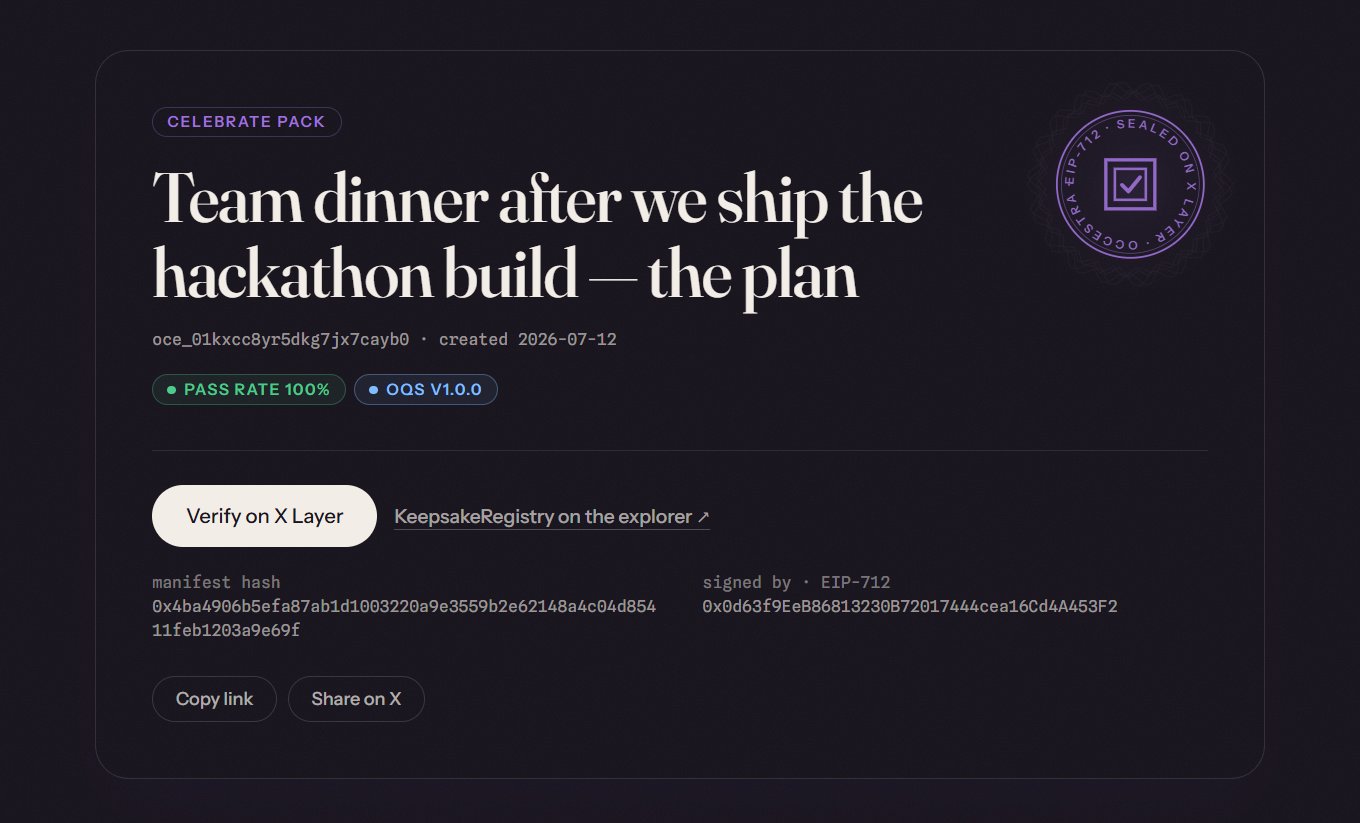
Occestra takes each finished pack, produces a canonical hash of exactly what it contains, signs that hash, and anchors it on X Layer. What sits on the chain is not your photographs, your notes or your guest list. It is a fingerprint of the work, and a timestamp.
What that buys you is small and specific. Anyone holding the finished pack can check that it is the same pack. If a single line of a schedule or a pixel of an image changed afterwards, the fingerprint no longer matches and the check fails. You can confirm when it was made and who signed it, and you can do all of that in your own browser without asking us anything and without our servers being involved or even online.
For private keepsakes we go further. The commitment is salted, so the chain proves the work existed at a point in time without the contents being guessable from the hash.
Verification is free forever and sits outside the paywall entirely, which was deliberate. Trust that costs money is not really trust.
None of this makes the work better. It makes it checkable, which is a different thing and increasingly the rarer one.
@XLayerOfficial @okx
#BuildonXlayer
Franklino retweeted
Occestra will not let you describe the style you want. There are ten, you pick one, and that is the whole choice.
This was deliberate and it is the decision people question most.
Open prompting sounds generous. In practice it hands the hardest part of the work back to the person who came for help. Most people do not know what they want visually, they know how they want to feel, and asking them to translate that into an art direction brief produces the same washed-out output everyone else is getting.
So we wrote the direction instead. Each house style is a real system: a medium, a palette, composition rules, a texture language, lighting, and an explicit list of what it will never do. Sunprint is cyanotype blues and pressed botanicals, quiet and nostalgic, and it is the default for keepsakes because memory looks better in one colour than in all of them. Atlas Ink is cream paper, contour lines and route marks, made for anything with a journey in it. Gilded Noir is champagne on near-black for the formal occasions. Solstice Bloom is coral and marigold for the warm ones.
Ten of them, each versioned, so a style can be improved without silently changing what it produced last month.
The constraint is the product. A style that permits everything has no point of view, and a tool with no point of view returns work that looks like it came from nowhere in particular.
occestra.xyz/gallery


Franklino retweeted
A few things we would do differently on Assay, written down while they are still fresh.
We would build the share portal first. It was one of the last things we shipped and it turned out to be the clearest explanation of the entire product. Everything before it was us describing a moat. The portal just shows it. If a feature explains your product better than your landing page does, it is not a feature, it is the pitch, and it should exist on day two here on @XLayerOfficial .
We would commission an independent buyer sooner. We had our own agent buy every service from a separate wallet through the marketplace, and it found three failures we had not seen from the inside. Testing your own product with your own harness tells you it works the way you built it. It does not tell you it works.
We would spend less time on breadth and more on the two or three things nobody else could copy in a month. The evidence gate and the parse-back are the reasons anyone remembers this product. Some of the surface area around them could have waited.
The thing we got right and would repeat without hesitation: putting the honesty in code rather than in the prompt. Every rule we enforced structurally held up. Every rule we asked a model to follow politely eventually did not.

Franklino retweeted
An identity layer for work.
Agents on X Layer can already pay each other. What they cannot do is establish that anyone, human or agent, is actually who they claim to be or has done what they claim to have done. Reputation on this chain is currently a star rating and a sold count.
We built the career half of that with Assay. Every claim in a dossier traces to evidence, the artifact is graded against a published standard, and a salted commitment is anchored on X Layer so anyone can verify the document is unchanged without a single personal detail touching the chain.
The same primitive extends well past résumés. Agent capability claims. Delivery history. Credentials. Anywhere someone has to trust an assertion they cannot check themselves.
Proof is the missing layer. Everything else on top of it gets more valuable once it exists.


Franklino retweeted

Four weeks ago I decided to build something for the OKX.AI Genesis Hackathon that I would keep working on whether or not it won anything. This is it.
@AssayAgent started from an observation that kept bothering me. AI has made every job application sound competent. Every cover letter reads well now, every résumé is polished, every candidate describes themselves fluently. Which means fluency stopped telling anyone anything. The scarce thing is no longer sounding good. It is being able to prove what you said here on @XLayerOfficial.
So I built the opposite of a résumé generator. Assay will not write a sentence about you that it cannot trace back to actual evidence. If you want to claim something and there is nothing supporting it, it asks you about it rather than writing it for you. That sounds like a small design decision and it is the entire product.
The month was mostly unglamorous. Building a claim gate in code instead of asking a model nicely. Rendering a résumé and then re-parsing it to check the dates and titles survived machine reading, because every tool in this category says its output is ATS friendly and none of them check. Publishing a grading standard generated from the same code that does the grading, so it cannot quietly drift. Shipping the runs where the first draft failed instead of hiding them.
Near the end I registered a separate agent on a separate wallet and had it buy every service through the marketplace like a real customer. It found three failures my own tests never surfaced. That was an uncomfortable afternoon and the best thing I did all month.
It is live, the source is public, and results are announced soon. I have no idea how it will go. What I do know is that I am going to keep building this one either way, because the problem is real and nobody is solving it properly yet.
Demo below. 90 seconds.👇
assayed.xyz
@wallet @OKXDevs
Franklino retweeted
Started this on a Sunday night and the ASP was listed on the marketplace two days later.
Most of what came after was not building. It was catching things.
A schedule anchored to UTC while the comment beside it said local, so every guest at a dinner in Lisbon would have arrived an hour early. A pass rate that quietly flattered itself, because failed artifacts were dropped from the denominator instead of counted, which meant the thinner the pack the better it scored. A launch kit that produced maps where a brand mark should have been, and a critic that passed them because they were beautiful maps.
None of those were visible from the outside. All of them would have shipped on @XLayerOfficial .
That is really what Occestra ended up being about. Not generating things, which is easy now and getting easier. Deciding whether the thing you generated is actually correct, and being willing to say so out loud when it is not.
So we published the standard it grades against, generated from the same code that enforces it. It failed our own launch copy twice, and that failure is on the homepage. A standard that spares its author is not a standard.
Live as Agent #5213 on OKX.AI. Demo below.
@wallet @OKXDevs @star_okx

Every meaningful moment turns into six browser tabs that never talk to each other.
A maps search. A weather check. A spreadsheet nobody double-checks. Something to write the invite. An image tool with no standard at all.
Occestra replaces the pile with one studio — and hands you the receipts proving the work was actually checked.
Who it's for: anyone with a moment worth doing right. A birthday next Saturday. A friend leaving the country. A trip you just got back from. A product launching Friday.
Three studios, one brief:
→ CELEBRATE — grounded plans: real venue candidates with sources, a real forecast, schedules, budgets that add up, contingencies, invitations, guest guides, toasts. No venue is ever claimed as booked.
→ REMEMBER — photos and notes become private keepsake art and an editorial story page. EXIF stripped on arrival, faces never identified, only a hash ever reaches the chain.
→ LAUNCH — reads your actual site in a real browser, extracts a brand genome, returns hero art, social cards, launch copy and OG assets. Inventing nothing.
What makes it different isn't the rendering. It's that nothing ships unchecked.
Every artifact is graded against the Occestra Quality Standard (OQS) — published, versioned, and generated from the same code that enforces it. Deterministic checks run before any model opinion: budgets must sum, schedules can't overlap, dates must be real, claims must carry sources. A hard failure can't be argued away by a flattering score.
Fail, and the artifact gets a concrete repair brief and goes back — up to twice. The full report ships either way.
It failed our own launch copy. Twice. That's on our homepage, because a standard that spares its author isn't a standard.
Then the finished pack gets sealed: canonical hash, EIP-712 signature, anchored on @XLayerOfficial mainnet. Open any /k page and your own browser reads the chain. You don't have to trust us.
Live now as OKX.AI Agent #5213 — 8 marketplace services, 13 tools on the endpoint, settled in USDT per call via x402. No API key, no signup. Machines are customers here too.
And for every other builder: oce_critique costs 0.01 USDT — send your own agent's output, get it graded against our published standard with a repair brief back. Priced below cost on purpose. A marketplace where output is checkable is better for everyone in it.
🔗 Agent marketplace: okx.ai/agents/5213
🏛 Demo: occestra.xyz
📏 Occestra Quality Standard: occestra.xyz/standard
⛓ KeepsakeRegistry, live on X Layer mainnet
Every moment, made monumental!💜
#OKXAI @okx @OKXDevs
Franklino retweeted
I spent a while deciding what to build for this, and I kept coming back to the same observation.
We are handing AI agents wallets and asking them to transact on our behalf. The tooling for that is moving quickly. But an agent has no instinct. It cannot look at a transaction and feel that something is off, which is the thing that actually saves most people most of the time. It reads hex and it signs.
So @SigilASP is the check that runs before the signature. You give it a pending transaction and it decodes what the transaction actually does, simulates the effect, screens the counterparties, and returns a pass, warn, or block with the evidence behind each finding.
The part I care about most is that the verdict is signed and anchored on chain. Most security tools give you an answer you have to trust in the moment and cannot verify afterward. That felt like the wrong shape for a product that autonomous systems are supposed to rely on without supervision. If an agent acts on a verdict and something goes wrong later, there should be a record of what it was told that does not depend on my servers or my honesty.
Built solo. Deterministic rubric with seventeen published rules, a registry contract deployed on X Layer, and the whole thing open source, because a scoring system you cannot inspect is not really auditable.
Demo is one-twenty seconds.