

We innovate to provide you with the most extensive software security solution. Rocq, Rust, ZK, Solidity, Web3
Paris, France
Joined April 2021
- Tweets1K
- Following1.8K
- Followers1.6K
- Likes4.8K





Pinned Tweet
👉 We secure your critical code using Formal Verification, to make sure even recent AI attacks cannot get through
👉 We educate around FV to make this technology available to everyone (presentations, posts)
👉 We verify code at the source level (most precise) using interactive provers (Rocq, most expressive)
Projects made:
- "rocq-of-rust" to verify optimized Rust code; Revm verification (grant from @ethereumfndn)
- "rocq-of-solidity" to verify Solidity code, at the Yul level
- "Garden" framework to verify ZK circuits (grant from @ethereumfndn)
- FV of part of the Tezos nodes (100,000 lines of OCaml, around 20% covered)
- "Excalead" for lightweight verification of Solana code with AI
Formal Land 🌲 retweeted

What does it take to design a programming language for zero knowledge proofs?
Founder of @FormalLand, @guillaumeclaret, on formal verification in Noir, its origins in Rust, and the dream of portable ZK at @__zkhack__ last year.
Formal Land 🌲 retweeted

Nice to see Claude Code talking about formal verification, probably many will talk about it at the office!
Rocq is the tool we have been focusing on at @FormalLand to make verification scale to large projects. Lean is quite similar. TLA+ is lighter but simpler for quick use
If AI review can find any bugs, why are there still tests in apps? 🤔
This remark should show why AI alone is not enough for code review. Unless you have other though?
Formal Land 🌲 retweeted

Realistically, the reason is that @FormalLand has been publishing tooling for generating embeddings of languages like solidity and rust, so that you can prove equivalence.
The ability to prove program equivalence distinguishes rocq from lean in applied cryptography, and in software security work.
I have yet to run into something that I cannot efficiently formalize in rocq. Though I agree, it's likely that people are probably producing more relevant foundational work in Lean at this point - or at least that's a common assumption.
Formal Land 🌲 retweeted

Weak IMO. The type theory of nested inductives as implemented in Lean is not understood to begin with, and you will find you need many more ad hoc "implementation" patches until a fragment of nested inductives that is understood is what is implemented.

Postmortem for Lean Kernel Soundness Bug #14576
leodemoura.github.io/blog/20…
#lean4 #leanlang #leanprover
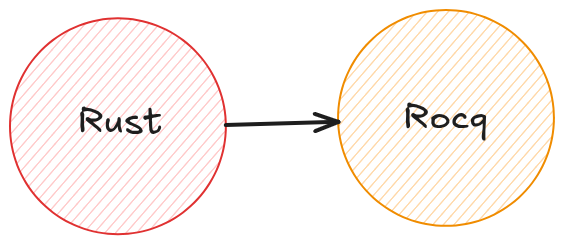
Here is a new blog post where we present our updating process in "rocq-of-rust", our tool to translate Rust code to the formal language Rocq, to update our functional specification of Revm, an Ethereum virtual machine.
The link to the post 👇

We are happy to have completed the implementation of the Guruswami-Sudan algorithm in Lean.
This implementation is heavily optimized for the various field or polynomial sizes and proven correct.
This work was made thanks to a grant of the @ethereumfndn
Links to report/code 👇

- The report: formal.land/reports/2026-06-…
- The code is integrated into the CompPoly and ArkLib libraries:
* github.com/Verified-zkEVM/Co…
* github.com/Verified-zkEVM/Ar…


What we are currently working on, to bring more Web3 security with formal verification:
- ZK circuits verification
- Analysis of the EVM implementations/specs
- Improving the tooling around Rust, especially "rocq-of-rust", since is it more and more used as a safe language!
How is AI changing formal verification?
It drastically reduces the cost of writing specifications, and proving them correct.

Formal Land 🌲 retweeted

We at Protocol Snarkification - me and @alexanderlhicks, plus about 30 or so external collaborators - are working hard with formal verification to ship the highest-assurance zkVMs possible. (see end of thread for collaborators) (1/n)
🤖 Made with AI

Formal Land 🌲 retweeted
Formal verification is a critical tool to protect protocols from vulnerabilities. The recent Zcash vulnerability with honest disclosure is a reminder of that.
FV is the technology we focus on at @FormalLand to secure protocols. Being 💯 focused enables us to create unique capabilities, some that we keep closed-source:
- FV on arbitrary circuit languages, without having to change one's implementation, using our Garden 🍀 framework. Verifying the code as it is very important to keep stacking security layers on the same code without having to re-implement things. Example: verification the optimized Keccak circuit in Plonky3, the main hash function of Ethereum.
- FV on Rust code 🦀 at the implementation level, without modifying the Rust code and for arbitrarily large properties. This is still something that open tooling struggle with, constraining the way the Rust code should be written. We believe code should be verified as it is, otherwise optimizations are lost and it becomes harder to combine tooling. We have a demo of that for Revm an EVM interpreter in Rust.
- FV for the Ethereum infra and Soldity smart contracts: this is ongoing development and behind closed doors.
- General belief of combining different approaches to not depend on a unique stack and take different angles. We bet heavily on the Rocq prover for that, with some work in Lean as well like a recent verification of polynomial algorithms for ZK with it. The two provers can in addition be connected.
Happy to chat more about that 🤝 to help teams secure their code even more, covering the whole stack with FV! 🛡️
We finished a work on optimization for polynomial algorithms used for primitive operations like evaluation, multiplication, ...
Polynomials on finite fields are the basis of most ZK implementations. The CompPoly library is implemented and verified in Lean. 👇

Covered are optimizations for:
- Horner evaluation
- Batch evaluation (one polynomial on many points, many polynomials on one point)
- NTT algorithms (Fourier transform for polynomials)
- Field operations for KoalaBear 🐨
with a benchmark system to measure all that.
This work was made possible thanks to a grant from the @ethereumfndn for which we are thankful.