

Your friends love your startup idea. ChatGPT loves it. The market might not. Find out — with hard data, not vibes. Saturday: top-5 ideas the market is killing.
USA
Joined July 2025
- Tweets351
- Following33
- Followers86
- Likes148





Pinned Tweet
We 10x'd our own web traffic. Here's the machine that did it.
We got fed up with the fake theatre from agencies (pricy retainers, bots, fake likes) and built our own thing. A few weeks after launch, fluenta.space went from DR 0 to 16, referring domains 4 to 322, and real visitors 10x, a couple dozen a day to hundreds (GA4, ad testing periods excluded). The chart is our real Ahrefs data. Don't take our word for it, check us with your own tools. Then we ran the same pipeline on a friendly project: Google traffic up 12x, referring domains doubled, DR climbing too.
Fluenta Magnet listens across 42 sources for what people actually ask, prioritizes by impact, then writes ready-to-publish pieces (text, visuals, charts, sourced quotes, real data). Every piece gets cross-validated (anti-slop, troll-crush) and reviewed by a real human before it ships. It learns every cycle. Linear at first, then pages feed each other and you hit the hockey stick.
Two steps:
1. Free AI-readiness audit. Drop your domain, get a long report, fix it yourself in a few hours. You can honestly stop there: fluenta.space/magnet
2. Want us to run the machine? Pick a package, hop on a call, see first results in Google Analytics in about a week.
A $10k a month agency ships 4 to 12 posts and a PDF.
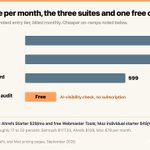
Same class of work, automated and human-checked, for way less: Dominance $3,900/mo (200 programmatic pages a quarter, 10 languages, multiple sites, API access, custom outreach). Growth ($1,990) and Starter ($990) run the same machine on a tighter volume plus every technical fix, under $83 a piece.
A human checks every launch, so capacity is real: 3 Starter launches a week, 1 Dominance a month.
Free audit: fluenta.space/magnet
#ContentMarketing

State of New Business Ideas, Sep 2026
77,717 launches from 52 sources, scored in September.
Five things the pile says.
1) The categories the headlines love are shrinking. No-code app builders down 54%. Design generators down 54%. RAG knowledge bases down 53%. AI image down 51%. AI video down 36%. "AI sales outreach" down 19%. Launch rate per 10,000, Dec 2025 to Sep 2026.
2) What is growing is boring. Self-hosted and privacy tools up 50%. Invoice and expense automation up 30%. Payments infra up 28%. Plumbing, not demos.
3) The single most buildable idea this month is a remote bookkeeping service. LRS 57.7. Nothing cleared 60. Five ideas did in August.
4) Jev dropped mid-month and 222 repos chased it in 15 days. Those ideas scored 18 out of 100 on "someone already pays for this." Everything else scored 76. A new model is a weekend, not a business.
5) On Product Hunt, 61% of launches now get one vote or none. On Reddit, 68% get no reaction at all. The pile is louder and quieter at the same time.
The index landed at 55.1. Build, yes, but only into demand that already has a payer attached.

All charts, the risers and faders in full, the 12 most buildable ideas ranked, and the method:
fluenta.space/resources/repo…
Thinking about paying for a tool to see whether ChatGPT names your business? Read this before you subscribe.
These tools do one of two jobs, and most do only the first.
Monitor: track whether AI engines mention a brand across ChatGPT, Perplexity and Gemini, with share of voice and alerts. Rankscale starts at $20 a month, Otterly at $29, Athena and Scrunch around $295 to $300. Profound is enterprise, custom-priced.
Fix: actually change what the engines say. Clear the technical blockers, publish answers engines can cite, earn mentions on trusted sources. No dashboard does this step. It takes a person or a service.
Here is the trap. If a site is already near-invisible, paying $29 to $300 a month to watch a flat zero is the most common waste in this category. The monitor confirms the problem it cannot fix.
Across 121 small-business sites audited in 2026, the median carried 66% of its backlinks flagged as spam, exactly the kind of blocker a monitor shows but never removes.
So judge a tool by whether it names you for the real prompts buyers type, not by a 0-to-100 score. Starting from zero, run one free check, then spend on fixing the content, not on watching the dashboard.
Full breakdown of every tool, price and use case is in the first comment.

full data breakdown here - fluenta.space/resources/guid…
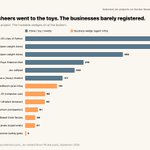
A new AI model, Jev, just made one thing almost free: the tiny yes/no decisions inside an AI agent. Is this a jailbreak? Which model should handle this? Is this answer good enough? Jev decides in about 100 milliseconds for a fraction of a cent, instead of a slow second call to a big model.
In two weeks, hundreds of products got built on it. Here is what a founder should actually take from that.
Build a tool that removes a cost a company already pays every month. Two clear ones:
- The safety check. Teams pay for a second AI call on every action to catch jailbreaks and leaked data. Replace that call.
- The eval. Teams pay a large model to grade their AI's output. Replace that too.
Both have real budget today and sit in categories investors already fund.
Skip the clever consumer toys (rate my Telegram channel, read my date's texts). They can charge, but nobody funds them, the pain is shallow, and a competitor clones them in a weekend. That is traffic, not a business.
The trap: Jev itself has no moat. Someone rebuilt it in 25 lines of code within two weeks, and there is no way to self-host it. So do not ship a thin wrapper whose only value is calling Jev for the customer. Own the workflow and the data around it. The model underneath will be a commodity by next quarter.
The rule for any breakout: wedge into a bill that already exists. The trend shows you attention. The money is in the recurring cost.
The full breakdown of all 22 products, and what separates the businesses from the toys, is in the first comment.

The full breakdown, all 22 products built on Jev and what separates the businesses from the toys:
fluenta.space/resources/repo…
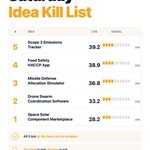
Saturday Kill List - 26 September 2026
5 ideas we'd kill for most founders, and hand to the one who is already cleared.
This week the list goes where I always warn founders off: space and defense, plus two markets ruled by regulation. The pattern is the sharpest yet. In every one, the decisive input is something you are not allowed to have: a flight-qualified solar cell, classified threat data, a cleared program, a health inspector's trust, a supplier's carbon numbers. You do not lose these markets on product. You lose them at the door, because the thing that unlocks demand is a clearance, a qualification, or a mandate a generic founder cannot obtain.
From the deadest up.
1 Space Solar Component Marketplace - 28.2 - pv-magazine
0 searches. A marketplace for space-grade solar cells, off the race for cislunar power. But flight-qualified cells come from a closed supplier base under export control, and PartsBase and Satair already broker aerospace parts. You cannot list a part you are not cleared to source.
2 Drone Swarm Coordination Software - 33.2 - Defense News
0 searches, budget proof 0 of 10. Swarm software for small defense contractors, off the Taiwan "hornet's nest" doctrine. Entry looks wide open at 19.2 of 24, but only because the buyer is a military under ITAR. The gate is a clearance and a program, not a repo.
3 Missile Defense Allocation Simulator - 36.8 - Breaking Defense
30 searches, 8% intent. A model to prioritize Patriot batteries, off the Golden Dome debate. But the inputs are classified threat and inventory data, and ANSYS and Northrop already sit inside the command. You cannot simulate a battle you are not cleared to see.
4 Food Safety HACCP App - 38.9 - App Store
15 searches, 12% intent. HACCP compliance tracking for restaurants. The demand is real and mandated by health code, but SafetyCulture, Jolt, and FoodDocs already own the inspections. A mandate is not an opening when incumbents already hold the accounts.
5 Scope 3 Emissions Tracker - 39.2 - Trellis
10 searches, 8% intent. Supply-chain carbon reporting for retailers, driven by disclosure rules. But the data lives with suppliers who do not share it, and Terrascope, Vaayu, and Net0 are already embedded. The rule creates the checkbox; the incumbents already sell the pen.
None of these five are bad ideas. Three sit in the exact worlds I flag every week, space and defense, where the input itself is classified, qualified, or export-controlled. The other two are mandated by regulation, then quietly filled by incumbents you cannot see from a search bar. In all five, demand is real. Access is not.
If you already hold it, the clearance, the qualification, the inspector's trust, the supplier's data, the silence is your moat. If you do not, that silence is the honest answer: you were never allowed near the thing that makes this a business.
Grade your own idea before you build. Link in the first comment.
More kills next Saturday. Disagree with a call? Tell us which door you are already cleared through.

Picking an SEO tool as a founder? Semrush, Ahrefs and Moz are the three that matter, and they are closer than the threads suggest. Each still owns one strength:
Semrush: the widest toolkit, largest keyword database.
Ahrefs: the reference for backlinks, largest live link index, plus a free Webmaster Tools tier.
Moz: the friendliest and cheapest to start, home of the original Domain Authority.
Pricing, September 2026: Moz Standard $99, Ahrefs Lite $129, Semrush Pro $139.95 a month. All three earn their price.
Just keep one thing straight. These measure what already happened: your rankings, traffic and backlinks, the current state of a site in Google. Excellent for research and monitoring.
They do not get a brand listed or cited anywhere. What you do with that data is a separate job.

Full Semrush vs Ahrefs vs Moz breakdown, all the data and pricing:
fluenta.space/resources/guid…
Check whether AI names you or a competitor today, free:
fluenta.space/magnet
SEO and getting found by AI (ChatGPT, Google's AI answers) confuses most founders. You do not need to be a specialist to get it. Here is the whole map.
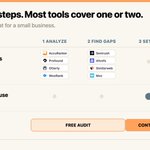
Getting found takes four steps. Most tools only cover the first two.
1. Analyze. Where do you stand? Rank trackers and AI monitors (Profound, Otterly) show you. They do not fix anything.
2. Find gaps. Which keywords, which fixes? Semrush, Ahrefs and Moz hand you the raw data. You still read it and decide.
3. Set up. Clear the technical blockers so Google and AI crawlers can read the site. No tool does this.
4. Publish. Produce content, index it, repeat. The step almost everyone skips. No dashboard does it.
Steps 1 and 2 are crowded with tools. Steps 3 and 4 are the actual work, done by a person, an agency, or a system.
That is why 96.55% of pages get zero Google traffic (Ahrefs, 14B pages). The pages exist. The work never got done.
So before you buy a tool, find your step. Stuck on 1 or 2? A $49 tool is plenty. Stuck on 3 or 4? No tool saves you, that is a doing problem.

Saturday Kill List - 19 September 2026
5 ideas we'd kill for most founders, and hand to the one who is already qualified.
This week the trap is subtler. Some of these even get searched: 320 people a month look up radiation-hardened space chips. But look at the intent, it is 8 percent. People are curious, not buying, because you cannot buy a space-grade chip from a search result. Every one of these sells into a world you enter through qualification, not awareness: a satellite prime, a defense procurement office, a clinical lab, a heavy-industry plant. The knowledge is public. The access is not. And the access takes years.
From the deadest up.
1 Genomics Infrastructure - 37.6 - YC
10 searches, 8% intent. Data infrastructure for genomic research, off a YC request. But the buyer is a clinical lab, gated by CLIA and CAP certification, and AWS HealthOmics, DNAnexus, and Illumina already hold the pipelines. You do not win a lab with a demo, you win it with an accreditation.
2 Electronics and Inference Chips for Space - 37.9 - YC
320 searches, still 8% intent. Curiosity is high; purchase is not. Rad-hardened chips are qualified over years of radiation testing, and BAE, Honeywell, and Teledyne already passed. The buyer is a satellite prime under ITAR. Reading about it is free. Qualifying a part is a decade.
3 Micromobility Fleet Analytics Platform - 38.3 - Knowledge at Wharton
0 searches. Analytics for scooter and bike fleets. The buyers are a handful of operators and the cities that permit them, and Vianova, Fluctuo, and Wunder already sit on that data. You reach this market through an operator contract and a city permit, not a signup page.
4 Waste Heat Recovery Service - 38.9 - pv-magazine
140 searches, 8% intent, funding hot. Thermophotovoltaics that turn furnace heat into power. But a factory buys this as a multi-year capital project, and Climeon, Orcan, and Enertime are already bidding. The gate is a plant walkthrough and an engineering sign-off, not a landing page.
5 Domestic Defense Sourcing Marketplace - 39.9 - Defense News
20 searches, but 100% of it transactional, off a local-sourcing mandate. Real intent, invisible buyer: government procurement offices bound by FAR and DFARS. Periscope and GSA already run those rails. You do not list your way in, you get cleared in.
None of these five are bad ideas. A few even show public curiosity. But curiosity is not a customer, and the buyer here lives behind a qualification you cannot shortcut: a lab accreditation, a radiation cert, a city permit, an engineering sign-off, a security clearance. Places a score cannot read, and a generic founder cannot enter for years.
If you already carry the credential, the accreditation, the cleared status, the operator relationship, the silence is your moat. If you do not, that silence is the honest answer: the knowledge was always public, and the access never was.
Grade your own idea before you build. Link in the first comment.
More kills next Saturday. Disagree with a call? Tell us which qualification you already hold.

Want your idea graded on the same 6 signals before you sink a quarter into it?
fluenta.space/x-ray

SEO, AEO, GEO for dental practices
A patient hears your name from a friend. What happens next decides whether they ever book.
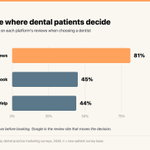
About 71% look the dentist up before calling, and roughly 96% read reviews first. The platform that decides is Google: 81% of new patients rely on Google reviews, far ahead of Facebook at 45% and Yelp at 44%.
Then the part most practices miss. In a real audit of a healthy clinic, the site scored 64 out of 100 on technical readiness but only 17 on AI visibility. Asked who the best dentist in the area was, 0 of 4 AI engines named it.
The referral still opens the door. The Google review and the AI answer decide who walks through it.
Details in first comment

Full local SEO playbook for dental practices, all the data:
fluenta.space/resources/guid…
Check whether AI names a practice or a competitor today, free:
fluenta.space/magnet
By the time a B2B buyer talks to sales, the decision is mostly already made.
Gartner: a buying group spends only 17% of its time meeting any one potential supplier. Any single sales rep competes for as little as 5% of a buyer's attention.
6sense: buyers are roughly 70% through the purchase before engaging a seller, and 81% already have a preferred vendor at first contact. The vendor a buyer prefers before talking to anyone wins about 80% of deals.
So the deal is decided in the quiet research phase, on whatever the buyer reads while no rep is in the room. And that phase is moving into AI answers, where most brands are absent:
- In a study of 175 brands, 89% never surfaced for a category question, though the model described each one accurately by name.
- Only about 12% of the sources ChatGPT cites overlap Google's top 10. A top ranking no longer buys the citation.
- 99% of AI citations point to third-party sites, not a brand's own domain.
The buyers already do the research. The only question is whether a brand is in the answer when they do.
Link for more data in first comment

Full B2B playbook, all the Gartner / 6sense / Princeton data:
fluenta.space/resources/guid…
Check which AI engines name you today, free:
fluenta.space/magnet
Saturday Kill List - 12 September 2026
5 ideas we'd kill for most founders, and hand to the one who is already inside.
Every one of these is a hot funding headline: a robotics arm at Rivian, a startup exiting stealth with millions, the xAI founders' next thing. That headline is the only public signal, and it belongs to the founder who raised, not the customer who buys. Underneath, these are deep-infrastructure and regulated-finance markets you can only enter from inside: a factory floor, a solar build site, a bank's risk desk, a private-markets data room. The capital is visible. The access is not. And the access is the whole business.
From the deadest up.
1 Industrial Robot Pilot Lab - 31.6 - TechCrunch
0 searches. A lab to pilot factory robots, riding a $500M robotics headline. But the buyer is a plant manager, and you need floor access, factory data, and an integrator's trust to run a single pilot. RoboDK, Wandelbots, and Siemens Tecnomatix are already on the line. Capital does not get you through the gate.
2 Private Data App Builder - 31.8 - Reuters
0 searches, entry scored tough. Secure AI apps on private data, inspired by the xAI founders' raise. The demand is real, but it lives behind enterprise security review, and Retool, PowerApps, and Appian already passed it. You win this in a procurement queue, not a search result.
3 Solar Installation Robotics - 34.1 - TechCrunch
0 searches, funding a perfect 10 of 10. Robots that install utility solar, off a $34M stealth exit. The buyer is a solar EPC, and the deal is a build contract signed years ahead. Built Robotics, Charge Robotics, and Terabase are already on site. No pipeline, no market.
4 Transaction Data Lending - 34.7 - McKinsey
0 searches, monetization 19 of 20. Underwriting loans from live payment data, straight from a McKinsey thesis. But lending is a regulated business, and the rails belong to Plaid, Finicity, and Ocrolus. Without a bank partner and a compliance stack, you are not lending, you are dreaming.
5 AI Capital Allocation - 37.0 - BCG
0 searches, funding 10 of 10. AI to decide where the capital goes, off a BCG paper. The buyer is a PE firm or a CFO, and the data is private-markets intelligence you cannot scrape. Grata, MSCI, and CEPRES already sit in those data rooms. Trust here is earned over a decade.
None of these five are bad ideas. The money behind them is real, sometimes a nine-figure round. But a funding headline is the founder's signal, not the customer's, and it is the only thing the public can see. The market itself lives inside a factory, a build site, a risk desk, a data room, places a score cannot read and a generic founder cannot enter.
If you already have the access, the plant relationship, the EPC pipeline, the banking license, the data-room seat, the silence is your moat. If you do not, that silence is the honest answer: the capital was never the hard part, and you do not hold the part that is.
That access is exactly what our score cannot see. Bring it, and we will re-score.
Want the honest read on your idea, the public signals and the private ones you would need to win? Follow link in first comment
More kills next Saturday. Disagree with a call? Tell us which door you can already open.

Search is splitting in two. Ranking in ten blue links is one game. Getting quoted inside an AI answer is another, and it rewards different things.
That second game is GEO, generative engine optimization. Here is what the study data actually says works.
Princeton tested the levers directly. Adding quotations lifted a page's AI-citation visibility by up to 41%. Statistics with named sources and clear citations also moved pages into answers. Keyword stuffing did the opposite, about 8% worse. The model rewards credibility it can read, not keyword density.
The biggest lever sits off the page. Across ~75,000 brands, off-site mentions tracked AI visibility about 3x more closely than backlinks (0.664 vs 0.218). Being named in roundups, comparisons and expert commentary beats link building, because almost every AI citation points off the brand's own domain.
And the gap is large: in a 175-brand study, 89% of brands never surfaced on a category question, even when the model described them accurately by name. Being known is not being cited.
The GEO playbook, in short:
1. Answer the real question in the first two sentences. Models lift self-contained passages.
2. Put verifiable evidence on the page: current stats with sources, real expert quotes with title and firm.
3. Structure for extraction: question-shaped headings, short definitional openers, clean lists and tables.
4. Keep entity data consistent across the site, schema and every third-party profile.
5. Earn mentions, not just links.
6. Drop keyword stuffing and thin templated pages.
7. Make sure AI crawlers can actually reach the pages.
Demand is already here: "generative engine optimization" draws about 8,000 US searches a month at an $11 CPC.
Full playbook in the comments.
