

Writer & Investor. I write FluentInQuality for 2.479+ ambitious investors compounding and investing in micro- to mid-cap businesses.
The Netherlands
Joined January 2023
- Tweets10.2K
- Following203
- Followers4.5K
- Likes6.3K


Pinned Tweet
Ok i’ve been rereading @naval this week and honestly half of his stuff is better investing advice than most investing books
so here are 15 lessons from naval that every investor should hear. some of these hurt a little 🧵


72b accounting loss from convertible bonds because the company's valuation skyrocketed...
Still an $8-9b loss, but yall just posting misleading BS to push your own narrative


Imagine your Cloud service fully booked for FY27, with a good chunk of FY28 already committed, and $220B invested still not enough to cover everything.
What a luxury position to be in.
$AMZN
YouTube has nearly 2x Netflix’s share of US TV time, and it pays for content after it works
YouTube took 14.2% of all US TV viewing in July, a record. Netflix sits around 8%. On the biggest screen in the house, a platform built on uploads now beats one that spends roughly $20B a year on content.
That gap is the core of my bear case. Netflix is a good business, and I think its best growth years are behind it.
Here are 3 reasons.
$GOOGL $NFLX
3. Netflix pays before it knows. YouTube pays after.
YouTube shares ad revenue with creators once the views are in, around 55% on long-form. Netflix commits billions before a single episode airs. That turns its growth into a bet on hits. If it finds the next Stranger Things, the numbers can surprise to the upside. But nobody can schedule a Stranger Things.
$GOOGL $NFLX
I'm still bullish on $NFLX, but we should not underestimate a) the increasing competition and b) the evolving landscape of the users... the younger generation
I grew up believing money is the root of all evil.
Turns out that’s a misquote. The verse says the love of money. I missed those 3 words, so I made sure I never had any.
The strange part is that money was never a problem in our house. Still, until I was 21, my paycheck would land, and 2 weeks later I’d be down to my last few euros, counting the days until the next one. I spent it on the most bizarre stuff. Like buying designer clothes that I would wear a couple of times, because it was trending and it 'felt good' to wear something expensive or an expensive watch just to flex?!.
But then I started reading. A lot.
Somewhere along the way my frontal lobe finally showed up for work, and it brought a sinking thought with it: I can’t keep doing this.
So I flipped it. I saved first and spent what was left. I started investing for the things that matter later, like a house and kids one day. I kept reading. And I kept living, which surprised me most, because I’d assumed being careful with money meant being boring.
7 years later, the worries I used to wake up with are gone. I wish I’d started sooner. I’m grateful I started at all.
If your paycheck runs out before the month does, here’s what I’d tell 21-year-old me. Invest in yourself first, then in the market. Have fun, do something crazy now and then, figure out who you are, and be kind to people along the way.
The verse warns about loving money. Nobody warned me about running out of it every 2 weeks.

I'm still waiting for a certain someone to call this cheaper than a sack of potatoes
Because it is
Look at the growth you're getting for 14x P/E
$UBER

$1,000 with Peter Lynch in 1977 became about $28,000 by 1990. The same $1,000 in the S&P 500 became $6,700.
His book says you can copy most of what he did without a single formula.
Here are his 7 rules, and why the last 3 are the ones most investors fail.
Link in my bio. 🔗

This chart says exactly NOTHING about the competitive nature of the music industry lol
Strong absolute growth is fully compatible with intense competition when the overall market is expanding which is the case for $SPOT and its competitors
YouTube premium is growing rapidly, Apple Music is growing rapidly, etc.
This chart just shows $SPOT is able to grow in a growing market. Thankfully.


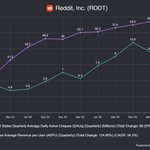
$RDDT lost 300,000 US daily users last quarter.
US revenue per user grew 51%.
The stock is down 40%+ this year because the market read the first line and stopped. 🧵

The next test comes Thursday, Oct 29.
$RDDT guided Q3 revenue to $860 - 870M, roughly +48% YoY. I’m watching 3 things: US DAUs, US ARPU, and Max adoption.
If US users hold flat while ARPU keeps climbing, the bears lose their best number.
The market read the first line: $RDDT is losing visitors.
Advertisers read the second: the ones who stay are buying.
One of those groups writes the checks. Their checks got 61% bigger in a year.