

Enjoying writing about computer architecture. Busy during weekdays but will try to answer DMs asap. Profile pic by Roger Dean. Photo of Ronda taken by me.
Scotland and Cambridge, UK
Joined January 2012
- Tweets571
- Following87
- Followers2.8K
- Likes138



Pinned Tweet
It's live! I'm really happy with the result. You can get a copy here amazon.com/dp/B0GLP3Q8HB


Reading this thread makes me wonder, maybe the future of game decompilations will look like this: On one side, tons of trendy projects entirely vibecoded and potentially unmaintainable...

... ultimately, scrapers will download the reference implementation (for free) to train their new models on. New models will be released, leading to new vibecoded decomp projects from scratch... and the cycle continues...
Rodrigo retweeted

A life highlight was seeing an edtn of Hennessy & Patterson that had a whole section on PS2 based largely on my articles. I posted on Ars that seeing this was like being a Christian & getting cited by Paul, & yrs later was talking to Hennessy & he mentioned the Paul comparison!
This article from 2000 by Jon Stokes (co-founder of Ars Technica) got me inspired to start my own site months later. I found it by chance while waiting at the airport. My flight was later cancelled, so it became a good distraction from all the stress... web.archive.org/web/20121101…

I've just extended the PS2 article (copetti.org/writings/console…) to prepare for the future book. By the way, what do you think of this possible cover? The new book will include the Dreamcast, PS2, GameCube and Xbox analyses


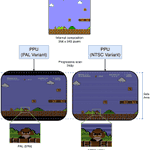
I fell into a rabbit hole trying to write about how 2D consoles output images as 240p scan-lines (so CRTs can display them). Every console has tricks worth mentioning, starting with the NES (copetti.org/writings/console…).

This came up while I was preparing the PS2 article for a future book release, requiring me to extend previous articles that serve as an introduction for the new information I will add on the PS2 one.
Anyway, analogue signals are very complicated to summarise in a few sentences, so I'm open to feedback (github.com/flipacholas/Archi…) if you find any sentence worth revisiting


I've rewritten the Dreamcast article with tons of new content, diagrams and images. But that's not all, you should now be able to read the article on a real Dreamcast!
Article: copetti.org/writings/console…
90s compatible edition: blink.copetti.org/writings/c…

ALT http://blink.copetti.org/writings/consoles/dreamcast/

ALT http://blink.copetti.org/writings/consoles/dreamcast/
The same could be said about the original Xbox, yet it’s not that simple.
I think Proton excels because the target hardware is the same, it’s mainly the software interface (Linux and Windows/DirectX) that’s changed.

"The game changer is the unified memory. That is the path Apple took years ago. (...) It is increasingly popular."
The unified memory model has existed for decades, even Microsoft used it for their Xbox 360 console... While it's easier to program, I think the main reason is cost

Nvidia is proposing a beast of a CPU system for Windows PCs.
It has 128 GB of shared memory and comes with up to 6,144 state-of-the-art CUDA cores.
CPU wise, the chip has 10 performance cores and 10 efficiency cores. The performance cores are based on the Cortex-X925. These chips appear to support six 128-bit SIMD execution units (SVE2), not as good as recent AMD chips, but better than Apple Silicon (on paper).
The game changer is the unified 128 GB memory. That is the path Apple took years ago. Instead of separate memory for the CPU and GPU, everything shares a single pool. It is increasingly popular.
The memory is not as fast as dedicated GPU memory, but it is cheap enough while delivering enough bandwidth to run AI models locally.
I am not sure how many people will run AI models locally. It still seems like a niche application to me. However, it will make decent machines to play video games.
It will be interesting to see how Intel and AMD respond. I think that the AVX-512 instructions supported by all recent AMD processors are far superior to the SVE2 instructions of the Cortex-X925. They can eat more data and they are more versatile. But Intel has been shy, thus far, in making it available on customer systems.


Lately I’m seeing tons of content claiming the PS1 was conceived as a 2D console and never intended to do 3D. I think there's confusion between cost-saving measures and native 3D operations. See the GTE processor, included for 3D math: copetti.org/writings/console…

Amazon doesn't allow to reply to comments so I'll try here. Did you get your issue sorted? I also received misprints in the past. It's rare but happens. I just had to return them and got another copy without issue.

