






More #warehouse space doesn’t necessarily mean lower #supplychain costs.
China is now third in U.S. trade, warehouse availability is rising, and transportation costs are climbing.
@SDCExec featured Flexe’s analysis of these shifts and what comes next: ow.ly/elqH50ZWQC6

Does a long-term #warehouse commitment always mean lower costs? Not necessarily. #Flexe data shows spot rates were lower than asking rents in 17 of 33 months since late 2023. Flexe Spot Warehousing Index was mentioned in Gartner's guide: ow.ly/vUYL50ZXlOH

Buyers have leverage on warehouse space. Not on price. September spot rates dipped, but inflation and shrinking low-cost options could push prices higher. How long will buyers keep the upper hand? See the Sept. Market Pulse data across 21 regional markets: ow.ly/gMbg50ZWqzw

Finding #warehouse space shouldn’t take weeks of outreach and spreadsheets. #Flexe Search lets you explore 3,000+ warehouses across North America from one interface, then narrow by market and capabilities like climate control, food grade or rail access: ow.ly/znH950ZVuUl

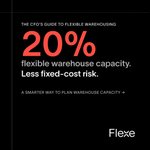
The problem with fixed #warehouse costs? Demand isn’t fixed.
The 20% Rule: keep ~80% of core capacity fixed and 20% flexible to adjust as demand changes.
Our CFO’s Guide breaks down the financial case and the math behind it: ow.ly/8M0x50ZSloq

Vacancy is up. Long-term #warehouse rates haven’t followed.
Why? Warehousing is still built around long-term commitments.
The Flexe Spot Warehousing Index brings market intelligence to short-term capacity, and right now, it’s a buyer’s market: ow.ly/wn8050ZLZkg
We made the #FreightTech100 list!
The #Flexe Spot Warehousing Index turned a decade of proprietary transaction data into warehousing's first published benchmark. Today, @FreightWaves recognized it as one of the industry's top technologies: ow.ly/fBZl50ZPfve

#Warehousing pressure looked like it was easing. August data says otherwise.
Demand remains roughly flat, while rising input and energy costs add pressure.
This month's #Flexe Market Pulse breaks down where the pressure's actually landing: ow.ly/Oj5Y50ZOh66

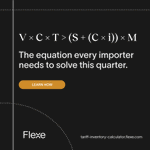
When you run the numbers on a 10%–25% #tariff increase, the tradeoff becomes clear: pulling inventory forward can cost less than paying higher duties later.
The companies doing the math early stay ahead.
See how: ow.ly/lve350YVygf

Speed matters more than ever in network design. #Flexiblewarehousing helps companies add #capacity where and when it’s needed without fixed infrastructure. #Flexe customers have seen a 50%+ reduction in ramp time. Explore real-time capacity: discover.flexe.com/?utm_sour…

Product launches drive 26% of revenue, but most #logistics networks can’t scale in time. One global gaming company launched 600K units using a flexible #warehouse network, hitting strict street dates with precise ship timing. See how: ow.ly/xxUm50YAU7u
#FlexibleWarehousing
Better #supplychain decisions start with better visibility.
Real-time insight into inventory and operations is now foundational for supply chain teams. The next step is visibility into capacity itself.
Explore real-time #warehousing capacity: ow.ly/Fshh50YzUZf

Supply chain #innovation isn’t about chasing new #technology, it’s about removing constraints that limit agility. See how future-ready #supplychains turn disruption into advantage: flexe.com/articles/innovatio…

Last-mile transportation can account for more than half of D2C shipping costs.
Network design is now a key cost lever. More #warehousing access gives #supplychain teams flexibility to position inventory and respond to demand.
Explore real-time capacity: ow.ly/CuyL50YzUGq

Capacity planning shouldn’t require long-term commitments. With the Spot Warehousing Index, teams can instantly search warehouse space & compare dynamic pricing across locations, aligning storage costs with real demand & adapting faster when markets shift: ow.ly/u9wn50Yp7Gy

Pandemic-era warehouse vacancy hit 3.3%. Today it’s 8.3% yet rents are ~50% higher than pre-pandemic. The challenge isn’t just capacity, it’s transparency. See how we give teams visibility into capacity & pricing across 800+ operators and 3,000+ locations: ow.ly/7LyR50YpFYH

Warehousing has long lacked the transparency of spot freight markets. Our new Spot #Warehousing Index delivers real-time visibility into capacity, vacancy rates, and site-level costs so teams can make decisions based on current market conditions. See how: ow.ly/XMWC50Yp6kW

Fast, affordable #delivery wins eCommerce, but expanding fulfillment networks has long been slow & complex. Flexe Discover changes that, giving companies real-time visibility into flexible warehouse capacity so they can launch new fulfillment nodes faster: ow.ly/e6p050YpEqq

When demand spikes, fixed #distribution can become a bottleneck. A top 5 food & beverage manufacturer expanded capacity to move 350+ extra truckloads each week, driving millions in added sales. See how aligning distribution to demand unlocked #peak growth: ow.ly/4ucy50Y4lY3

For #supplychain leaders, the real test of a #logistics partner isn’t just today’s performance, it’s adaptability. Fixed logistics models struggle with change, while flexible approaches help organizations respond to uncertainty, scale with demand and evolve as requirements shift.
