

Trying to figure out this DFS thing.
Joined August 2021
- Tweets249
- Following105
- Followers4.6K
- Likes1.1K




I'm wondering if all those Brissett people at 25% ownership are starting to second guess not playing Drake Maye at 4%.
This is either going to be the best or worst DFS slate of all time. #FadeTheChalk


cc: @GregSankey

What does a 30-golfer contest with loose pricing look like from a combo/dupe standpoint? Here's a summary of possible lineups & a look back at last year's large field contest:
455,695 possible lineup combos vs. 442,416 last year
3,875 combos use all $50k of salary vs. 4,198 last year
In last year's large field GPP (won by @NelsonAdcock), the winning lineup used $49,100 of salary. There were 5 potential lineups that would have scored higher than the winner. The optimal lineup used $49,300 of salary.
Below is a breakdown of potential lineups vs. those that were played in the $49-$50k zone last year. The higher you go in the salary range, two things happen: fewer options and more likely to be duped.
Of the 50,051 combos between $49-$50k, 15,122 were played in the large field contest. 438 of the top 1,000 lineups sat in this range and 115 of them were entered. The other 562 sat below $49,000 where the field entered only 8.

Interesting to see what's happened with the NFL Week 1 Mega Millionaire contest ($4,444 buy-in) on DK over the last five years:
2026 - $3.0M (750 potential entries)
2025 - $3.5M (875 potential entries - 816 entered)
2024 - $4.0M (1,000 potential entries - 934 entered)
2023 - $3.1M (768 potential entries - filled)
2022 - $2.5M (634 potential entries - filled)


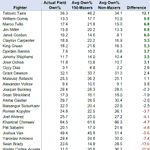
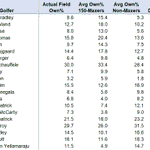
I took a look at the large $25 PGA contest for the week and compared average ownership of the 150-maxers to those who didn't enter 150. Interesting to see how big some of the differences are. Below are the six highest on both sides.
For context, there were 86 150-maxers (27% of all entries).

Scheffler ownership is also interesting. 150-maxers had average exposure of 24.3% vs. the non-150-maxers of 29.4%. Below is a histogram that shows how Scheffler's ownership was spread across the 150-maxers with the majority being below 30% and a few being much more concentrated.

