

Mobilizing for tomorrow, today.
Joined June 2024
- Tweets396
- Following19
- Followers1.2K
- Likes206








First Breakfast retweeted

The U.S. doesn’t just have an unmanned systems procurement gap. It has an unmanned forces gap.
My thoughts Ukraine’s Unmanned Systems Forces and what it means for U.S.'s @DeptofWar #AutoWarCom.
Published by @FirstBreakfast:
substack.com/home/post/p-219…

First Breakfast retweeted

I spoke with Oleg Rogynskyy, CEO and co-founder of the Ukrainian drone company UFORCE, about Ukraine's acquisition system and his company's attempt to break into the Western defense market.
I hope you'll read the whole thing:
firstbreakfast.com/p/ukraine…

First Breakfast retweeted
The Conquest of Space (1969). Cool vintage poster from back in the day when it was still easy to list all space missions and satellites. Source: buff.ly/2uDkLXX

First Breakfast retweeted

President & CEO @GlennNye recently returned from Ukraine, where he examined a defense production ecosystem built around rapid adaptation between soldiers and manufacturers. In his latest piece for @FirstBreakfast, Nye explores what the U.S. can learn from Ukraine’s approach to building a more adaptive defense industrial base: firstbreakfast.com/p/the-ult…

First Breakfast retweeted

This topic is extremely important. Counting out or turning your back on Americans is un-American.
We do not need to import talent. We can source it locally and have proved how with a battle-tested roadmap from the Naval Nuclear Power Training pipeline.

As America reindustrializes, industries that are starved for technical talent should study the U.S. Navy’s nuclear training pipeline.
Under Admiral Hyman Rickover, the Navy proved that ordinary recruits can transform into elite technical operators through rigorous academics, hands-on qualification, relentless standards, and real responsibility.
The Navy nuclear model is simple yet demanding. Students first master fundamentals: math, physics, reactor theory, thermodynamics, electrical and mechanical systems, chemistry, and radiological controls. They must explain, calculate, defend, and prove understanding. Then they move to real nuclear plants, where theory becomes action through oral checkouts, evaluated watches, drills, and qualification under pressure.
This rigorous training works because of the culture of excellence instilled by Rickover himself. “Good enough” is not good enough. Competence is built through repetition, ownership, hard study, and instructors who know both the equipment and how to develop people. Qualification is only the beginning. Continuous training, audits, daily drills, critiques, and root-cause analysis keep standards from decaying.
Civilian industry can’t simply copy the Navy. Companies can’t compel their employees the way the military can. But they can adapt the principles: paid intensive training, labs, simulations, mentored on-the-job qualification, clear standards, frequent evaluation, strong instructors, career ladders, and retention incentives tied to real advancement.
Manufacturing, energy, semiconductors, defense production, data centers, and advanced nuclear all need this mindset. If these industries want workers, they will have to grow their own.
Rickover’s legacy is about more than nuclear submarines. It is proof that excellence can be engineered. If America wants to rebuild its industrial strength, it must stop waiting for talent to appear and start replicating the pipelines that can produce it.

First Breakfast retweeted

Critical Materials Group Co-Founder & CEO Kevin Capozzoli recently joined @Madeline_Zimm on @FirstBreakfast to talk about the moment he realized the depth of the vulnerability in U.S. energetics production and why he couldn't walk away from it.
He shares how he went from seeing the problem from the commercial side to connecting with co-founder Travis Swanson and ultimately building CMG to address this gap with an unmet need across defense, commercial, and space applications.
Listen to the full episode here. firstbreakfast.com/p/bringin…
First Breakfast retweeted

“Secularists in Silicon Valley are filling the God-shaped hole in their heart with AGI.” - @ssankar
“There’s not an empirical basis to believe that such a thing….The models get better. Why do you think that this cliff is gonna happen, or they somehow turn us into house cats?”
“The people who have religion are the most skeptical of this. The people who are kind of transhumanists…..it becomes what they wish were true.”
“The doomerism of Silicon Valley, it’s both a fundraising shtick where the frontier labs can say, ‘My technology’s so powerful, it’s going to lead to mass unemployment, so you better invest in me or you’re gonna be poor.’”
“And also it’s divorced from any sort of reality.
They are sitting in Silicon Valley building these models, spending no time on the front lines of how are people using this.”
This was filmed 10 months ago……
First Breakfast retweeted

There is an unseen hand pushing AI safety as a political ideology.
Effective Altruists believe a tiny group of technocrats should decide how much technological progress the rest of us are allowed to have…. and how many shrimp your life is worth.
You are witnessing their attempted coup.
thefp.com/p/dangerous-ideolo…


First Breakfast retweeted

In the last decade, the Pentagon has lost more than $125 billion because of an outdated budgeting process that requires any unspent, congressionally appropriated dollars to be returned to the Treasury.
Billions of budgeted dollars simply vanish instead of being used to replenish munitions stockpiles, procure new technology, or invest in America's defense industrial base.
A special fund should be created that the Secretary of War can use to fund enduring priorities at the speed of relevance, @ChairmanG argues.
Read in @FirstBreakfast: firstbreakfast.com/i/2128852…

First Breakfast retweeted

Honored to modestly contribute to this terrific anthology on the policies still necessary to upscale the industrial base for the threats that won't wait.

Hot takes on munitions production you can’t get anywhere else! Featuring @ssankar @vc @ChairmanG @ChaseHDalton @WilliamThibeau Nadia Schadlow (@HudsonInstitute ) Kevin Capozzoli Daryl Wieland
First Breakfast retweeted

Hot takes on munitions production you can’t get anywhere else! Featuring @ssankar @vc @ChairmanG @ChaseHDalton @WilliamThibeau Nadia Schadlow (@HudsonInstitute ) Kevin Capozzoli Daryl Wieland
On August 5, Deputy Secretary of War Steve Feinberg lit a fire under industry to solve America's munitions production problem.
He sent a memo to industry leaders giving them 21 days to submit plans to “drive significantly faster, more aggressive delivery schedules and/or increased production for critical capabilities. . . "
We put the question to some of our favorite doers in the industry: If you had free reign to fix America’s munitions bottleneck, what would you propose?
It's been three weeks, so we’re sharing the best—and hottest—takes we received. 👇

First Breakfast retweeted

Was fun to write a short piece for this anthology. The munition shortage is a big and complicated problem that will require many of the solutions outlined here if we hope to close the gap on the critical timeline necessary to maintain peace.
Which idea do you think is most impactful?
On August 5, Deputy Secretary of War Steve Feinberg lit a fire under industry to solve America's munitions production problem.
He sent a memo to industry leaders giving them 21 days to submit plans to “drive significantly faster, more aggressive delivery schedules and/or increased production for critical capabilities. . . "
We put the question to some of our favorite doers in the industry: If you had free reign to fix America’s munitions bottleneck, what would you propose?
It's been three weeks, so we’re sharing the best—and hottest—takes we received. 👇
First Breakfast retweeted

Really important and under-observed fact here:
China is running PUBLIC COMPETITIONS.
Heck, they’re probably running private ones too.
We need to do the same. Quarterly!


First Breakfast retweeted
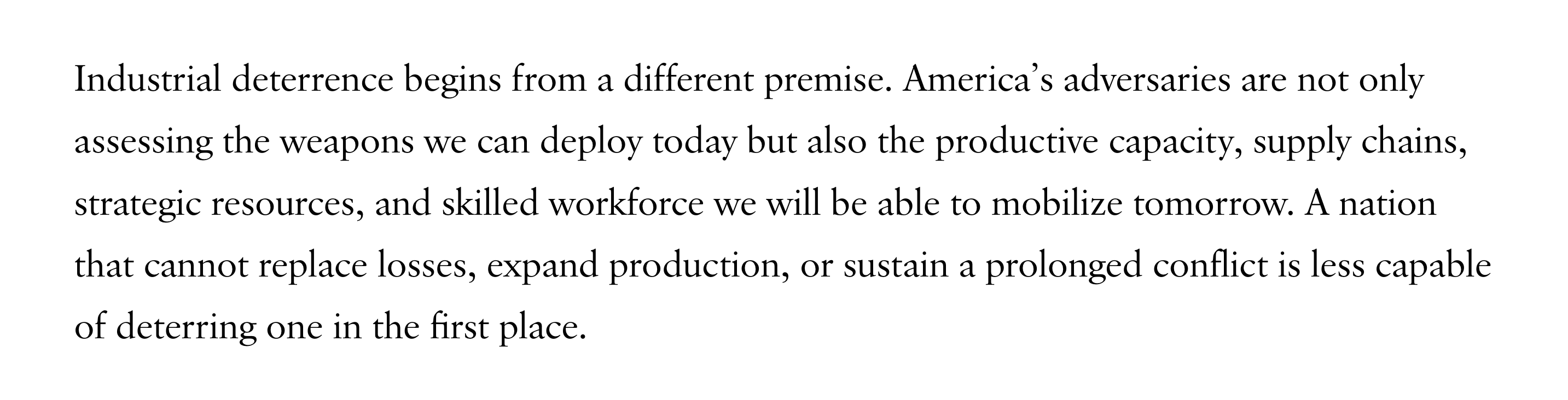
The ability to surge, adapt, and manufacture at scale will increasingly determine military advantage.
As Congress debates next year's defense budget, they should consider not simply the advanced platforms, but fielding capabilities that can be sustained, replenished, and adapted in combat.
This will require harnessing the private sector and commercial manufacturing facilities.
Factories are becoming strategic assets, Nadia Schadlow and Mislav Tolusic write.
Read in @FirstBreakfast: firstbreakfast.com/p/the-fac…

First Breakfast retweeted
Everyone is talking about missile shortages but few are talking about the energetics bottleneck. RDX is made at a single World War II era plant in Tennessee. It's used in nearly every bomb, missile, and artillery shell.
The production target that's slipped to 2030 is 15 millions pounds per year. For reference, the U.S. produced that much RDX every month during Vietnam.

First Breakfast retweeted
Earlier this week, we hosted a conference celebrating the alumni of our American Tech Fellowship. They shared their stories and showed how they’re using AI to amplify their tradecraft and revolutionize their professions. Below are my opening remarks:
For too long, the national conversation about AI has been dominated by Silicon Valley, Wall Street, and Washington DC. But I think we’ve heard enough from the investors, researchers, and regulators.
It’s time to hear from the builders.
AI is a tool, and the value of this technology will be determined by the people who wield it. It will be determined—is being determined—by the American worker.
We created the American Tech Fellowship because we saw some of the most exciting and transformative applications of AI being driven by people without traditional tech backgrounds. These are men and women on literal frontlines and factory floors, with agency, ambition and a drive for mastery.
Silicon Valley said there wasn’t enough talent in America. Tonight, you’ll meet some of the men and women proving them wrong every day, in every way.
The goal of the American Tech Fellowship is to unleash the American worker. To unleash people like Brittany, Kwame, Michael, Mason, and Jonah and amplify their tradecraft.
The goal is not to turn welders, nurses, and farmers into developers—it’s to fit them with an ironman suit that accentuates their unique talents. To give the American worker superpowers.
It’s more efficacious to teach a master of his trade to wield AI than to teach an AI researcher a trade.
An institution’s alpha comes from the secrets they’ve earned about how the world works. Information and insights that you have, and no one else does.
This tribal knowledge is earned. It’s earned by successes and failures in the ICU unit, on the manufacturing line, on the launchpad. And this begins with the American worker.
The purpose of AI is not to reduce headcount or focus myopically on efficiency—it’s to supercharge the American worker, and make sure they share in the value they create.
American culture is distinctive, and uniquely suited to mastering new technology. We’re entrepreneurial, tolerant of failure, eager to play positive sum games, and inheritors of an intensely meritocratic culture that honors winning above conventional status.
And nowhere is that culture more fully embodied than in the American worker.
The American worker deserves a seat at the table. Tonight, they will be sitting at its head.