

3rd-year economics PhD student @ University of Wyoming | climate + development + macro
Laramie, WY
Joined March 2026
- Tweets47
- Following293
- Followers250
- Likes116




@matthewgburgess says it best here
xitter.cf/matthewgburgess/status…

tl;dr: My twin brother--who used to work in carbon markets--and I couldn't make sense of the idea that society needs trillion-dollar spending on a public good, but the private sector would somehow provide it.
After digging in, we concluded that it makes no sense.
1
18
New working paper with @matthewgburgess and colleagues.
Governments either need to substantially increase their investments in sequestration (a challenge at current prices) or admit that 10 Gt-scale is infeasible and plan around lower-sequestration scenarios (or both).
New working paper:
"Private demand cannot scale carbon sequestration"
It came out of conversations with my twin brother, Ian, who used to work with carbon markets in industry.
Some great students, including @FinbarCurtin, helped us crystallize the ideas.🧵 1/

Finbar Curtin retweeted

Another analysis, by @RogerPielkeJr, illustrating the fundamental issues with using panel econometrics to draw broad conclusions about macroeconomic damages from climate change (and by extension legal liability). Roger's analysis illustrates several of the themes (e.g., influential points, understated and irreducible model uncertainty) raised by @FinbarCurtin's and my working paper from few months ago, in different papers from the ones we examined.
This time, Roger argues there are sensitivities and possible data errors in famous Science and Nature papers used to support ongoing climate litigation, that change, or, in some cases, reverse, the headline conclusions about economic liability. Roger also raises some new methodological issues (e.g., about currency and temperature units) that deserve a look in the broader climate econometrics literature.
That said, the issues with these specific papers should be debated, and the authors should have a chance to respond (which Roger has offered) before people rush to judgment. We are entering an amazing new phase of post-publication peer review with AI. But we should still be diligent, scrutinize, and engage due process for judgment and anything consequential like correction or retraction.
Nonetheless, we should also be careful about using damage numbers from studies, which are subject to deep, typically understated, and likely irreducible model uncertainty, to precisely assign hugely consequential practical quantities like liability.

A $28 Trillion Mistake
Major errors in two papers at the center of the climate liability movement
rogerpielkejr.substack.com/p…

Finbar Curtin retweeted

The Deans and the majority of the media are eager to embrace studies that find enormous costs of climate change and that downplay our ability to adapt to this emerging risk. Here is a paper that should receive equal attention.
osf.io/preprints/socarxiv/g8…

Finbar Curtin retweeted

Do economists view papers written in LaTeX more favorably than those written in Word?
We asked economists to evaluate research cover pages that varied by document editor (LaTeX vs. Word) and the presence of a single spelling or grammar error.
Here’s what we found (a thread):
This is why economics is simultaneously fascinating & frustrating. On the relatively simple question of whether the US or the EU is better off, we can't find consensus because of nuances around PPP, consumer surplus in GDP, product quality, etc...

Some reflections on the @lgaricano and @paulkrugman discussion. The key question in terms of numbers is -- how do u think about the value of goods whose price declines (a lot). Paul Krugman argues that in ppp at today's prices, the US-EU gap is not a big deal; Luis highlights
2
224
Finbar Curtin retweeted
I agree with @noahqk here.
I don't like the title either (which was not written by Roger), but @RogerPielkeJr raises some important points in his WSJ piece about how research evolves, and how policymakers should pay more attention to the nuances and updates, with examples from climate damage estimates, RCP8.5, and hurricane data.
As Noah rightly says, climate economics as a whole is an important and rigorous field, which has generated lots of important insights, and is full of smart, honest, and rigorous people. @FinbarCurtin's and my paper simply raises questions about the feasibility of one (important) project in that field: estimating marco-scale damages from time-series data (a project that has been carried out by smart, honest, and rigorous people, whether our critique is right or wrong).

Finbar Curtin retweeted

Climate economics is a broad subfield with terrific scholars and useful insights on topics from climate risks to mitigation pathways.
This article raises a narrower (but important) issue: our inability to produce policy-relevant estimates of total climate damages.
You Can’t Trust ‘Climate Economics’
Governments, banks and other institutions have based policies on models unconnected to reality.
wsj.com/opinion/you-cant-tru…

This is a critical takeaway from our paper "The empirically inscrutable climate-economy relationship". We emphasize uncertainty; that does *not* mean carbon is externality-free, and it does *not* mean climate change is harmless.

Insightful blog post from @matthewgburgess on some high-level takeaways from our paper and the discussion it has generated.
I have a new Guided Civic Revival post on some of the feedback we have received so far on @FinbarCurtin's and my paper "The empirically inscrutable climate-economy relationship". Thanks everyone! Keep it coming (both positive and critical).

2
228
Finbar Curtin retweeted
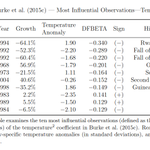
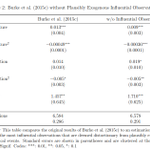
I am a big fan of this paper and have learned about the robustness of my co-authored paper's estimates as a function of outlier observations. Macro/climate regressions are historical benchmarks and shouldn't be used to predict the future. Lucas Critique, Lucas Critique!!
Link: osf.io/preprints/socarxiv/g8…
Comments and critiques welcome! 12/12 END
Finbar Curtin retweeted
New working paper, led by @FinbarCurtin:
"The empirically inscrutable climate-economy relationship".
Link and quick 🧵 below. 1/

23/END) We thank the authors of these papers, as well as colleagues at the University of Wyoming and University of Colorado-Boulder, for their thoughts and suggestions.
We welcome any feedback for improvements!
15
1,896
22/n) Importantly: we are *not* claiming that climate change is economically harmless. We're arguing that the magnitude of damages is deeply and irreducibly uncertain, and trillion-dollar decisions need to stop being made as if it isn't.
20/n) There is no SCC or projection of climate damages that is “the answer.” (An “answer” which seems to change depending on who is in the White House.) Climate damages are deeply uncertain, and policy makers should truly grapple with decision making under deep uncertainty.
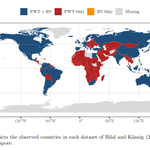
18/n) BU results are more robust, but the BU dataset excludes many of the most climate-sensitive countries, which raises the questions of what’s driving the estimated effect and what does it mean for future projections?

2
7
2,004
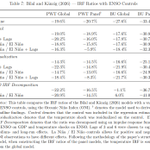
17/n) Bilal and Känzig (2026) use two datasets (PWT and BU). PWT results (used to calibrate their damage function) are ENSO-sensitive.
They are also sensitive to a bandstop filter and long-run controls.


1
6
2,230
16/n) The methodology of Bilal and Känzig (2026) requires that 0.1°C of climate change induce the same effect as 0.1°C of warming from ENSO, solar cycles, etc. Such is the result of reducing climate (and climate change) to a single variable.
3
7
2,166