
Crafting local AI agents with open-weight models. Benchmarks, finetuning, local hosting, AI 3D building and what actually works on consumer hardware.
San Francisco, Tokyo, travelin
Joined November 2026
- Tweets56
- Following26
- Followers5
- Likes22


Pinned Tweet
maya-ik2 vs llama.cpp (Inkling 2 Mini · UD-Q4_K_XL)
Same 6,244 uncached input tokens → 8.3× faster prefill with maya-ik2 (2.03s vs 16.93s).
Maya also leads on decode across every task. Both engines answered correctly (median of 3 runs, identical tokens, zero cache reuse).
Full numbers in the chart 👇
#LLM #inference #benchmarks #mayaik2 #llamacpp

27B weights in 5.93 GB. PrismML’s Ternary Bonsai 2.5 vs Qwen3.8-27B FP16 (53.8 GB).
• Tool calling (5 tests) 77.2 vs 77.7
• Terminal-Bench 2.1 60.1 vs 70.8
Building a local agent? Replay your hardest shell tasks before switching.
huggingface.co/prism-ml/Tern…
🤖 Made with AI

Trying Ternary Bonsai 2.5 27B locally? Run llama-cli --version before downloading. Stock llama.cpp b11556+ runs Q2_0. Older builds can load it and still output garbage. For the smaller ~6 GB PTQ1_0 file, use PrismML’s fork.
huggingface.co/prism-ml/Tern…
🤖 Made with AI

9
How fast is your local LLM? Try llama-bench.
I tested Qwen3.5-4B Q4_K_M on my RTX 4080 SUPER.
2,048-token prompt → 12,853 tokens/s
128-token generation → 167 tokens/s
Separate llama-bench runs. Generation started with an empty context.
github.com/ggml-org/llama.cp…
🤖 Made with AI

5
Running a long agent task in VS Code? The 1.148 stable release adds a preview that prevents idle sleep on supported Agent Hosts. Search the host’s Settings for sessions.keepAwakeWhileWorking. On Linux desktop, choose always.
code.visualstudio.com/update…
🤖 Made with AI

5
I ran a fresh 6,244-token Inkling 2 Mini prompt on my RTX 4080 SUPER + A4000. maya-ik2 read it in 2.03s. Strata took 5.29s. Both ran with drafting off, using different weight and cache formats.
What I’d try first:
• llama.cpp for GGUF models that need both VRAM and system RAM.
• Strata with DSpark when there’s VRAM to spare and generation speed matters.
• SGLang for a shared endpoint. Test p95 time to first token at peak concurrency.
• maya-ik2 for Inkling 2 Mini agents that read long files.
xitter.cf/FerretOutAi/status/212…


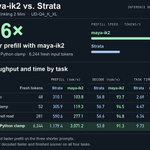
maya-ik2 vs Strata on Inkling 2 Mini (UD-Q4_K_XL)
On a long prompt (6,244 fresh tokens), maya-ik2 was 2.6× faster at prefill.
More importantly: it decoded faster and finished every task sooner — even the short ones where Strata had the edge on prefill.
What this means in practice:
Faster time to first token on longer inputs
Quicker overall replies across the board
Better for real workloads (coding, longer context, agents) instead of just short prompts
Both engines answered correctly. Full numbers in the chart.
If you’re running local models and care about speed on consumer hardware, specialized engines like maya-ik2 are starting to pull ahead of more general ones.
What engine are you currently using for Inkling or other local models?
#LocalAI #LLM #Inference #Inkling2Mini #mayaik2 #Strata

10
If you maintain an AI agent that sends email through the Gmail REST API, switch its send step to the Workspace CLI or a Workspace MCP server. Test that external sends ask for confirmation as your admin policy requires. Enforcement starts Feb 1, 2027. workspace.google.com/blog/pr…
🤖 Made with AI

1
37
Not every AI experiment needs a benchmark.
I used Inkling 2 Mini for something different: a fully 3D marble run in a warm workshop. Realistic textures, soft rolling sounds, pure ASMR.
Oddly satisfying. Sound on. 🔊
#Inkling2Mini #ASMR
46
My study on decoding speed with splitting strategy in dual or triple GPUs:
after studying the source code for different inference engines (llama.cpp, strata, maya-ink2), I found that the latest model splitting strategy is so called 'expert split' instead of the old 'layer split'. see below compare:
Drafting: off | Time (s), Speed (tok/s)
Config | Time↓ | Prefill↑ | Decode↑
----------------------|-------|----------|--------
Layer split | 15.48 | 1,087.0 | 55.8
Expert split | 12.51 | 1,512.2 | 64.0
expert split, DSpark | 9.63 | 1,516.9 | 110.8
old method with layer splitting like in llama.cpp, after a layer, need to sync data between two gpus, PCIe is the data rate bottle neck
the 'expert splitting', is able to apply dspark drafting for the experts on different gpus in parallel.
that made the big difference in decoding speed!
1
53
maya-ik2 vs Strata on Inkling 2 Mini (UD-Q4_K_XL)
On a long prompt (6,244 fresh tokens), maya-ik2 was 2.6× faster at prefill.
More importantly: it decoded faster and finished every task sooner — even the short ones where Strata had the edge on prefill.
What this means in practice:
Faster time to first token on longer inputs
Quicker overall replies across the board
Better for real workloads (coding, longer context, agents) instead of just short prompts
Both engines answered correctly. Full numbers in the chart.
If you’re running local models and care about speed on consumer hardware, specialized engines like maya-ik2 are starting to pull ahead of more general ones.
What engine are you currently using for Inkling or other local models?
#LocalAI #LLM #Inference #Inkling2Mini #mayaik2 #Strata
Small model + one tool, beat Max thinking
Gave local Qwen3.5-4B five Tower of Hanoi disks.
At Max it burned 11,229 thinking tokens and got stuck after 14 legal moves.
Switched to Low (512) and gave it a Python sandbox. It wrote a recursive solver, noticed its own output format was wrong (`A C` instead of `A>C`), fixed it, and solved all 31 moves in 1,414 thinking tokens.
Then it solved 6 disks and the full 7-disk tower (127 moves) at the same Low budget.
A tiny local model with a code interpreter cleanly finished a problem that pure high-budget reasoning couldn’t. Tools don’t just help - they change what “capable enough” means.
69