

Charles S. Hamlin. First Governor of the Federal Reserve. 1914–1916. “The more things change, the more they stay the same.” — Alphonse Karr
United States
Joined December 2009
- Tweets5.1K
- Following152
- Followers349
- Likes9.2K




Pinned Tweet
“The Americans of the Revolution planted financial corporations, private money, and financial exemptions from public burdens. In a word, they planted another revolution.”
— Alexander Del Mar
Quite a statement to make. 👇
The Americans of the Revolution had before them not merely the chimerical Utopias which were dreamed of during the Halcyon Age of Europe, they had the historical examples of Greece and Rome. In all of these states, the main contention from first to last between the aristocratic and popular factions, arose out of and centered in the monetary system; that greatest of all dispensers of equity or inequity.
In America there were no such difficulties in the way as those which had beset the great republics of antiquity, no dissonance of races, language or history; no conflicting religions; no constriction of territory; no fear of neighboring interference. The Colonists had practically an entire continent to themselves. They had only to take care that the seed they planted was genuine and uncontaminated. Nature was certain to do the rest.
Well, they planted; and now look at the fruit and see what it is that they planted! They planted financial corporations, a rotten seed that Rome had trampled under foot nearly two thousand years before; they planted private money, in which successively both Greece and Rome had found the germs of social decay; and they planted financial exemptions from public burdens, whose offspring has already become a tree so mighty that it casts a threatening shadow over the land. In a word they planted another revolution.
Del Mar, Alexander. The History of Money in America: From the Earliest Times to the Establishment of the Constitution. New York: Cambridge Encyclopedia Co., 1899.


Fed Governor retweeted

The ECB thought it was a rather clever idea to make member nation sovereign yields move in unison. Until they realized with the French crisis that bond prices that rise together fall together.
The anti-fragmentation tool did not reduce risk; it spread.
via Bloomberg


Not for me either.
Thanks mate.

bitcoin warning on security youtu.be/1HQuR8oOsEs?si=RmQa… via @YouTube

"We desire the utmost friendship with the people of Canada. If their country is ever attacked, our Navy will be defending their seas, our soldiers will fight on their battlefields, our fliers will die in their skies.
But have they the right to draw this hemisphere into a European war simply because they prefer the Crown of England to American independence?"
Charles Augustus Lindbergh
Washington, D.C.
October 13, 1939
teachingamericanhistory.org/…

In the late 19th century Republicans supported protective tariffs to shield American industry. Democrats supported tariffs for revenue only, limited to the needs of the government.
In 1896 the Democrats also demanded free and unlimited coinage of silver at the ratio of 16 to 1. Republicans supported the gold standard.
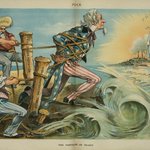
Title
The Tantalus of to-day / J.S. Pughe.
Summary
Print shows Uncle Sam as Tantalus, bound with ropes to posts labeled "High Protective Tariff" and "Free Silver Agitation" by two men labeled "Protected Manufacturer" and "Silverite"; they are preventing him from satisfying his desires for "Prosperity", depicted as a female figure holding a cornucopia, standing among factories spewing smoke, along the waterfront, across an "Ocean of Politics".
Names
Pughe, J. S. (John S.), 1870-1909, artist
Created / Published
N.Y. : Published by Keppler & Schwarzmann, 1897 June 2.

At no time in the history of the world have such enormous, such inequitable, such widespread, I may almost say cosmic disturbances of prices, such unforeseeable and undeserved changes of opportunity and fortune occurred as have occurred since the evil day—now some thirty years ago—when the coinage of silver began to be checked throughout the civilized world.
Del Mar, Alexander. History of Monetary Crimes. London: Effingham Wilson, 1880.
Title
He must be kept out / Keppler.
Summary
Print shows Uncle Sam as a policeman using a billy club labeled "Votes" to prevent a diminutive figure labeled "Free Silver" and "16 to 1" from entering the White House with papers labeled "Populism" and "Dishonest Money Schemes".
Names
Keppler, Udo J., 1872-1956, artist
Created / Published
N.Y. : Published by Keppler & Schwarzmann, 1896 June 17.

Stability: The One Point of Agreement Amid Conflicting Theories of Money
Before the United States Monetary Commission, meeting in Washington under the chairmanship of Senator John P. Jones, Alexander Del Mar spoke in the winter of 1876–1877.
Congress had created the commission by joint resolution of August 15, 1876, in the wake of the Panic of 1873, to inquire into the silver question, the resumption of specie payments, and the relative merits of gold, silver, and paper. As Mining Commissioner and statistician to the body, Del Mar addressed the members on the single principle upon which all parties appeared to unite—the need for a stable monetary system.
Mr. Chairman:—Amidst the conflict of monetary theories, doctrines and assumptions which divide the American people—nay the entire civilized world to-day—I can discern but a single principle upon which all parties unite. That principle is stability.
Those who hold that like other measures the measure of value should be of dimensions prescribed by law; those who would leave such dimensions to the chances of mining discovery, the vicissitudes of war, or the caprices of fashion; those who are willing to trust the government with the regulation of money; those who have no faith in the virtue or prudence of congress and demand a metallic pledge behind each fraction of the monetary measure; those who regard the whole number of dollars as the measure of value; those who regard the material of each separate dollar as the true measure of value; those who regard money as a legal institution, as well as those who view it only as so much metal—all these alike agree in the cardinal principle that a monetary system, if it is to be just and equitable in its operation, should be stable. It should afford a reasonable assurance to the buyer, the seller, the debtor, the creditor, the producer, the consumer, the annuitant, the pensioner, and the wage-earner, that it will work no essential, no violent, no revolutionary, rise or fall of prices, so that men may buy and sell, contract, undertake and plan for the future upon a more or less assured and enduring basis.
Del Mar, Alexander. History of Monetary Crimes. London: Effingham Wilson, 1880.

“No wonder so many pension-fund managers fail to beat the market averages. When you ask a bank to handle your investments, mediocrity is all you’re going to get in a majority of the cases.”
— Peter Lynch, One Up on Wall Street (1989)

“If no great book or symphony was ever written by committee, no great portfolio has ever been selected by one, either.”
— Peter Lynch, One Up on Wall Street (1989)
“Stocks you trade, it’s wives you’re stuck with.”
— Peter Lynch, One Up on Wall Street: How to Use What You Already Know to Make Money in the Market (1989)
Not the Coffee!
The sentiment was intensely in favor of doing everything necessary to sustain the Union, yet the proposed expansion of the taxing power was enormous. There was more opposition to the imposition of the tax on coffee than on any other article.
The secretary proposed five cents a pound; some members were very strenuous for a reduction to three. Finally a compromise was made, and the rate was fixed at four cents.
Bolles, Albert S. The Financial History of the United States, from 1861 to 1885. D. Appleton and Company, 1886.
🤖 Made with AI

The Debate Between Issuing Short vs. Long-Term Paper Is Not New
At the very beginning of his administration of the treasury office, Mr. Chase was confronted with a grave question with respect to modes of getting money. Should he issue long-time bonds for it, or six-per-cent treasury-notes of small denominations? He could procure the money needed by the latter mode at rather better rates than by the former, and this consideration weighed strongly with him.
Mr. Gallatin was opposed to the issue of treasury-notes. His reasons are worth giving: “In the form of stock,” he writes to the secretary, “this loan will be funded and out of the way for twenty years; but, in the case of treasury-notes, should sudden panics arise in the uncertain future, these would be thrown in upon you for duties, and most likely at a moment when you would be heavily pressed for means to carry on the government, they would aggravate the embarrassments of the treasury. Besides, future emergencies may arise, in which the issue of treasury-notes would be the best and speediest means of supplying temporary wants. It would seem, therefore, more desirable to negotiate this loan as you have proposed, in the form of stock having twenty years to run, if you can do so, which I have no doubt you can, at a fair price—say three to four per cent above the rate obtained by the late administration for the last loan—and reserve the power of issuing treasury-notes for future contingencies.”
Bolles, Albert S. The Financial History of the United States, from 1861 to 1885. D. Appleton and Company, 1886.

Fed Governor retweeted

The same usual suspects who will tell you the US is in trouble due to all of the unfunded liabilities that the US owes to itself...will simultaneously tell you that the debt that China owes doesn't matter because...wait for it...they owe it to themselves.

Few of us seem to realize that bond yields also reflect expectations for future economic growth. Falling Chinese bond yields aren't exactly something to celebrate.

“I Can't See a Thing, Mates! We Must Be Perfectly Safe!”
September 1939. As war spread across Europe, Senators William Borah, Gerald Nye, and Hiram Johnson remained committed to keeping the United States out of another European conflict.
Sheltering behind a wall labeled Neutrality, the three men appear oblivious to the explosions across the Atlantic. The cartoonist's message is unmistakable: refusing to see the danger does not necessarily make a nation safe.
Source: Clifford K. Berryman, political cartoon, The Evening Star (Washington, D.C.), September 7, 1939. National Archives, Identifier 6012202.

“I Never Thought I'd Come to This!”
As war engulfed Europe in October 1939, the United States faced an increasingly contentious debate over neutrality. President Roosevelt's administration sought to repeal the arms embargo, while opponents warned that supplying weapons to belligerent nations could eventually draw America into the conflict.
This political cartoon captures the anxiety surrounding America's possible involvement in another European war, barely two decades after the First World War.
Source: The Evening Star (Washington, D.C.), October 17, 1939, p. 1. Library of Congress, Chronicling America.


